



Looking at a map from 100 years ago feels strange. Places that once took months to reach? Now just hours away.
The world hasn’t actually shrunk. But it sure feels like it has.
This weird feeling has a name: time-space compression. It’s changing how people work, travel, and connect. Cities that were once isolated now buzz with global trade. Ideas that took years to spread now go viral in seconds.
So what’s really happening here? How did distance become less… distant? And why does this matter for understanding our world today?
Let me break down this concept in a way that actually makes sense.
What is Time-Space Compression?
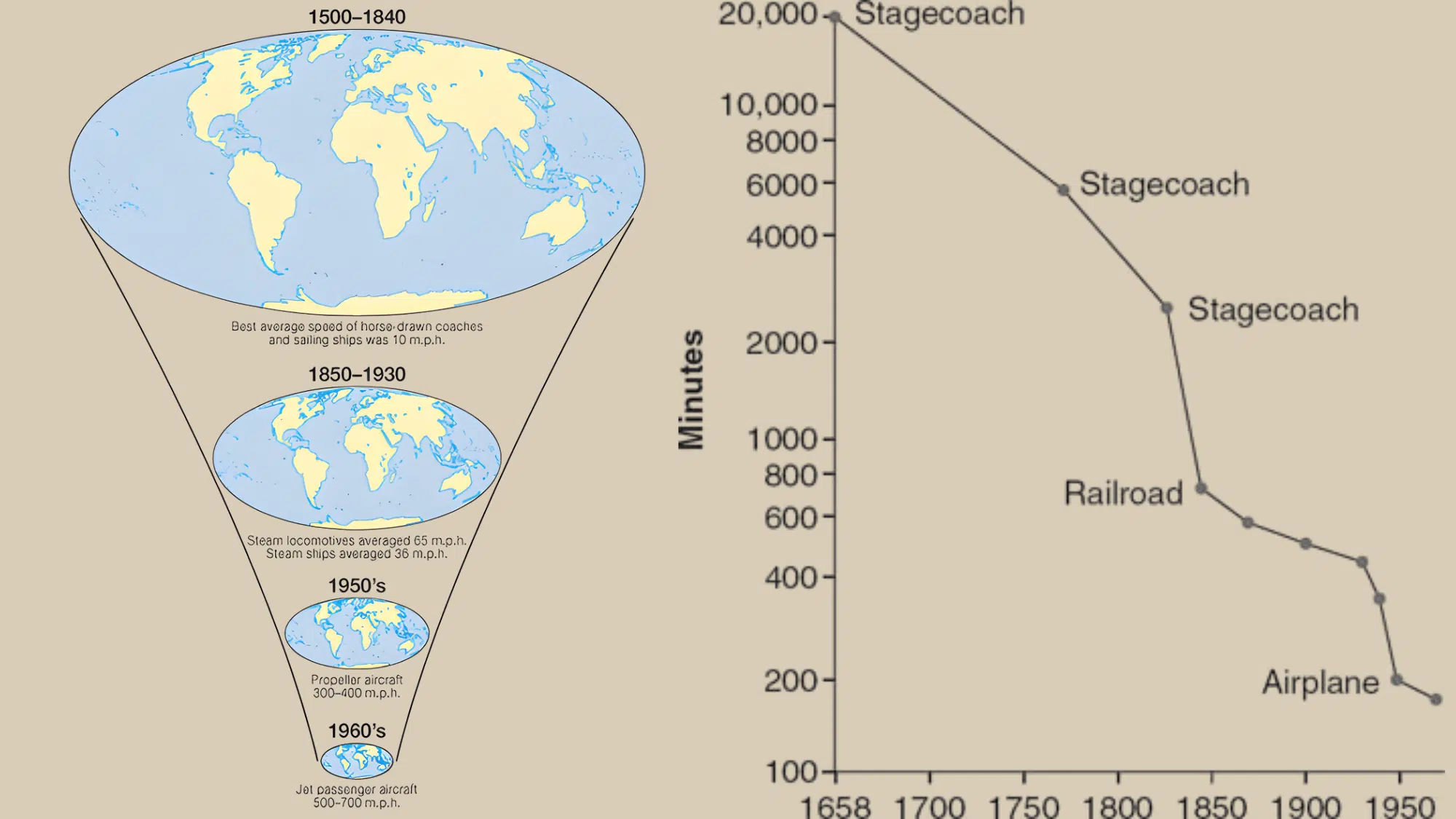
Time-space compression is how technology and transportation make the world feel smaller. It’s not about actual distance. It’s about how fast people can travel or communicate across those distances.
Think about it. A letter used to take weeks to cross an ocean. Now? An email arrives in seconds. A flight from New York to Tokyo takes 14 hours instead of months by ship.
This compression changes everything. It affects trade, culture, and how societies interact. Places that felt worlds apart now share ideas instantly.
The physical space hasn’t changed. But the time it takes to cross it has collapsed dramatically.
Origins of the Concept Time-Space Compression
The idea didn’t just pop up overnight. It has deep roots in economic theory.
Karl Marx first noticed something odd about capitalism. It constantly needs to speed things up. Faster production, quicker delivery, and rapid communication. All to maximize profit and beat competitors.
David Harvey took this further in 1989. He coined the actual term “time-space compression” in his book about postmodernity.
Harvey saw how capitalism systematically breaks down spatial barriers. Railroads, telegraphs, airplanes and the internet. Each innovation shrinks the time between places.
Throughout history, certain periods saw massive compression. The Industrial Revolution brought trains and steamships. The 20th century gave us airplanes and phones. The digital age? It practically eliminated distance for information.
Marx and Harvey both understood: capitalism doesn’t just operate in space and time. It actively reshapes them
Implications of Time-Space Compression in Human Geography
Time-space compression doesn’t just affect how fast we travel. It fundamentally reshapes where we live, how economies function, and how cultures mix.
Key implications include:
- Economic Globalization: Companies now operate across continents. Supply chains stretch worldwide. A product designed in California gets manufactured in China and sold everywhere.
- Urban Growth Patterns: Cities become global hubs. Places with good connections thrive. Remote areas fall behind. Location matters differently now.
- Cultural Exchange and Homogenization: Ideas spread faster than ever. McDonald’s appears in Tokyo. K-pop dominates American charts. But local cultures also blend and adapt.
- Environmental Concerns: Faster travel means more carbon emissions. Global trade increases pollution. The planet feels the pressure of our compressed world.
- Labor Market Changes: People can work remotely across time zones. Jobs move to cheaper locations. Workers compete globally, not just locally.
- Social Relationships: Families stay connected across oceans. Communities form online. Physical proximity matters less for relationships.
Spatial Interactions and Time-Space Compression
Spatial interaction is just a fancy term for how places connect with each other. Trade, migration, communication. All of it.
Time-space compression supercharges these interactions. Cities that rarely traded now exchange goods daily. People migrate farther for work. Information flows between continents instantly.
Distance used to limit everything. Only nearby places interacted regularly. Now? A factory in Detroit depends on parts from Shanghai. A student in Seoul takes classes from a professor in London.
The barriers haven’t disappeared completely. But they’ve weakened dramatically. Geography still matters. Just differently than before.
Time-Space Compression vs. Time Distance Decay

These two concepts sound similar but work in opposite directions. Understanding the difference helps clarify how geography and time interact in our world.
| Aspect | Time-Space Compression | Time Distance Decay |
|---|---|---|
| Basic concept | The world feels smaller as travel speeds up | Interaction decreases as distance increases |
| Direction | Reduces perceived distance over time | Explains why nearby places interact more |
| Focus | How technology changes spatial relationships | How distance naturally limits interaction |
| Timeframe | Historical process that evolves | Constant principle across time |
| Examples | Airlines are making continents closer together | Shopping locally instead of driving 50 miles |
| Effect on interaction | Increases the connection between distant places | Shows why proximity matters |
| Driving force | Technology and infrastructure improvements | Natural human tendency to minimize effort |
| Modern relevance | Explains globalization patterns | Still applies despite technological advances |
Real-World Examples of Time-Space Compression
Theory makes sense on paper. But seeing time-space compression in action makes it click. Here are concrete examples from everyday life.
1. Air travel revolution: In 1950, flying from London to Sydney took four days with multiple stops. Today? A direct flight takes under 24 hours. Business meetings happen across continents on the same day.
2. Internet and instant communication: Video calls connect faces across oceans in real-time. Messages arrive instantly. Social media lets events in one country trend globally within minutes.
3. Global supply chains: Your smartphone contains parts from dozens of countries. Assembled in China, designed in California, with rare minerals from Africa. All coordinated seamlessly.
4. Financial markets: Stock exchanges operate 24/7 globally. A crisis in Tokyo affects New York markets before lunch. Money moves between countries with a click.
5. Shipping containers: Standardized containers revolutionized trade in the 1950s. Loading times dropped from weeks to hours. Global trade exploded as costs plummeted.
6. Streaming services: Entertainment crosses borders effortlessly. A show released in one country becomes available worldwide simultaneously. Cultural products travel at light speed.
Challenges and Controversies: Who Benefits from This Theory?
Time-space compression sounds great. But it doesn’t help everyone equally.
Wealthy nations and corporations benefit most. They have the infrastructure, technology, and capital to exploit compressed space. Poor regions? They often get left behind.
Critics argue the theory ignores power imbalances. Who controls the technology? Who profits from faster trade? Usually, it’s already powerful entities.
There’s also the digital divide. Not everyone has internet access or can afford flights. For billions, the world hasn’t compressed at all.
Time-space compression can amplify inequality rather than reduce it. The benefits flow upward while costs spread downward.
Wrapping Up
Time-space compression isn’t slowing down. If anything, it’s accelerating.
New technologies keep pushing boundaries. Quantum communication, hyperloop trains, maybe even space travel for regular folks. The compression continues.
Understanding this concept helps make sense of modern life. Why do cities grow while rural areas shrink? Why does a pandemic spread globally in weeks? Why your job might compete with someone halfway across the planet?
It explains our interconnected world better than almost anything else. The world keeps getting “smaller.” The question is: will it bring people together or push them further apart?