


Looking up at the stars, most people wonder what’s out there.
But have you ever wondered if you can actually fire a gun in space? It sounds like something straight out of a sci-fi movie, right?
The answer involves some seriously cool physics that challenge what we think we know about how things work. Guns need oxygen to fire, or do they? Space is a vacuum, so does that change everything? The truth might surprise you.
This blog breaks down the real science behind firing weapons beyond Earth’s atmosphere and reveals what would actually happen if someone pulled the trigger in the void of space.
Would a Gun Work in Space? The Role of Oxidizers
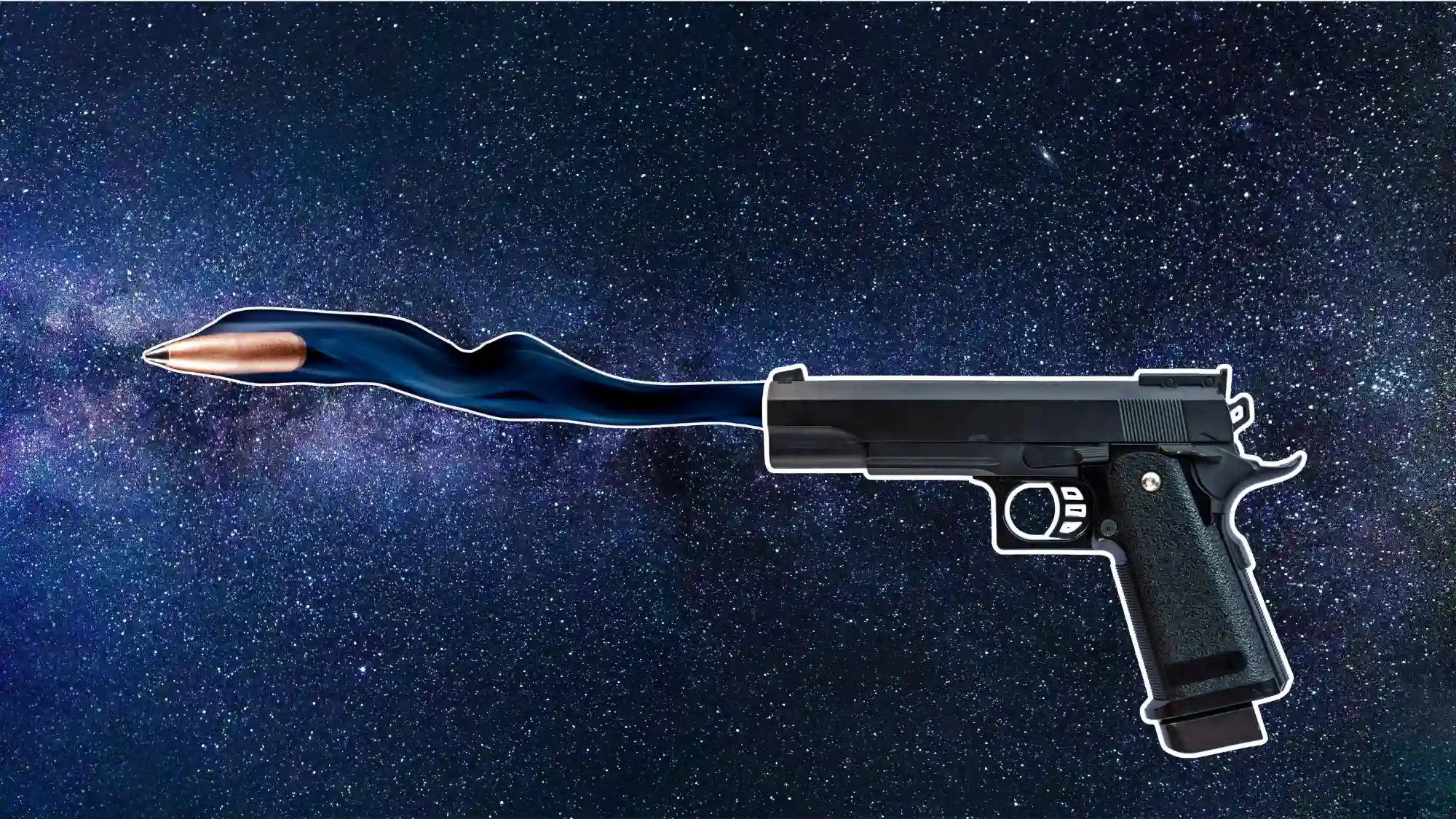
Here’s the thing about guns in space: they can totally fire. Shocking, right? Most folks assume guns need air to work, but that’s not quite accurate.
Modern ammunition carries its own oxygen supply built right into the cartridge. The gunpowder inside bullets contains oxidizers, chemical compounds that provide the oxygen needed for combustion.
So when you pull the trigger, the firing pin strikes the primer, igniting the gunpowder. The oxidizer releases oxygen instantly, creating that explosive reaction even in the airless void of space.
No atmosphere? No problem. The bullet would actually fire just fine, maybe even better, without air resistance slowing it down.
How Would Recoil Affect Firing a Gun in Space?
Firing a gun in space creates some wild physics problems. Newton’s third law means every action has an equal and opposite reaction, and in zero gravity, that gets interesting fast.
But understanding how gravity shapes force and motion on Earth makes the contrast even clearer.
On Earth, when you fire a gun, you feel the kick against your shoulder. Gravity keeps your feet planted, and your body mass absorbs most of that backward push. But space changes everything.
There’s no ground beneath you, no gravity holding you down. Pull that trigger, and Newton’s third law goes into overdrive.
The bullet flies forward at incredible speed, and you? You’re flying backward just as fast, relatively speaking.
Without anything to anchor yourself, you’d spin uncontrollably through the void. The recoil would send an astronaut tumbling backward, potentially at dangerous speeds.
It’s not just uncomfortable, it’s genuinely hazardous. You could crash into equipment, spin out of control, or even drift away from your spacecraft entirely.
That’s why firing any weapon in space would require careful planning and strict controls.
Physics of Bullets in Microgravity

Without gravity, bullets on Earth follow curved paths; in space’s microgravity, they behave wildly differently. The physics simplifies in key ways, but the outcomes can turn dangerous fast.
1. Straight-Line Inertial Paths
On Earth, gravity arcs a bullet downward, forcing shooters to adjust for drop. In microgravity environments like those in orbiting spacecraft, there is no such pull that bends the trajectory relative to the shooter.
The same environment where even something as routine as eating becomes a completely different physical challenge.
Fire a gun, and the bullet follows a straight inertial path, keeping its initial direction until it collides or distant gravitational influences, like Earth’s, shift it into an orbit. It won’t fall or arc noticeably in the short term; it’ll just coast along by Newton’s First Law.
2. No Air Resistance
Earth’s drag and friction slow bullets, leading to a gradual drop. Space’s vacuum offers no air, no friction, nothing to sap momentum.
Once fired, the bullet holds its barrel-exit speed indefinitely, potentially zipping for years or centuries across vast distances.
3. Unpredictable Dangers and Recoil
This turns every shot into a lasting threat, creating orbital debris that could smash satellites, spacecraft, or even loop back unpredictably.
Plus, recoil propels the shooter in the opposite direction due to momentum conservation, complicating stability in weightless conditions. Trace cosmic particles might add negligible drag over eons, but the hazard lingers.
What Happens to the Bullet in Space?
So you’ve fired a bullet into the endless void. Now what? That little piece of metal becomes an eternal traveler.
Without air friction or gravity, it maintains its speed indefinitely, cruising through space at thousands of feet per second. It won’t slow down, won’t stop, won’t fall.
The bullet essentially becomes a tiny satellite, following its own orbit around the sun or whatever massive object’s gravity catches it.
It could drift for millions of miles, potentially colliding with asteroids, space debris, or unlucky spacecraft years later.
That single shot creates a permanent piece of space junk, a microscopic missile flying blind through the cosmos forever.
Practical Examples: Guns Used in Space Missions

Believe it or not, astronauts have actually carried guns into space. These weren’t for alien encounters, though. The reasons were far more practical and rooted in Cold War-era survival concerns.
- Soviet TP-82 Survival Pistol: Russian cosmonauts carried this triple-barreled weapon for decades. It wasn’t meant for space combat but for survival after landing in the remote Siberian wilderness. Bears and wolves posed real threats to crews awaiting rescue in isolated areas.
- Apollo Moon Missions: American astronauts reportedly had access to survival weapons during Apollo missions. The concern wasn’t extraterrestrials but dangerous wildlife if they landed off-course on Earth. Emergency landings in jungles or deserts required protection.
- Modern Space Stations: Current space stations don’t carry firearms anymore. The risks outweigh the benefits in pressurized environments. A stray bullet could puncture the hull, causing catastrophic decompression. Modern crews rely on other emergency protocols instead of weapons.
- Test Firings: Some experiments have explored how firearms function in vacuum conditions. These controlled tests confirmed guns work in space, proving the oxidizer theory correct and providing valuable data for engineers.
Differences Between Firing a Gun on Earth vs. in Space
Firing a gun sounds the same wherever you are, right? Wrong. The environment drastically changes how weapons behave. Space and Earth create completely different experiences for both shooter and bullet.
| Factor | On Earth | In Space |
|---|---|---|
| Sound | A loud bang was heard clearly | Complete silence, no sound waves |
| Recoil Effect | Absorbed by body mass and ground | Sends the shooter spinning backward uncontrollably |
| Bullet Trajectory | Curves downward due to gravity | Travels in a straight inertial path until gravitational influences |
| Bullet Speed | Slows down due to air resistance | Maintains constant velocity indefinitely |
| Stopping Distance | Eventually falls to the ground | Never stops unless it hits something |
| Flash Visibility | Less visible in the atmosphere | Extremely bright in the vacuum |
| Danger Duration | The threat ends when the bullet lands | Becomes a permanent space hazard |
| Oxidizer Need | Ambient oxygen helps combustion | Relies entirely on built-in oxidizers |
Conclusion
So there you have it. Guns absolutely work in space, thanks to self-contained oxidizers in modern ammunition. But just because something’s possible doesn’t mean it’s smart.
The recoil would send you spinning, the bullet would fly forever, and you’d create dangerous space debris lasting centuries.
Those Soviet cosmonauts who packed heat were thinking about Siberian bears, not space battles. The physics checks out, but the practicality? Not so much.
Space exploration demands cooperation and precision, not weaponry. Still, it’s pretty cool knowing that if Hollywood ever needs scientific accuracy for its space-shootout scenes, the guns would actually fire. They’d just cause absolute chaos.