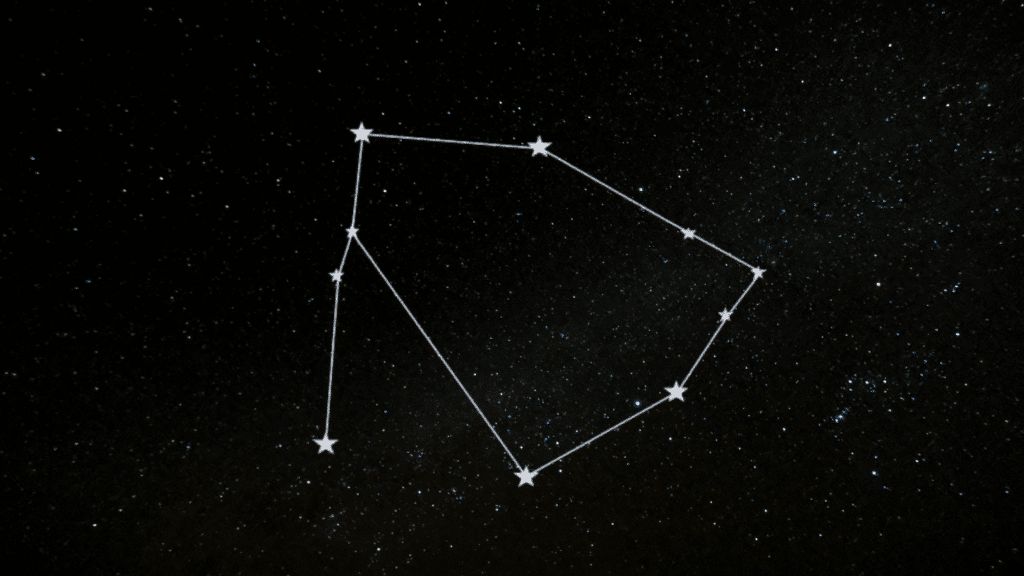
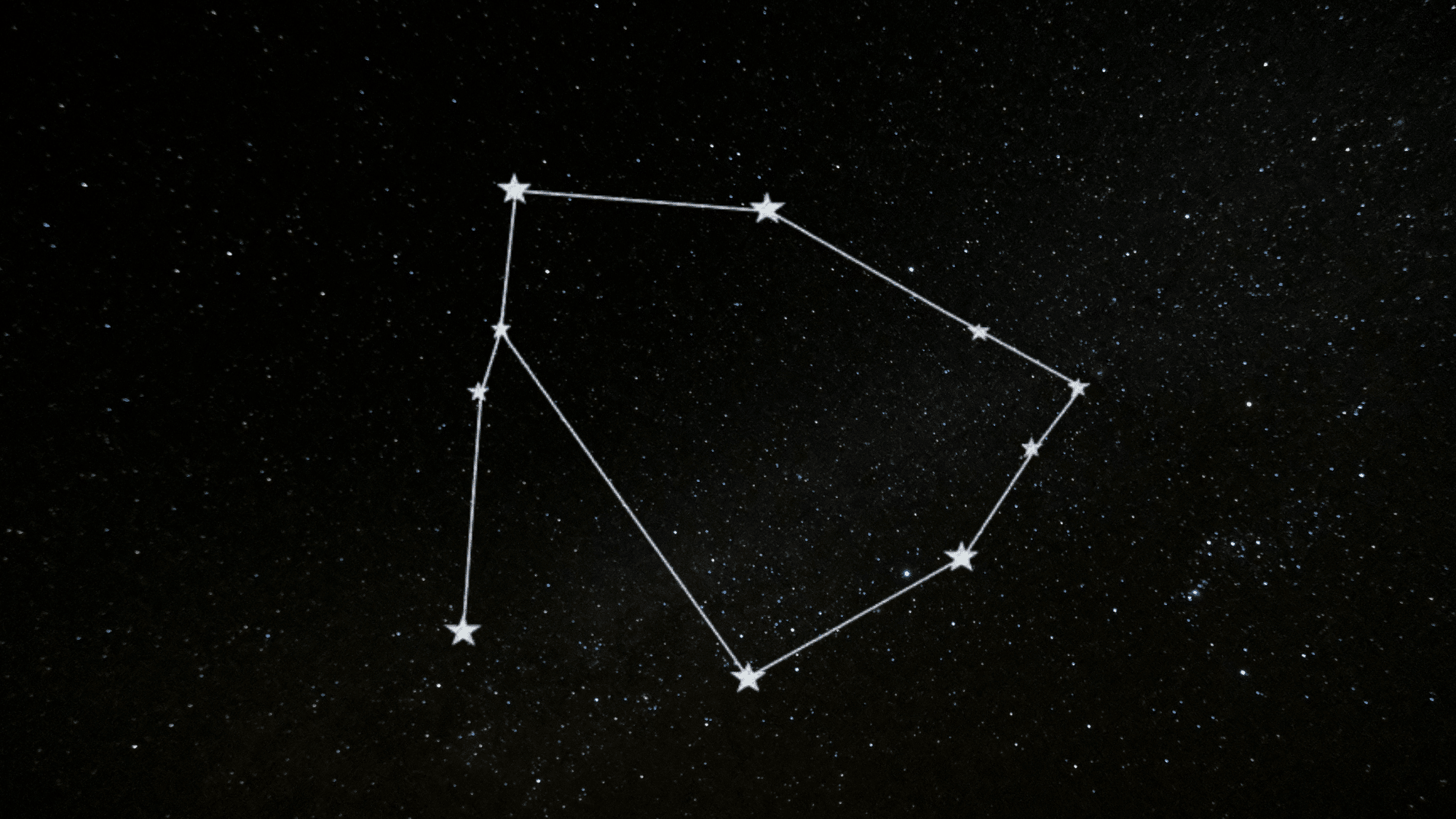



Looking up at the night sky, most people know their zodiac sign. But there’s one constellation that doesn’t get much attention. Ophiuchus sits quietly between Scorpius and Sagittarius, yet few have heard of it.
This star pattern has been around for thousands of years.
Ancient astronomers mapped it, and it carries rich mythology. Some even call it the 13th zodiac sign, though that’s sparked plenty of debate.
So what makes Ophiuchus special? And should it really be part of the zodiac? This blog covers everything about this mysterious constellation, from its history to its stars and the myths surrounding it.
History of the Ophiuchus Constellation
The story of Ophiuchus goes back over 2,000 years. Greek astronomer Ptolemy first cataloged it in the 2nd century, listing it among 48 constellations. But its roots stretch even further back to ancient Babylonian star charts.
The name comes from Greek, meaning “serpent-bearer.” Ancient cultures saw a man holding a snake, which tied into various healing legends. Over centuries, astronomers across different civilizations recognized this constellation.
Today, Ophiuchus remains one of the 88 modern constellations recognized by the International Astronomical Union.
Its position along the ecliptic has sparked recent discussions about zodiac signs, bringing this ancient constellation back into popular conversation.
Top Stars and Deep-Sky Objects in Ophiuchus
Ophiuchus contains some remarkable celestial objects that astronomers love to study. From bright stars to distant globular clusters, this constellation offers plenty to observe through telescopes and binoculars.
- Rasalhague (Alpha Ophiuchi): The brightest star in the constellation, shining at magnitude 2.1. Located about 47 light-years away, it’s a white giant star easily visible to the naked eye.
- Barnard’s Star: One of the closest stars to Earth at just 6 light-years away. This red dwarf has the largest proper motion of any known star, moving noticeably across the sky.
- Kepler’s Supernova (SN 1604): The last supernova visible to the naked eye in our galaxy. It exploded in 1604, and its remnant still glows in X-ray wavelengths today.
- Messier 10 (M10): A beautiful globular cluster containing hundreds of thousands of ancient stars. Located about 14,300 light-years away, it’s visible through small telescopes as a fuzzy patch.
- Messier 12 (M12): Another globular cluster, slightly looser than M10. It sits roughly 16,000 light-years from Earth and contains fewer stars due to tidal interactions with the galaxy.
- Rho Ophiuchi Cloud Complex: A stunning dark nebula and star-forming region. It’s one of the closest areas of active star formation, located just 460 light-years away, with colorful nebulae.
Ophiuchus Mythology and Legends
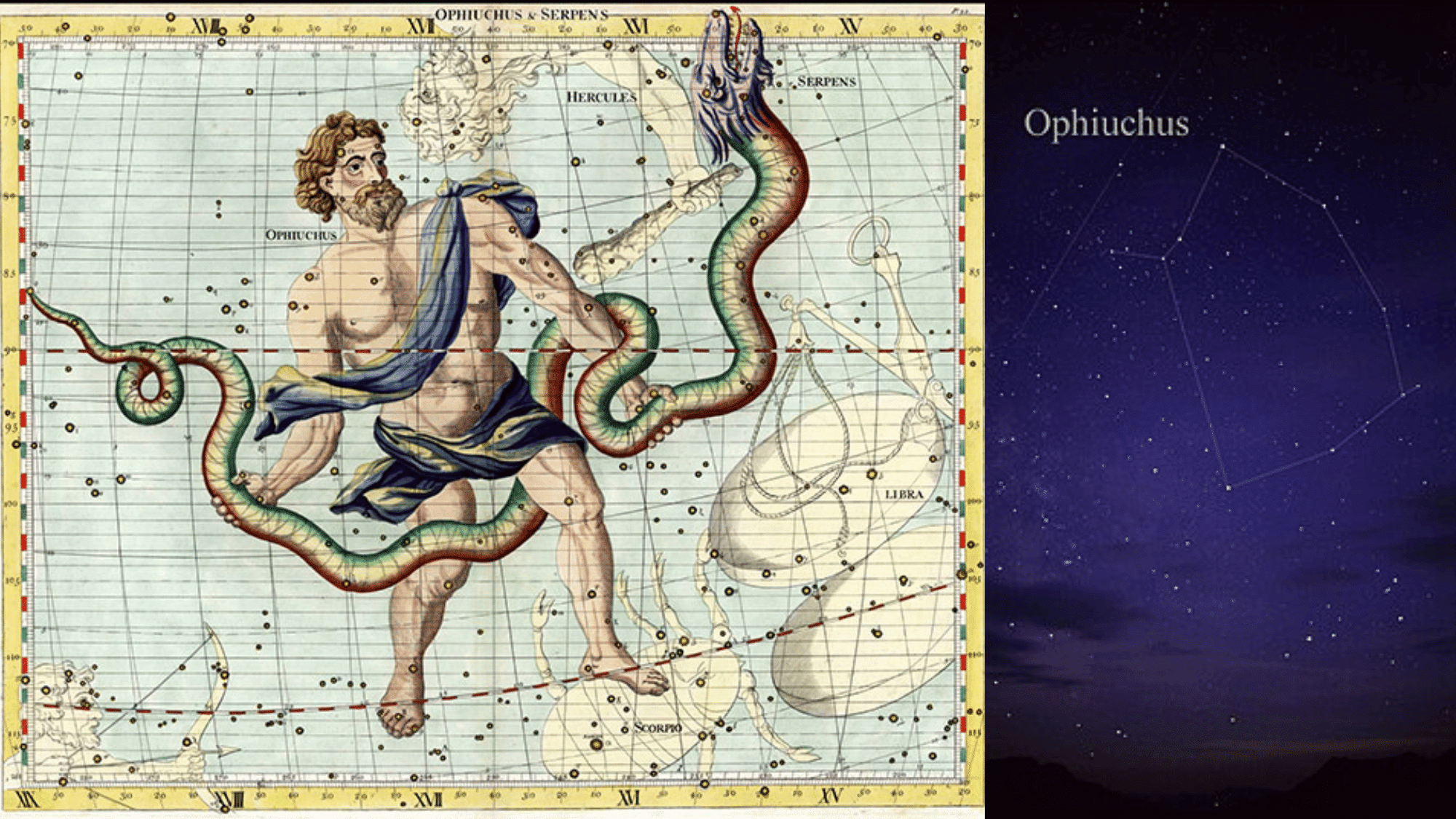
Ophiuchus carries fascinating myths that explain why ancient cultures saw a serpent-bearer in the stars. These legends connect healing, death, and the gods themselves.
Asclepius the Healer
The most famous myth identifies Ophiuchus as Asclepius, the Greek god of medicine. He was so skilled that he could bring people back from the dead using snake venom and herbs.
Zeus killed him with a thunderbolt, fearing humans would become immortal.
To honor his healing gifts, Zeus placed Asclepius among the stars, forever holding the serpent that symbolized medical knowledge and renewal.
The Serpent Symbol
Snakes played a central role in ancient healing practices. They shed their skin, symbolizing rebirth and transformation.
Greek healing temples often kept sacred serpents, and patients would sleep there hoping for divine cures. This connection between serpents and medicine continues today in the medical caduceus symbol.
The constellation shows Asclepius holding the snake, representing the eternal link between healing arts and nature’s wisdom.
Apollo’s Son:
According to legend, Asclepius was the son of Apollo, the god of healing and prophecy.
Apollo taught him medicinal arts, but the student surpassed the teacher. When Asclepius raised the dead, Hades complained to Zeus that the underworld was emptying.
This divine conflict ended with Asclepius’s death but also his immortalization in the stars, proving that great knowledge deserves eternal recognition.
Best Time to See the Ophiuchus Constellation
Timing matters when trying to spot Ophiuchus in the night sky. This constellation is best visible during the summer months in the Northern Hemisphere, particularly from June through August.
During these months, it reaches its highest point in the sky around midnight.
Ophiuchus sits along the celestial equator, making it visible from most places on Earth. Observers in mid-northern latitudes get the best views, though people in the Southern Hemisphere can see it too.
The constellation appears low on the southern horizon for northern observers.
For optimal viewing, find a dark location away from city lights. Ophiuchus lies near the Milky Way’s center, so light pollution can wash out its fainter stars.
Late evening hours offer the clearest views, when the constellation climbs higher above the horizon, and atmospheric interference decreases.
Ophiuchus Constellation Astronomy Facts
Ophiuchus holds several interesting astronomical features that make it noteworthy. Here are some key facts about this constellation worth knowing.
- Ophiuchus is the 11th largest constellation in the night sky, covering an area of 948 square degrees.
- The Sun passes through Ophiuchus from November 29 to December 17, spending more time here than in Scorpius.
- It contains seven Messier objects, more than most constellations, including several beautiful globular clusters.
- Ophiuchus lies in a rich region of the Milky Way, making it home to numerous star clusters and nebulae.
- The constellation borders five other constellations: Hercules, Serpens, Scorpius, Sagittarius, and Libra.
- RS Ophiuchi is a recurrent nova that has erupted multiple times, with major outbursts recorded in 1898, 1933, 1958, 1967, 1985, 2006, and 2021.
To Conclude
Ophiuchus may not be as famous as other constellations, but it deserves recognition. From Rasalhague’s bright glow to the stunning Rho Ophiuchi nebula, this region offers incredible sights for stargazers.
The myths of Asclepius remind us how ancient civilizations connected the stars to their daily lives and beliefs.
Summer nights provide the perfect opportunity to locate this serpent-bearer. Grab a telescope, head to a dark spot, and see what treasures await. Understanding Ophiuchus adds depth to any astronomy experience.
So next time someone mentions zodiac signs or points out Scorpius, take a moment to appreciate the often-overlooked constellation between them. The night sky holds more stories than we realize.