


Looking up at the night sky, Betelgeuse stands out. It’s a red giant star that has caught everyone’s attention.
Astronomers have been tracking its strange behavior for years now. The star has been dimming and brightening in unpredictable ways. This has sparked countless debates in the scientific community.
Could Betelgeuse be on the verge of going supernova? The question keeps stargazers and scientists on their toes. Some experts believe the explosion could happen soon, while others think it might take thousands of years.
What makes this star so special? And what would happen if it actually exploded? This blog explains everything about Betelgeuse’s potential supernova.
About Betelgeuse: The Red Supergiant Star
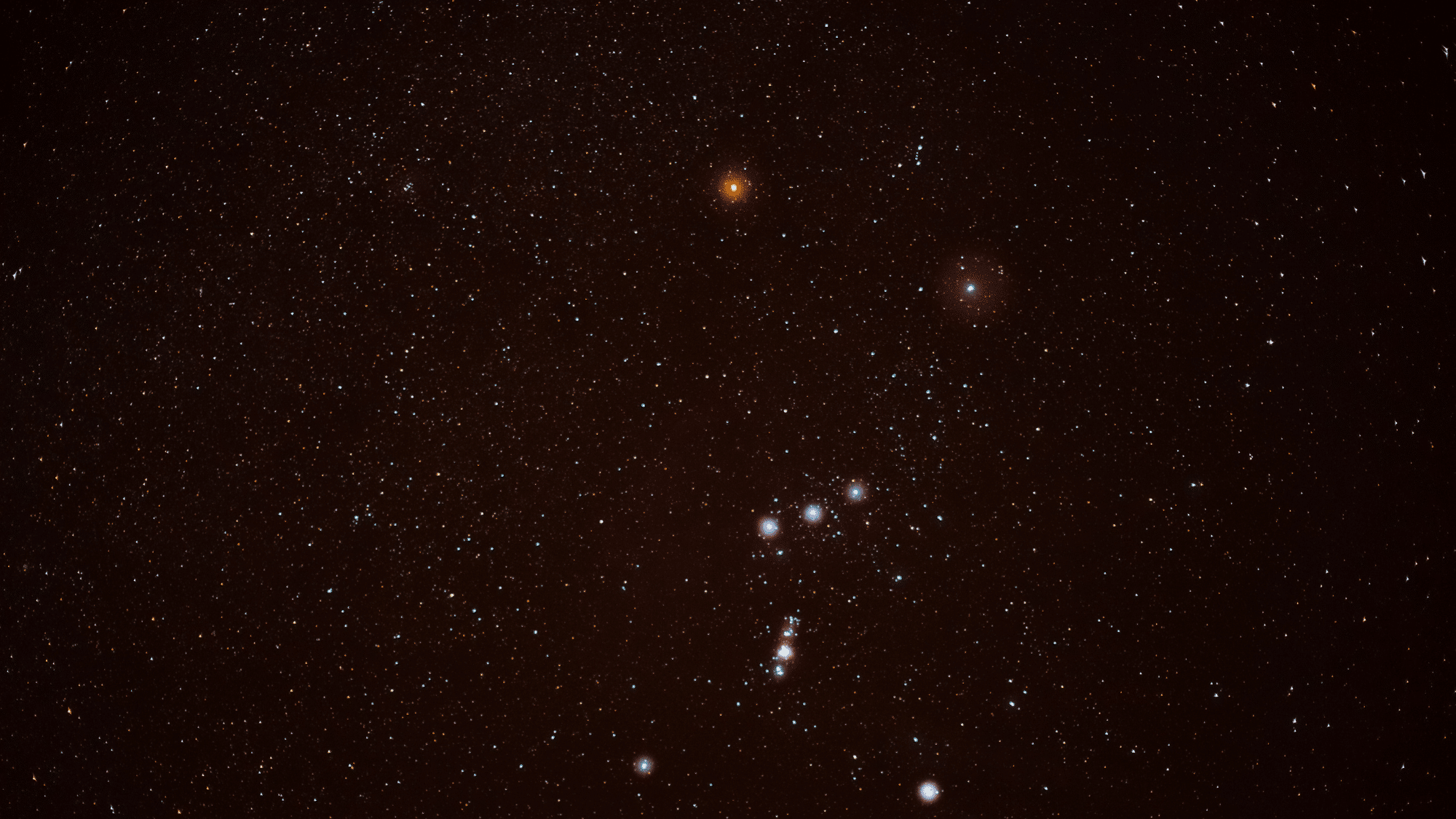
Betelgeuse, also known as Alpha Orionis, sits at Orion’s right shoulder. It’s located roughly 548-640 light-years from Earth.
This M1-2 Ia-ab red supergiant is massive. It spans about 1,000 times the Sun’s diameter, stretching from Earth’s orbit out to Jupiter’s.
The star radiates with 100,000 times the Sun’s luminosity but has a cool surface temperature of around 3,500K, giving it that distinctive orange-red glow.
Betelgeuse is a semiregular variable star. Its brightness shifts between 0.0 and +1.6 magnitude over roughly 400-day cycles due to pulsations.
It evolved from a blue supergiant about 10 million years ago and now sheds mass through powerful stellar winds.
Why Betelgeuse is Expected to Explode Eventually
Betelgeuse has burned through most of its nuclear fuel. That’s the key reason astronomers expect it to explode.
Red supergiants like Betelgeuse fuse heavier elements in their cores as they age. Right now, it’s likely working through silicon and other heavy elements.
Once the core runs out of fuel to burn, there’s nothing left to hold the star up against gravity’s crushing force.
When that happens, the core collapses in seconds. The collapse triggers a massive rebound explosion, a supernova. For Betelgeuse, this is inevitable because of its mass and evolutionary stage.
The star is already showing signs of instability. It’s pulsating irregularly and ejecting huge amounts of material into space.
These are classic behaviors of a star nearing the end of its life, though “nearing” in cosmic terms could still mean thousands of years.
What Astronomers Mean by “Soon” for Betelgeuse
“Soon” in stellar terms doesn’t match human timelines. It can span decades, centuries, or even millennia; not just a few years.
- Pre-2025 estimates: Studies from 2023 suggested Betelgeuse might explode within tens of years, based on carbon-burning data and core pulsations.
- 2025-2026 discovery: The binary companion “Siwarha” changed everything. Its 2,170-day orbital cycle pushed estimates out to 100,000+ years.
- Surface changes: Earlier predictions relied on visible pulsations and dimming events, which seemed urgent.
- No 2026 explosion: Despite rumors, no credible study confirms a supernova happening in 2026.
Recent Observations & Updates on Betelgeuse
Recent studies reveal Betelgeuse remains stable despite earlier concerns. New discoveries have reshaped our understanding of its timeline.
| Year | Discovery/Observation | Significance |
|---|---|---|
| 2025-2026 | Spectroscopy & ALMA imaging | Revealed Siwarha’s influence on gas ejections; no core-collapse signs detected |
| Post-2020 | Brightness recovery | Stable variability patterns returned after the Great Dimming event |
| 2026 | High-resolution data | Debunked “imminent explosion” hype circulating on social media |
| Ongoing | Neutrino detector monitoring | Watching for pre-explosion neutrino bursts that signal core collapse |
| Current | Mass-loss tracking | Refining understanding of supernova precursor behaviors |
The data shows Betelgeuse isn’t rushing toward an explosion anytime soon. Scientists continue monitoring, but the star’s behavior suggests it has plenty of time left before going supernova.
What is the Great Dimming?
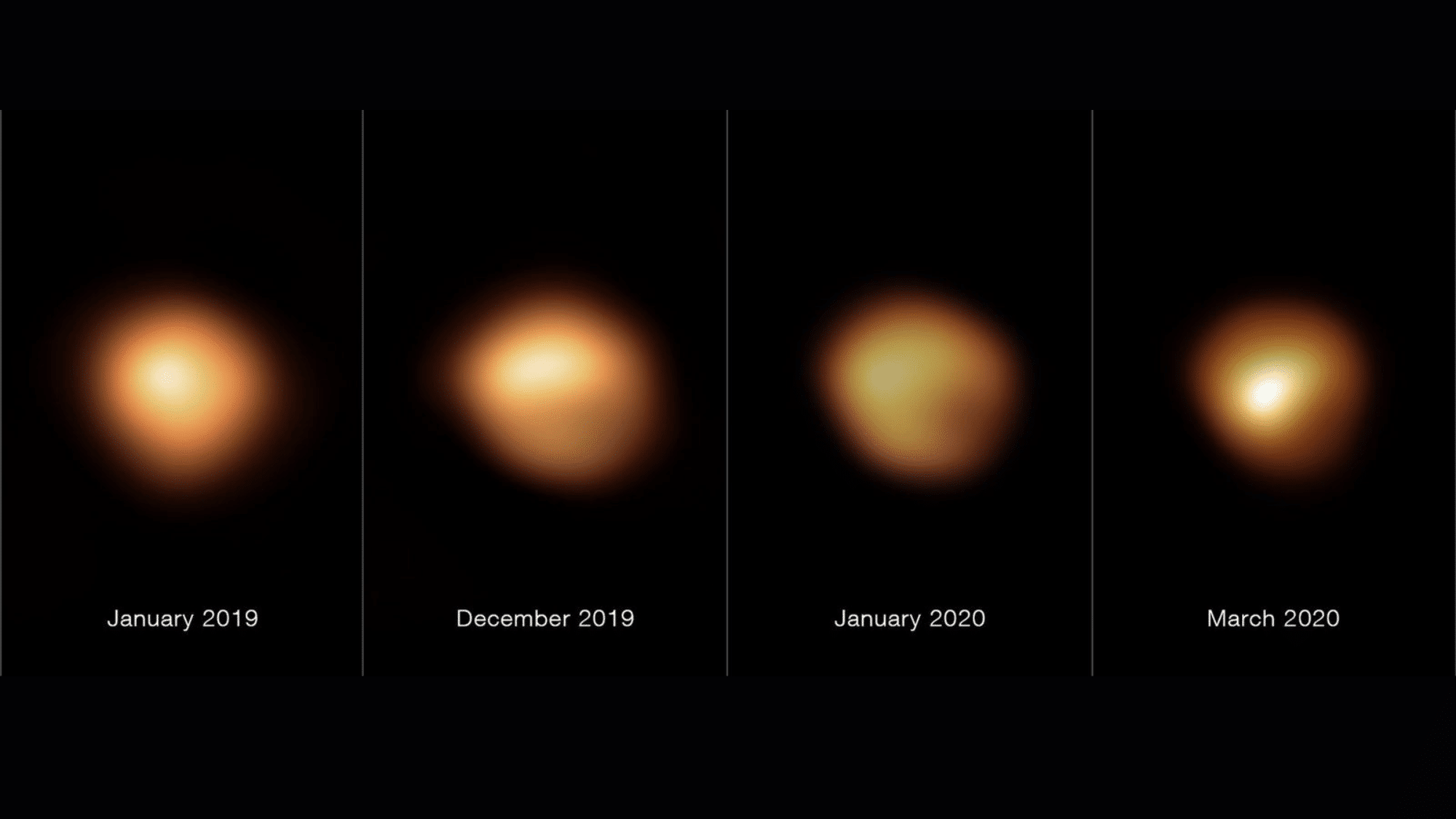
Image Source: Britannica
The “Great Dimming” happened between 2019 and 2020. Betelgeuse’s brightness dropped by roughly one magnitude, falling to about +1.6.
This sudden change sparked widespread supernova fears across the astronomy community and the public alike. But it wasn’t a sign of imminent explosion.
Scientists later discovered the dimming was caused by massive dust clouds. Material ejected from Betelgeuse’s South Pole formed these clouds, which temporarily blocked the star’s light from our view. Binary interactions with Siwarha likely played a role too.
By 2021, Betelgeuse’s brightness had returned to normal levels. The event taught astronomers valuable lessons about distinguishing between dramatic surface activity and actual core-collapse warning signs.
Can We Detect “Final Years” Signals Before Betelgeuse Explodes?
Scientists have multiple detection methods ready. These signals would arrive hours to days before the visible supernova explosion occurs.
- Neutrino flux: Super-Kamiokande and other neutrino detectors would catch massive bursts hours to days before the explosion becomes visible; this is the first and most reliable warning sign.
- Rapid brightening: Ground-based telescopes monitoring sudden increases in luminosity as the core destabilizes.
- Gamma rays: Space-based observatories detecting high-energy radiation released during collapse.
- Asymmetry monitoring: JWST and other advanced telescopes tracking irregular shape changes and material ejections from the star’s surface.
- Optical light: Traditional telescopes would capture the visible explosion, though this arrives days after neutrino detection.
Neutrinos travel at nearly the speed of light and escape the collapsing core immediately. That makes them our earliest warning system, giving astronomers precious time to point every telescope at Betelgeuse before the light show begins.
How Bright Would Betelgeuse Be If It Goes Supernova?
If Betelgeuse explodes, the show would be spectacular. At peak brightness, it would reach an absolute magnitude of about -12.4. That’s roughly 20 times brighter than a full Moon.
From Earth, the supernova would be visible during the daytime for several months.
It would appear as a brilliant “new star” in the sky, outshining everything except the Sun. Ancient civilizations would have considered this a major celestial event.
The light would gradually fade over time. But, at 640 light-years away, we’re perfectly safe. No harmful radiation would reach Earth, making this a front-row seat to cosmic fireworks without any danger.
Conlcusion
Betelgeuse won’t explode tomorrow, next year, or probably even in our lifetimes. The discovery of its binary companion Siwarha pushed estimates out to millions of years, debunking earlier panic about an imminent supernova.
Still, astronomers keep watching. Neutrino detectors stand ready to catch the first signals when collapse finally begins.
For now, Betelgeuse remains a stable red supergiant, pulsating and shedding mass as expected. The Great Dimming taught scientists valuable lessons about distinguishing normal stellar behavior from true danger signs.
Keep looking up. The show will happen eventually, just on the universe’s schedule, not ours.