


The universe is getting bigger. That’s not up for debate. But how quickly? Now that’s where things get tricky.
Scientists have been measuring this cosmic growth spurt for decades, and they keep hitting a wall.
Different methods give different answers, and the gap between them is growing. Some call it the biggest crisis in modern cosmology.
So what’s the real speed? Why can’t the smartest minds on Earth agree? And what does this confusion tell us about the nature of space itself? The answers might shake everything we thought we knew about how our universe works.
What does “Universe Expanding” Even Mean?
Picture a balloon with dots drawn on its surface. As you blow air in, the dots move apart.
That’s basically what’s happening with our universe. Space itself is stretching, pulling galaxies away from each other. There’s no explosion, no center point, no edge to rush toward.
The fabric of spacetime is just growing. Edwin Hubble figured this out in the 1920s when he noticed something odd: distant galaxies appeared redder than they should.
Their light waves were stretching as space expanded, shifting toward the red end of the spectrum. The farther away a galaxy sits, the faster it moves away from us.
How did Scientists Discover the Universe is Expanding
It started with Vesto Slipher in the 1920s. He measured light from distant galaxies and found something strange: most were rushing away from us.
Then Edwin Hubble took over, using the massive Hooker telescope to measure cosmic distances. He relied on special stars called Cepheid variables, which pulse at predictable rates.
In 1929, Hubble dropped a bombshell: galaxies weren’t just moving, they were fleeing faster the farther out they sat.
This pattern shattered Einstein’s belief in a static universe and gave birth to what we now call the Big Bang theory.
The Big Bang Theory and the Expansion of the Universe
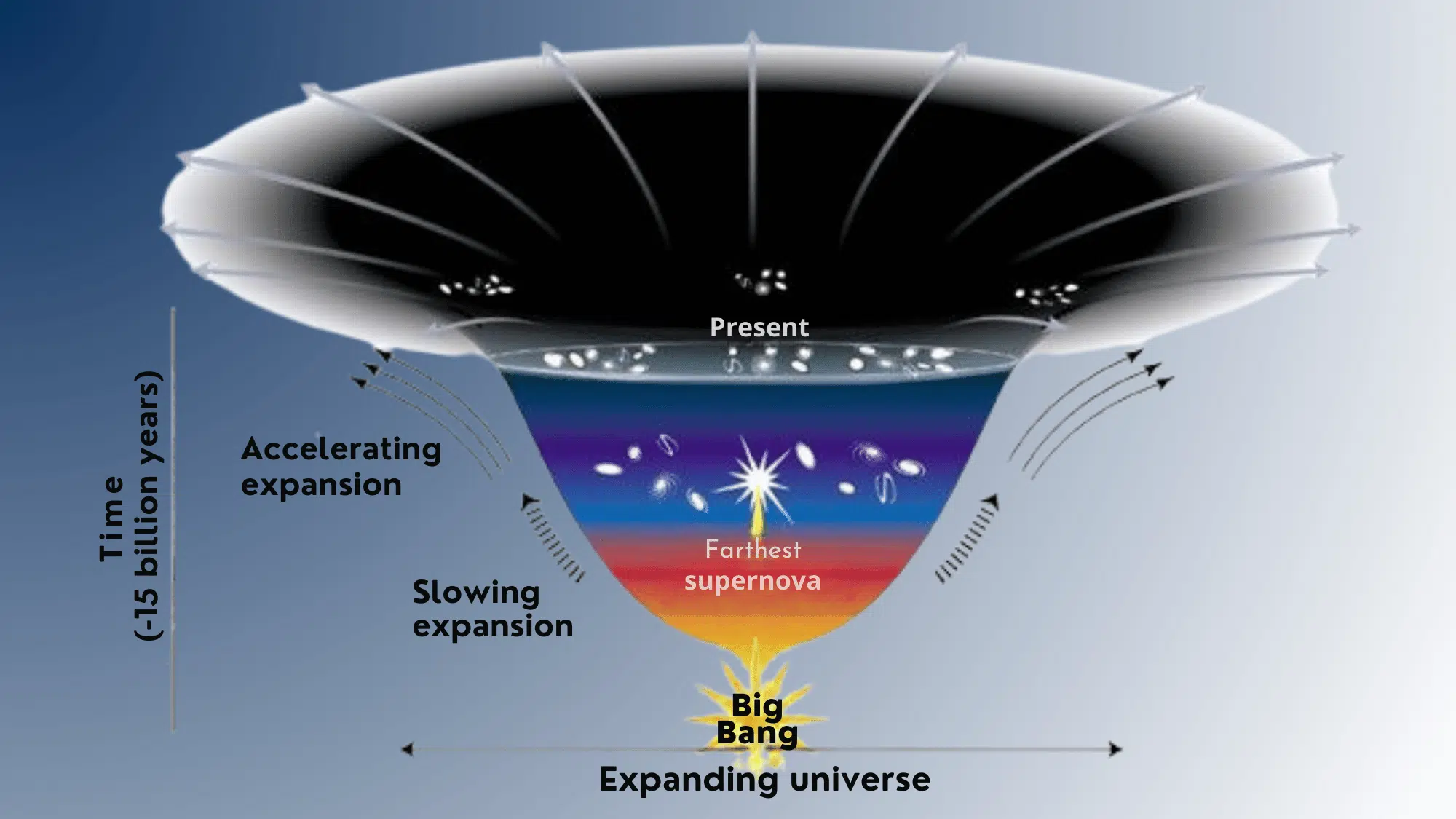
The Big Bang wasn’t an explosion in space; it was an explosion of space itself. Around 13.8 billion years ago, everything began from an incredibly hot, dense point and has been stretching ever since.
1. First Fraction of a Second (Inflation): The universe exploded outward faster than light, growing from subatomic to grapefruit-sized in a trillionth of a trillionth of a second. This explains why distant regions look so uniform.
2. First 380,000 Years: Too hot for atoms to form. Light couldn’t travel freely; it just bounced around in a fog of particles.
3. 380,000 Years After: The universe cooled enough for atoms to stick together. Light broke free, creating what we now see as the cosmic microwave background, a faint glow visible in every direction.
4. First Few Hundred Million Years: Gravity pulled matter together, forming the first stars and galaxies.
5. Billions Years Ago to Now: Expansion started accelerating. Something called dark energy began pushing galaxies apart faster and faster, and it hasn’t stopped since.
How do Scientists Measure the Expansion Rate Today?
Scientists use two main approaches: studying light from distant supernovae and ancient stars, or analyzing the cosmic microwave background radiation left over from the Big Bang. Each method requires different tools and calculations, but they should agree.
- Kilometers per second per megaparsec (km/s/Mpc): The standard unit for the Hubble constant. It shows how many kilometers per second faster a galaxy moves for every megaparsec (3.26 million light-years) of distance.
- Megaparsec (Mpc): A unit of cosmic distance equal to about 3.26 million light-years. Astronomers prefer it over light-years for measuring vast intergalactic spaces.
- Redshift (z): A dimensionless number showing how much light has stretched. Higher values mean greater distance and faster recession speeds.
- Hubble Time: The inverse of the Hubble constant, roughly estimating the universe’s age if expansion were constant—currently around 14 billion years.
- Giga-years (Gyr): Billions of years, used to discuss cosmic timescales and the universe’s 13.8-billion-year age.
What is the Hubble Constant and Why Does it Matter?
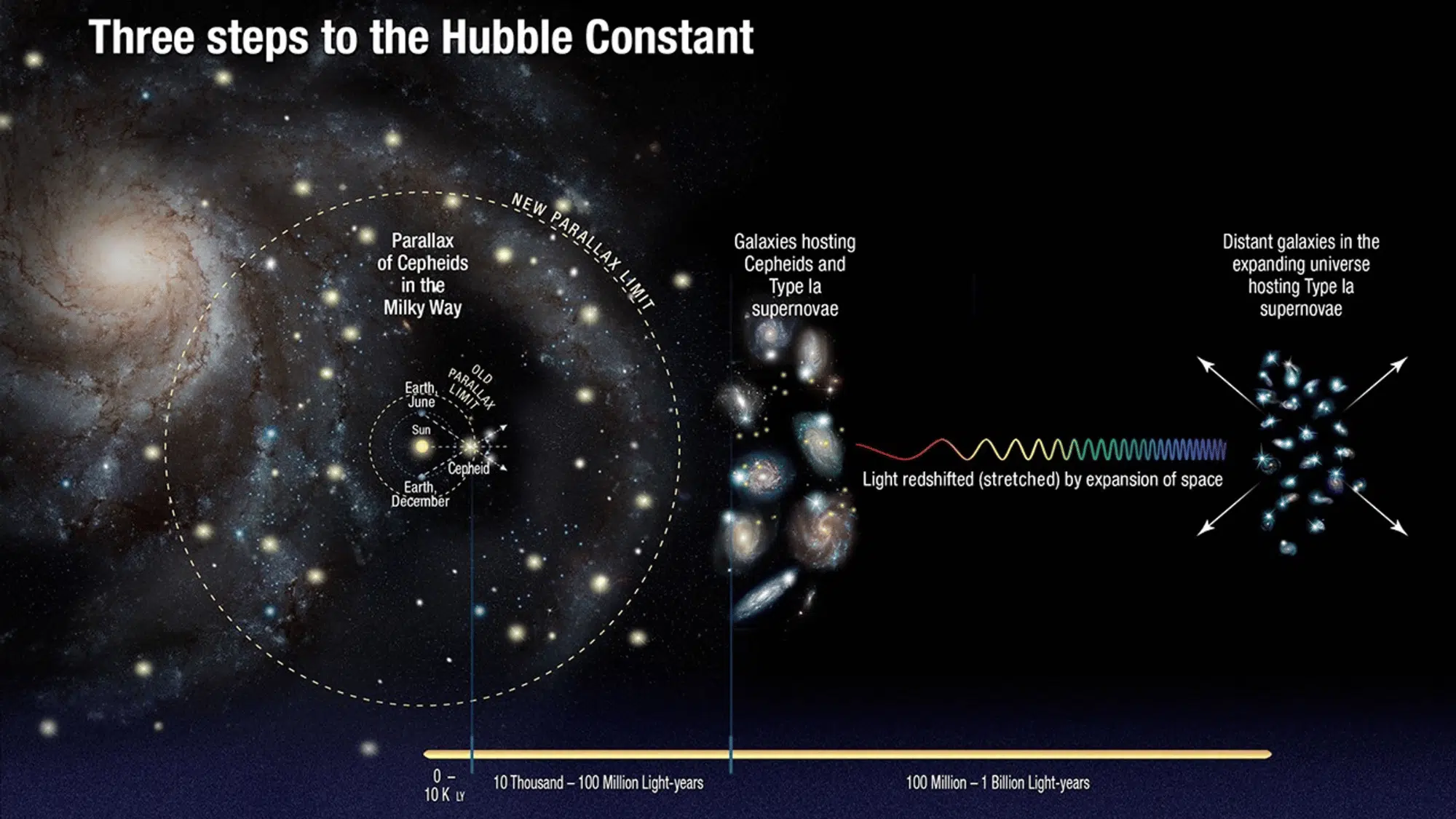
Image Source: NASA Science
The Hubble constant, or H0, is the universe’s speedometer. It tells us how fast space is expanding right now.
Scientists express it in kilometers per second per megaparsec, which sounds complicated but breaks down simply: for every 3.26 million light-years of distance, galaxies move away a certain number of kilometers faster per second.
Why does this number matter so much? Because it’s the key to unlocking cosmic history. Get H0 right, and you can calculate the universe’s age, size, and ultimate fate.
You can rewind the clock back to the Big Bang. But different measurement methods keep spitting out different values. And that gap isn’t small anymore; it’s becoming a full-blown crisis that’s shaking the foundations of cosmology.
Will the Universe Expand Forever?
All signs point to yes. Dark energy makes up about 68% of everything out there, and it’s been pushing galaxies apart faster since around 1998.
If this force stays steady, we’re heading toward a cold, lonely “heat death” where stars burn out, and galaxies drift beyond view.
But if dark energy gets stronger, things could get violent; a Big Rip scenario where even atoms get torn apart.
New telescopes like Euclid and Roman are scanning deeper into space to nail down dark energy’s behavior and reveal our cosmic endgame
Key Takeaways
The universe’s expansion rate should be a settled number by now. But it’s not.
Two reliable methods keep disagreeing, and the gap widens with better data. That’s not a failure; it’s a doorway. Maybe dark energy is shifting.
Maybe gravity works differently at cosmic scales. Or perhaps something fundamental about spacetime still eludes us.
Future telescopes will dig deeper, but for now, this tension reminds us how much mystery still fills the void. The cosmos isn’t done surprising us, and frankly, that’s the exciting part.