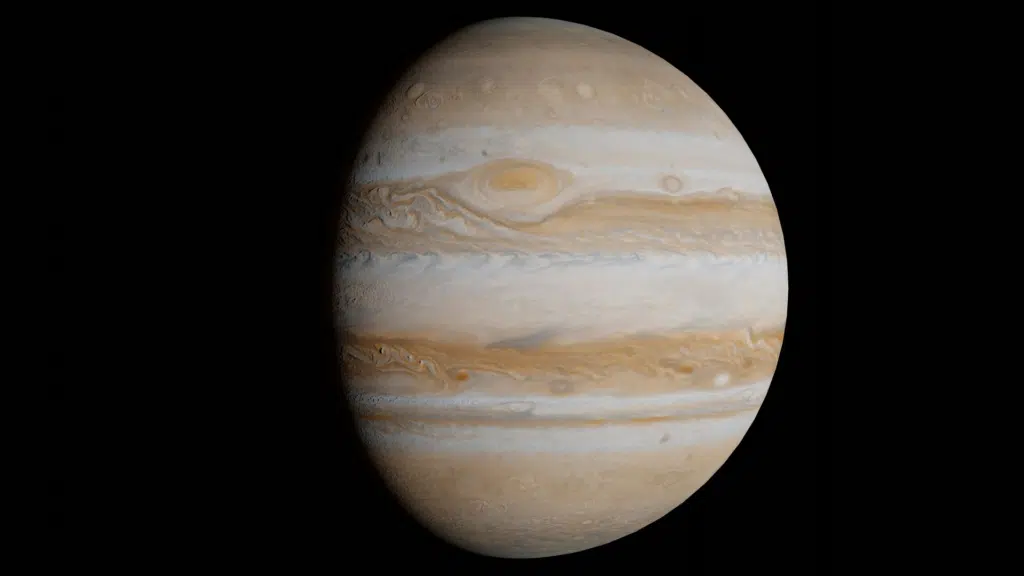
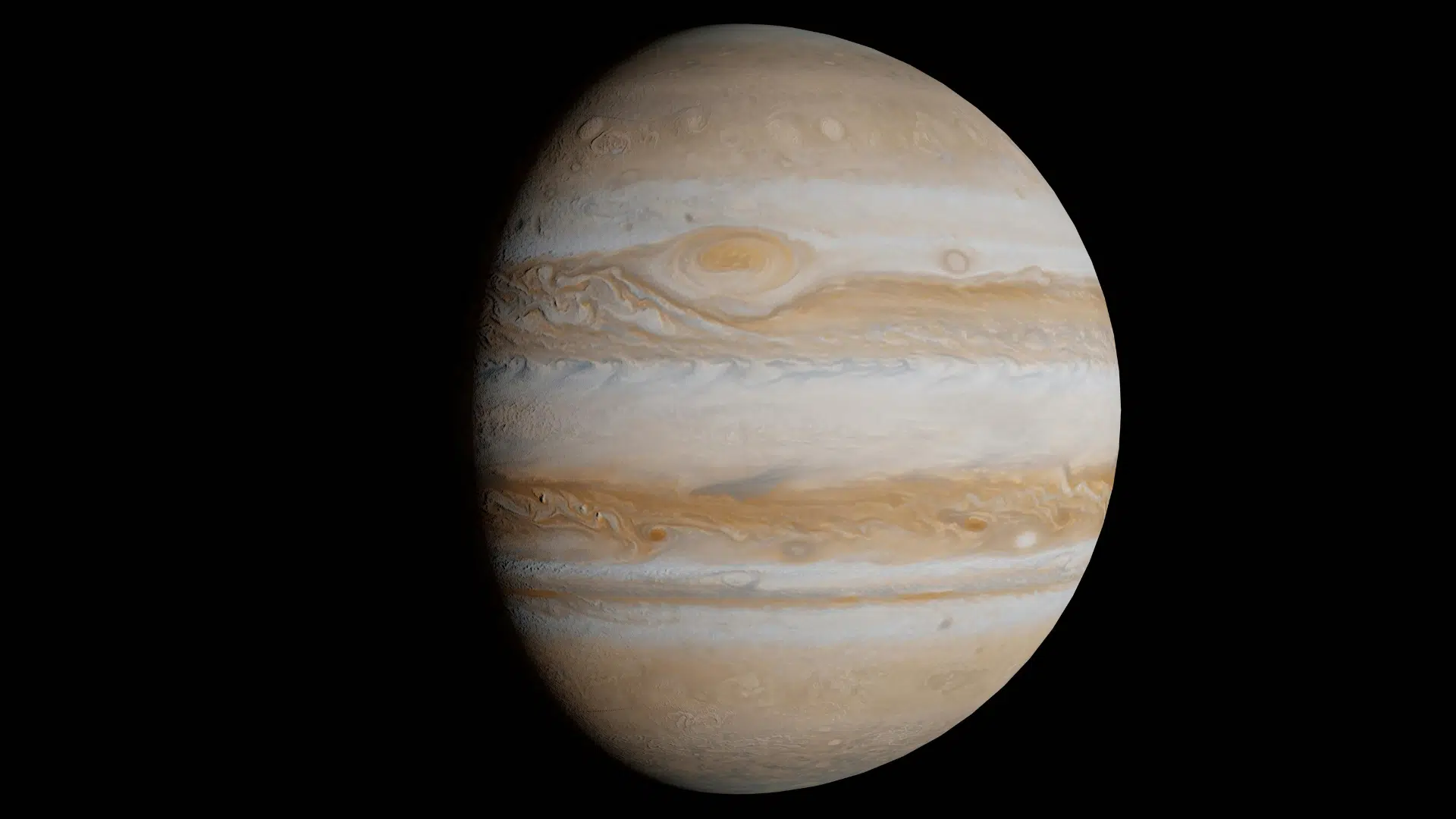



Jupiter didn’t get its name by accident. Long before modern science, ancient people looked at the sky and gave names to the bright objects they saw.
Jupiter stood out as one of the brightest and biggest, and its name reflected that. The choice wasn’t random; it was tied to powerful beliefs and stories from Roman mythology.
Understanding how Jupiter got its name helps connect science with history, showing how people used myth to explain the world.
This blog explains who named Jupiter, what the name means, and why it was such a fitting choice for the largest planet in our solar system.
Jupiter Before Modern Astronomy
Today, we know Jupiter is a gas giant 11 times wider than Earth and more massive than all the other planets combined.
NASA’s Juno spacecraft, which has been orbiting Jupiter since 2016, has revealed details about its deep atmosphere, gravity field, and magnetic structure. (NASA Juno Mission Overview)
But ancient observers didn’t know any of that.
What they did know was this:
- Jupiter was extremely bright.
- It did not twinkle like stars.
- It moved against the background of fixed constellations.
- It followed a predictable path over time.
To early civilizations, anything that “wandered” among the stars was special. The Greek word planētēs means “wanderer.” That’s where we get the word planet.
Jupiter was one of only five visible planets known in antiquity: Mercury, Venus, Mars, Jupiter, and Saturn. And among them, Jupiter appeared dominant. That dominance shaped its name.
The Roots of Planetary Naming
The tradition of naming planets after gods goes back to the Babylonians and was later adopted and refined by the Greeks and Romans. Visible planets, those observable without telescopes, were named for deities whose appearance or motion resembled theirs.
By the time the Roman Republic gave way to the Empire, five planets were known:
| Planet | Roman God | Role |
|---|---|---|
| Mercury | Mercury | Messenger god; fast-moving |
| Venus | Venus | Goddess of love and beauty |
| Mars | Mars | God of War |
| Jupiter | Jupiter (Jove) | King of the gods |
| Saturn | Saturn | God of time and harvest |
Jupiter received the most commanding name of all. As the most massive and radiant of the five, it earned the title of Jupiter, king of the Roman pantheon, equivalent to the Greek Zeus.
Roman Mythology and the God Jupiter

In Roman mythology, Jupiter (or Jove) ruled the heavens. He was the god of thunder and lightning, law and order, and divine justice.
The Romans looked to him as the ultimate source of power and protection. His image was often shown holding a thunderbolt, seated on a throne, commanding storms.
Jupiter was said to watch over Rome and its people. His temple on the Capitoline Hill was one of the most important religious sites in the Roman Empire.
When early Roman astronomers saw a massive moving light high in the night sky, naming it after their supreme deity made both cultural and religious sense.
To the Romans, this wasn’t just a planet. It was a celestial body that symbolized kingship, control, and permanence, qualities they believed their top god embodied.
How Greek Mythology Shaped the Name Jupiter
The Roman gods didn’t emerge from nothing. Much of Roman mythology was adapted from the Greeks, whose pantheon had been in place for centuries.
At the top of that system stood Zeus, the sky god and thunder-wielder who ruled Mount Olympus. His power, symbolism, and role inspired the Roman version: Jupiter.
As Roman culture absorbed Greek influence, it translated gods into Latin while keeping their core traits.
Zeus became Jupiter, but the Roman version took on a more formal, civic role, still commanding thunder, but also guarding Roman law and institutions. The stories remained familiar, though the tone shifted.
So when the time came to name the planet, it wasn’t just about brightness or size; it was about continuity. The name Jupiter represents a blend of Greek mythology and Roman identity, passed from one empire to the next and written into the stars.
Earlier Civilizations: Jupiter Before Rome
Long before the Romans, other cultures had recognized the importance of the planet we call Jupiter.
Babylonian Astronomy
The Babylonians, as early as the 7th century BCE, tracked Jupiter’s movement with remarkable precision. Clay tablets show detailed calculations predicting its position.
They associated Jupiter with their chief god, Marduk, another sky ruler. The pattern is clear: the largest planet aligns with the highest deity.
Vedic India
In ancient Indian astronomy, Jupiter was called Brihaspati, the guru or teacher of the gods. It was associated with wisdom and knowledge. Even today in Hindu astrology, Jupiter represents expansion and growth.
Chinese Astronomy
In ancient China, Jupiter was known as Suìxīng, meaning “Year Star,” because its roughly 12-year orbit around the Sun matched the 12-year zodiac cycle.
Galileo, the Telescope, and Modern Validation
The name “Jupiter” solidified in the early modern era, especially after Galileo Galilei turned his telescope toward the planet in 1610. What he saw changed astronomy forever.
He discovered four large moons: Io, Europa, Ganymede, and Callisto, orbiting Jupiter. This was revolutionary.
It proved that not everything revolved around Earth. Galileo published his findings in Sidereus Nuncius, referring to the planet as Jupiter, following the Roman naming tradition.
His work marked a turning point not just in science, but in the cultural reinforcement of the planet’s name.
The International Astronomical Union (IAU) and Modern Naming
Today, planetary naming is governed by the International Astronomical Union (IAU). The IAU maintains official naming conventions for celestial objects (IAU Naming Themes).
Interestingly, the mythological tradition continues.
- Jupiter’s moons are named after lovers and descendants of Zeus/Jupiter.
- NASA missions to Jupiter follow mythological themes.
For example:
- Galileo spacecraft (1995–2003) honored the astronomer who studied Jupiter.
- Juno spacecraft (2016–present) is named after Jupiter’s mythological wife. In Roman mythology, Juno could see through Jupiter’s clouds, fitting for a spacecraft studying the planet’s hidden interior.
The continuity between ancient myth and modern science is not accidental. It creates narrative coherence in space exploration.
How Jupiter Lives Up to Its Name
What makes this story especially compelling is that the name still fits scientifically.
Consider the facts:
- Jupiter contains more than twice the mass of all other planets combined.
- Its gravity acts as a shield, redirecting comets and asteroids.
- It has the strongest magnetic field of any planet.
- Its Great Red Spot has been raging for at least 350 years.
- It emits more energy than it receives from the Sun.
In Roman myth, Jupiter commanded thunder and ruled the heavens. In physics, Jupiter dominates gravitational dynamics in the solar system.
The metaphor survived scientific scrutiny. That alignment between myth and measurable force gives the name unusual staying power.
Final Thoughts
Empires fall. Religions shift. Scientific models change. Yet the name Jupiter has endured.
It began as a symbolic act by ancient skywatchers who saw a bright, wandering light and associated it with ultimate authority. It passed through Greek philosophy, Roman religion, medieval scholarship, Renaissance astronomy, and modern astrophysics.
Today, when spacecraft orbit the planet and transmit gravitational data across hundreds of millions of miles, they still use that same ancient name.
So when someone asks how Jupiter got its name, the real answer is this: It was named by people trying to understand power in the sky, and somehow, they chose a name that still makes sense.
Frequently Asked Questions
Who Approved the Name “Jupiter”?
No single authority. The Romans named it, and the name became widely accepted long before modern naming bodies like the IAU.
Why Use Mythological Names Today?
They preserve cultural continuity. Agencies like NASA and the IAU still follow these traditions in naming planets and missions.
Does the Name Affect How We See the Planet?
Yes, in part. It adds symbolic meaning and helps shape public understanding, especially in education and media.