


The Delphinus constellation is a small yet striking pattern in the night sky. Though modest in size, it has held meaning for centuries.
Ancient astronomers gave it a story, and modern science gives it structure and clarity. Its shape stands out once it is recognized, forming a compact group of stars that draws steady interest.
Over time, it has remained part of official star charts and seasonal sky guides. The constellation continues to capture attention because of its history and quiet presence overhead.
This guide provides clear, comprehensive information about Delphinus, explaining its background, features, and enduring importance in astronomy and cultural tradition.
What is the Delphinus Constellation?
The Delphinus constellation is a small constellation in the northern sky that represents a dolphin. Its name comes from the Latin word for dolphin, and its shape loosely reflects that image.
Although it is not one of the largest or brightest constellations, it stands out because of its compact and recognizable pattern.
Delphinus is officially recognized by the International Astronomical Union (IAU) and has defined boundaries like every modern constellation.
In size, Delphinus ranks near the bottom compared to the 88 constellations recognized today. However, its small area does not reduce its importance.
For centuries, it has appeared in star maps, navigation guides, and mythological stories. The constellation is often appreciated for its clear outline and historical depth rather than its brightness alone.
Location and Visibility in the Night Sky

Image Source: Name A Star
The Delphinus constellation lies in the northern celestial hemisphere, near the celestial equator. Because of this position, it can be seen from many parts of the world.
Quick Location Facts
- Hemisphere: Northern
- Right Ascension: Around 20 hours
- Declination: About +15°
- Visible from: Most of the Northern Hemisphere and much of the Southern Hemisphere
Delphinus lies near several recognizable constellations:
- Aquila (home of the bright star Altair)
- Pegasus
- Sagitta
The best time to view Delphinus is from July through September in the Northern Hemisphere. During these months, it rises high enough in the evening sky for clear observation.
Because its stars are moderately bright, dark skies away from city lights make a noticeable difference.
How Delphinus Appears in the Sky
The Delphinus constellation is known for its compact and distinct pattern. Its main stars form a small diamond shape that is sometimes called “Job’s Coffin.”
A fifth star extends outward from the diamond, suggesting the dolphin’s tail.
This tight grouping makes Delphinus easier to recognize than many larger constellations. Observers do not need to scan a wide stretch of sky. Instead, they can focus on a small, balanced cluster.
While the resemblance to a dolphin is symbolic, the association has remained consistent across centuries of star charts,
Major Stars of the Delphinus Constellation
Although the Delphinus constellation does not contain extremely bright stars, its primary stars are well-suited to forming a recognizable pattern.
Alpha Delphini (Sualocin)
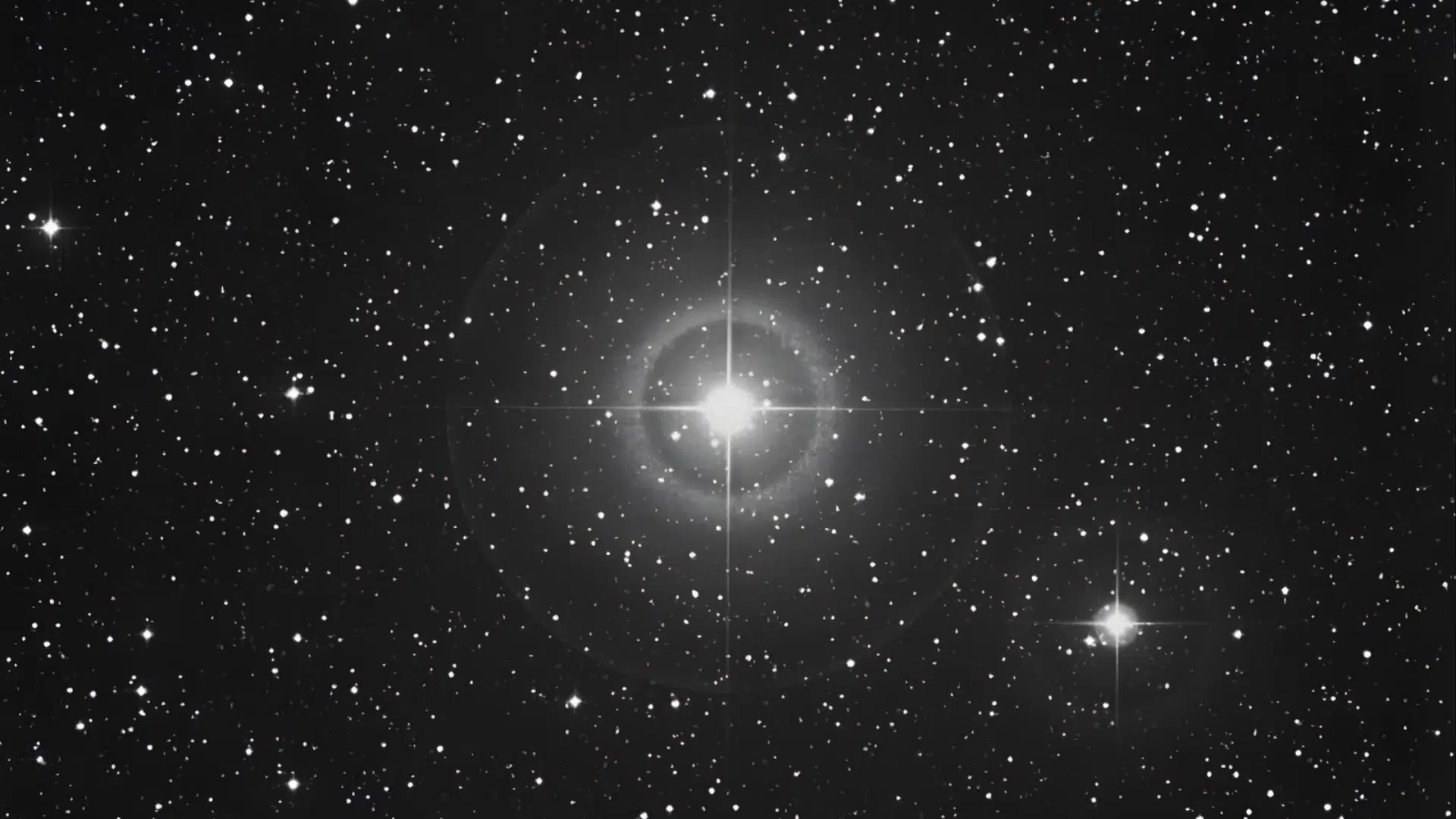
Image Source: TheSkyLive
Alpha Delphini, also called Sualocin, is the brightest star in the constellation. It is not a single star but a multiple-star system located roughly 240 light-years from Earth.
It shines with a bluish-white color and plays a central role in shaping the diamond pattern.
The name “Sualocin” has an unusual origin. It is “Nicolaus” spelled backward, a tribute to the Italian astronomer Niccolò Cacciatore. This naming detail reflects the historical layers embedded in star catalogs.
Beta Delphini (Rotanev)

Image Source: Star Facts
Beta Delphini, known as Rotanev, is another key star in the Delphinus constellation. It is a binary system located about 100 light-years from Earth.
Like Sualocin, Rotanev’s name is also reversed, derived from “Venator,” the Latinized form of Cacciatore’s surname.
Together, Alpha and Beta Delphini form the brightest points of the constellation’s core pattern.
Gamma Delphini
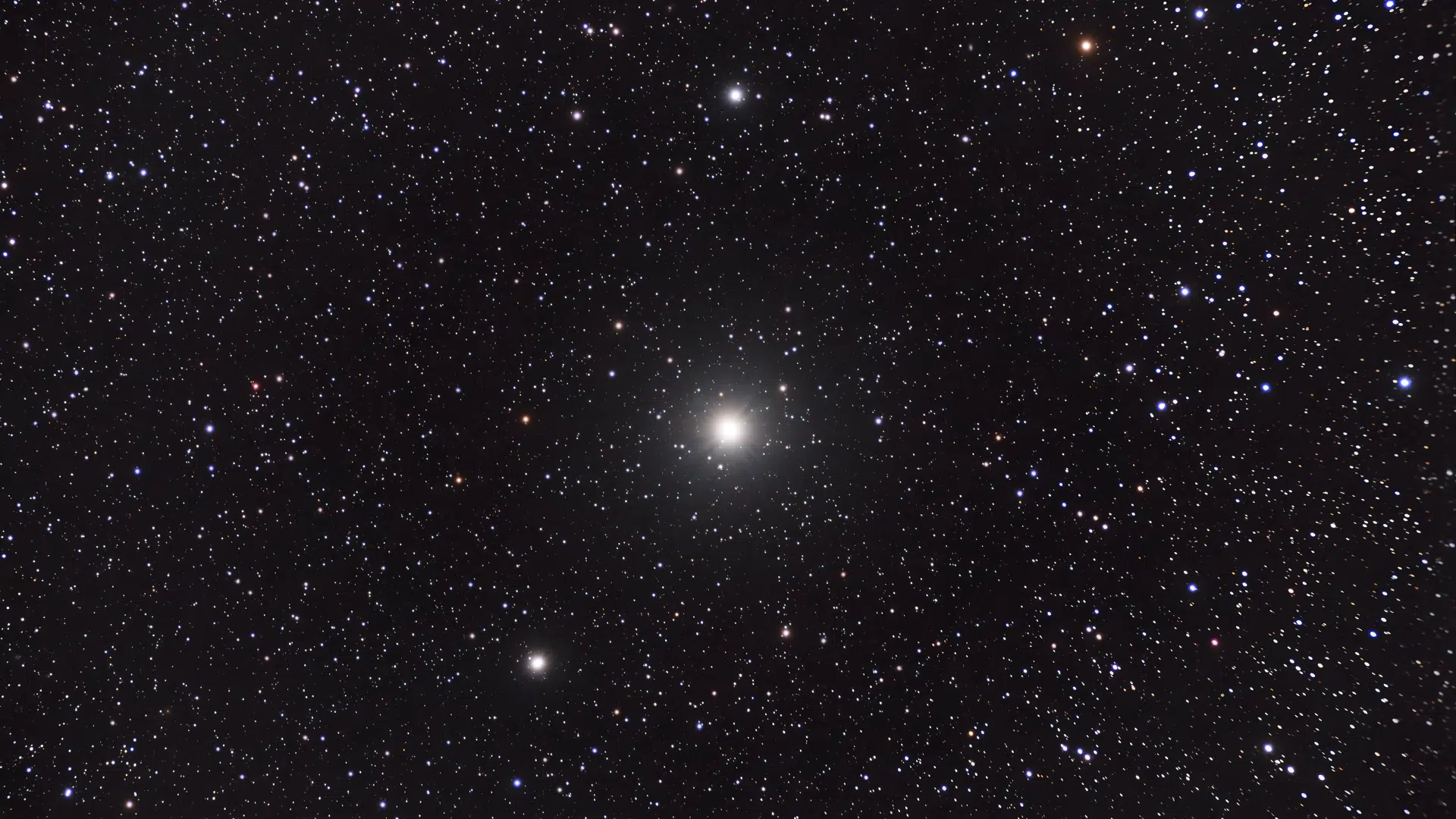
Image Source: ViewFrom.Earth
Gamma Delphini is one of the most admired double stars in the night sky. Through a small telescope, it can be seen as two stars orbiting one another.
The pair often displays a pleasing color contrast, with one appearing golden and the other bluish. This visual effect makes Gamma Delphini a popular target for amateur astronomers.
Delta and Epsilon Delphini

Image Source: Star Facts
Delta and Epsilon Delphini complete the diamond-shaped body of the constellation. While not as widely discussed as Gamma Delphini, these stars are essential for defining the overall pattern.
Their placement gives Delphinus its balanced and compact structure.
Deep-Sky Objects in Delphinus
The Delphinus constellation is not rich in deep-sky objects, but it does contain a notable example.
NGC 6905: The Blue Flash Nebula
- Type: Planetary nebula
- Appearance: Faint bluish glow
- Requires a telescope for observation
This nebula formed when a dying star expelled its outer layers into space. Planetary nebulae represent a late stage in stellar evolution.
Although Delphinus does not contain bright star clusters or massive nebulae, objects like NGC 6905 contribute to our understanding of how stars age and shed material.
There are also faint galaxies within the constellation, but these require advanced equipment to observe.
Mythology and Cultural Background
The Delphinus constellation is rooted in Greek mythology.
One popular story involves Poseidon, the god of the sea. According to legend, Poseidon wished to marry the sea nymph Amphitrite. When she hid from him, a dolphin persuaded her to return. In gratitude, Poseidon placed the dolphin among the stars.
Another myth connects Delphinus to the musician Arion. After pirates threw him into the sea, a dolphin rescued him and carried him safely to shore. The dolphin was later honored in the sky.
In ancient maritime cultures, dolphins symbolized:
- Protection
- Intelligence
- Guidance
These positive traits helped preserve the constellation’s identity through the centuries.
Historical Role in Astronomy
Delphinus has been recognized since ancient times. It was included in:
- Ptolemy’s Almagest (2nd century)
- Classical Greek star catalogs
- Medieval and Renaissance star atlases
Because it lies near the celestial equator, it was visible from much of the ancient world. This wide visibility helped secure its place in astronomical tradition.
In the 20th century, the IAU formally defined its boundaries. This ensured consistency in modern sky mapping.
How to Locate the Delphinus Constellation
Finding Delphinus becomes easier with reference stars.
Step-by-Step Guide
- Locate Altair in the constellation Aquila.
- Look slightly eastward from Altair.
- Identify a small diamond-shaped cluster of stars.
- Find the fifth star extending outward as the tail.
You can also use the Great Square of Pegasus as a nearby reference point.
For best results:
- Observe during late summer evenings
- Choose a dark location
- Allow your eyes time to adjust
Because the constellation is compact, once identified, it becomes easy to recognize again.
The Bottom Line
The Delphinus constellation shows how even a small region of the sky can carry depth and structure.
Its stars form a clear pattern, yet they are part of a much larger cosmic system shaped by gravity and time. Generations have charted this constellation with increasing precision, refining its position while preserving its identity.
Today, Delphinus stands as a stable reference point in both amateur observation and professional research. It reminds observers that scale does not determine significance.
The next time the late summer sky is clear, look upward and identify its compact diamond. Continue learning the sky one constellation at a time.