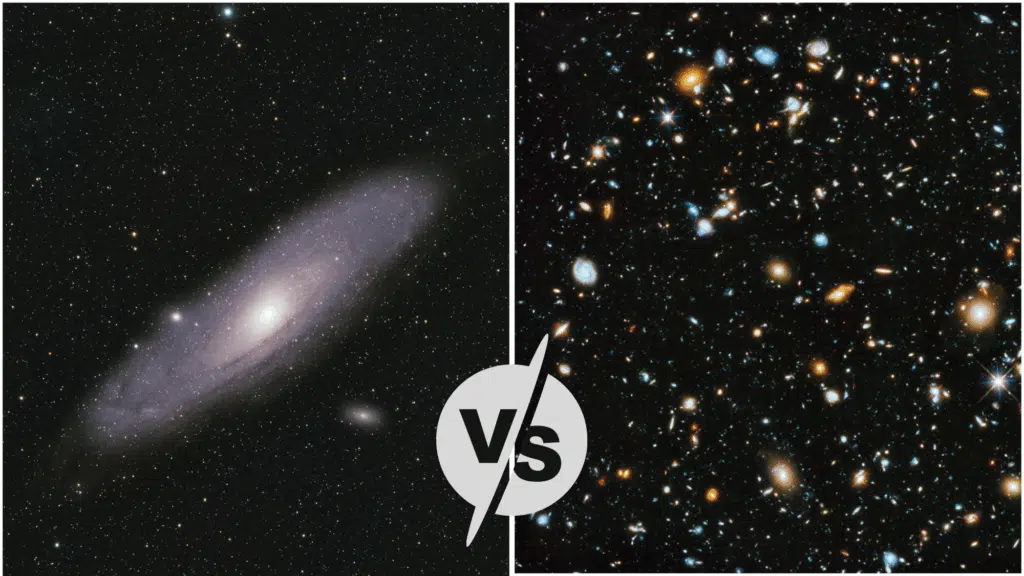
Most people use the words “galaxy” and “universe” as if they mean the same thing. They don’t.
It’s an easy mix-up. Both show up in science documentaries that make heads spin. But there’s a real difference between the two, and the night sky starts to look very different.
Think about it this way. Have you ever looked up at the stars and wondered just how far they go? That question has a layered answer. One that starts with a galaxy and ends somewhere much, much larger.
This blog breaks it all down in plain, simple terms. No jargon. No confusion. Just clear answers to one of space’s most commonly mixed-up questions.
What is a Galaxy?
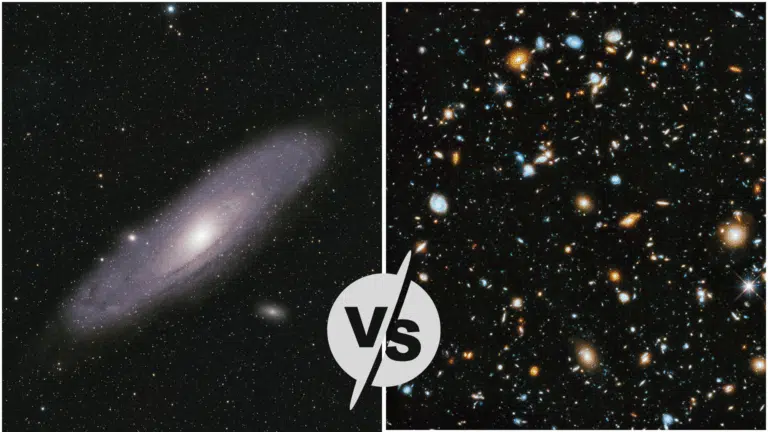
A galaxy is a massive collection of stars, gas, dust, and dark matter. All of it held together by gravity. Think of it as a giant city in space, with billions of stars acting as the buildings.
Our own galaxy is called the Milky Way. It holds somewhere between 100 to 400 billion stars. And it’s just one of billions of galaxies out there.
Galaxies come in three main types:
- Spiral galaxies have long, curving arms that wrap around a bright centre. The Milky Way is one.
- Elliptical galaxies are rounder and older, with very little new star formation happening inside them.
- Irregular galaxies have no fixed shape at all. They form mostly after two galaxies collide and merge together.
What is the Universe?
The universe is everything. And that’s not an exaggeration.
Every star, every planet, every galaxy, every black hole, every bit of gas floating in empty space; all of it makes up the universe. It’s the largest thing that exists. Nothing sits outside of it.
Scientists estimate the observable universe stretches about 93 billion light-years across. That’s just the part humans can see. The full universe could be far, far larger.
It contains hundreds of billions of galaxies. Each one packed with billions of stars. The scale is hard to picture, but that’s exactly what makes it so worth understanding.
Galaxy vs Universe: Side-by-Side Comparison
A galaxy is just one part of the universe. The universe holds all galaxies together within its vast, unending space.
| Aspect | Galaxy | Universe |
|---|---|---|
| Size | Typically 10,000–100,000 light-years across (e.g., Milky Way ~100,000 ly diameter). Largest known exceed 1 million ly. | Observable universe ~93 billion light-years in diameter; total size possibly infinite. |
| Contains | Billions to trillions of stars, stellar systems, nebulae, black holes, and dark matter halos. | ~2 trillion galaxies, plus intergalactic gas, dark energy, cosmic web filaments, voids, and all cosmic microwave background radiation. |
| Examples | Milky Way, Andromeda (M31), Triangulum (M33), Sombrero (M104), IC 1101 (largest known). | Only one known universe (ours); multiverse theories propose others but unproven. |
| Structure | Spiral, elliptical, irregular, or dwarf shapes; organized into clusters and superclusters. | Large-scale cosmic web: galaxy filaments, clusters, superclusters, walls, and vast voids; governed by expansion and dark energy. |
| Number | ~2 trillion observable galaxies in the universe. | 1 (singular encompassing entity). |
How Big is a Galaxy Compared to the Universe
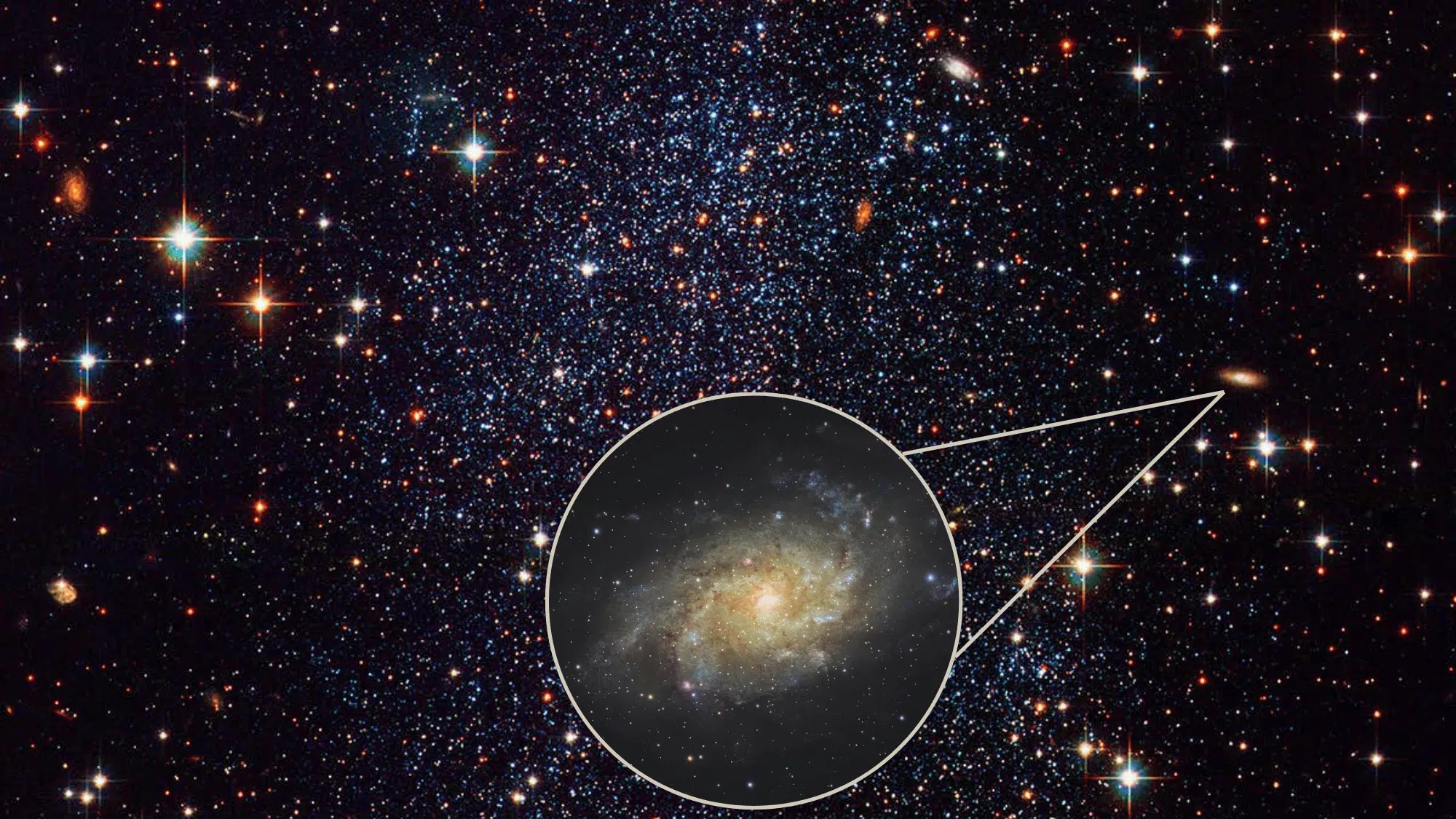
The Milky Way is about 100,000 light-years across. That alone is hard to wrap a head around. But the observable universe is 93 billion light-years wide. The difference is staggering.
If the Milky Way were the size of a coin, the observable universe would be roughly the size of the entire United States. That’s how big the gap is.
And the Milky Way isn’t even a small galaxy. It sits somewhere in the middle range in terms of size.
The universe doesn’t just dwarf a single galaxy. It contains hundreds of billions of them. Each one sitting in its own corner of space.
How Many Galaxies are in the Universe
Scientists estimate there are roughly 2 trillion galaxies in the observable universe. That’s 2,000,000,000,000. And that’s just the part humans can actually see.
For a long time, the estimate sat at around 200 billion galaxies.
But a 2016 study by Christopher Conselice and his team revised that number dramatically upward. Ten times higher, in fact.
Each of those galaxies contains billions of stars. Some contain hundreds of billions.
The universe is still expanding. New regions of space are moving beyond the range of human observation every single day. So that number? It may never be fully known.
Observable Universe vs Entire Universe: What’s the Difference?
| Aspect | Observable Universe | Entire Universe |
|---|---|---|
| Definition | Region from which light has reached us since the Big Bang. | All of space, time, matter, and energy that exists. |
| Size | ~93 billion light-years in diameter. | Likely much larger or infinite; unknowable extent. |
| Boundary | Cosmic light horizon (expanding over time). | No known boundary; may be infinite. |
| Contents | ~2 trillion galaxies, stars, CMB radiation we can detect. | Same types of structures, plus unseen regions forever. |
| Observability | Limited by light speed and universe age (~13.8B years). | Includes regions light will never reach Earth. |
Is the Milky Way a Galaxy or the Universe?
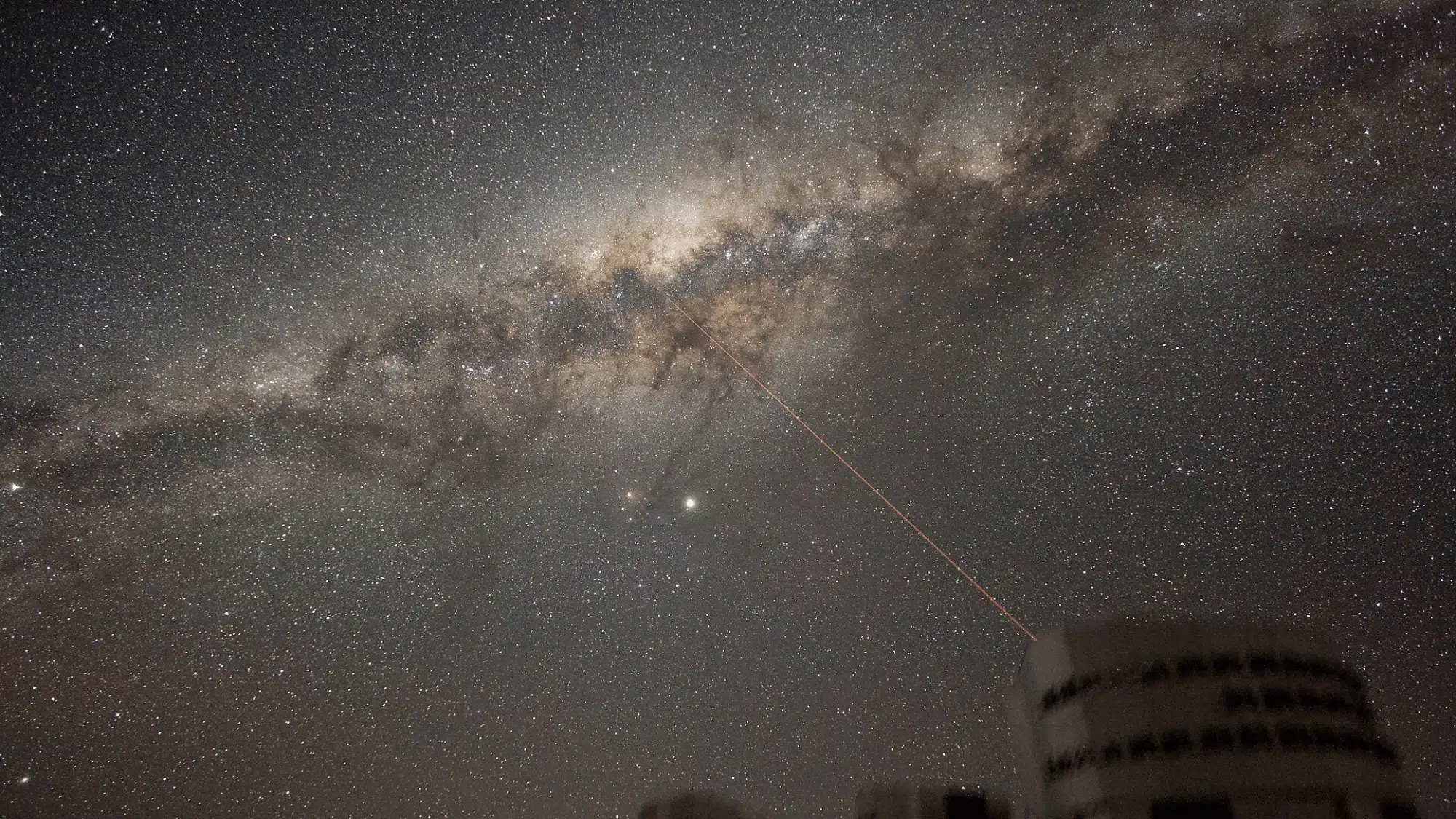
Image Source: Wikipedia
The Milky Way is a galaxy. Just one of trillions out there.
It’s the galaxy that contains Earth, the Sun, and every single star visible to the naked eye on a clear night. It’s home. But it’s not the whole picture.
For a long time, people thought the Milky Way was all there was. Early astronomers had no way of knowing otherwise. It wasn’t until the 1920s that Edwin Hubble proved other galaxies existed beyond it.
So the Milky Way is not the universe. It’s simply one piece of an almost incomprehensibly large puzzle. A very small piece, at that.
How Did Galaxies Form in the Universe
Galaxies didn’t appear overnight. They formed through a slow, step-by-step process that started right after the universe began.
- The Big Bang set everything in motion: Around 13.8 billion years ago, the universe began with the Big Bang. Matter, energy, and space all burst into existence at once.
- Gas clouds began to collect: Hydrogen and helium gas spread across early space. Gravity pulled these clouds together into dense clumps, setting the stage for what came next.
- The first stars were born: Inside those dense gas clumps, pressure and heat triggered nuclear fusion. Stars switched on for the very first time, lighting up the early universe.
- Stars grouped into galaxies: Gravity continued pulling stars, gas, and dust together into larger structures. Over hundreds of millions of years, these groups grew into full galaxies.
- Galaxies kept growing over time: Galaxies merged with each other and pulled in surrounding matter. This process of growth and collision continues even today across the universe.
Conclusion
Galaxies and the universe are not the same thing, and now that distinction is clear. A galaxy is a massive collection of stars and matter. The universe is everything that exists, galaxies included.
The scale of it all is hard to picture. Trillions of galaxies, each holding billions of stars, all sitting inside one universe. That’s the reality of the cosmos.
Next time someone uses both words interchangeably, there’s now enough knowledge to set the record straight.
Got questions about space? Drop them in the comments below. There’s always more to talk about when it comes to the universe.