


Few names in space history carry the weight of Gene Kranz. His white vest became a symbol of American grit during the space race.
The man behind Mission Control didn’t just watch history unfold. He shaped it with every decision, every protocol, and every moment of crisis management that saved millions of lives.
His story isn’t about rockets or moonwalks. It’s about leadership under impossible pressure, building teams that never failed when failure meant death, and creating a culture where “failure is not an option” became more than a catchphrase.
This is how one flight director changed NASA forever and set the standard for excellence that still guides space missions today.
Who is Gene Kranz?
Gene Kranz stands as one of NASA’s most legendary flight directors. Born in 1933, he joined the space program during its earliest days and quickly rose through the ranks at Mission Control.
His career spanned from the Mercury missions through Apollo and beyond. But numbers and dates don’t capture his real impact.
Kranz built the backbone of Mission Control operations, creating procedures that turned chaos into order during critical moments.
His trademark white vest, sewn by his wife, became an iconic symbol in the control room. More than his appearance, though, his calm demeanor and decisive leadership defined an era when America reached for the stars.
Gene Kranz’s Role at NASA
Gene Kranz didn’t just occupy a seat at Mission Control. He transformed what it meant to be a flight director during America’s most ambitious space endeavors.
Starting as an assistant flight director in 1960, Kranz worked his way up through sheer competence and unshakeable focus.
He served as lead flight director for Gemini missions, perfecting rendezvous techniques that would prove essential for Apollo.
During Apollo 11, he led the White Team that guided Armstrong and Aldrin to the lunar surface. His team made split-second calls that kept the mission alive when computer alarms threatened to abort the landing.
But his finest hour came during Apollo 13. When the explosion crippled the spacecraft, Kranz orchestrated the most dramatic rescue in space history, bringing three astronauts home against impossible odds.
His Role in The Apollo 13 Mission
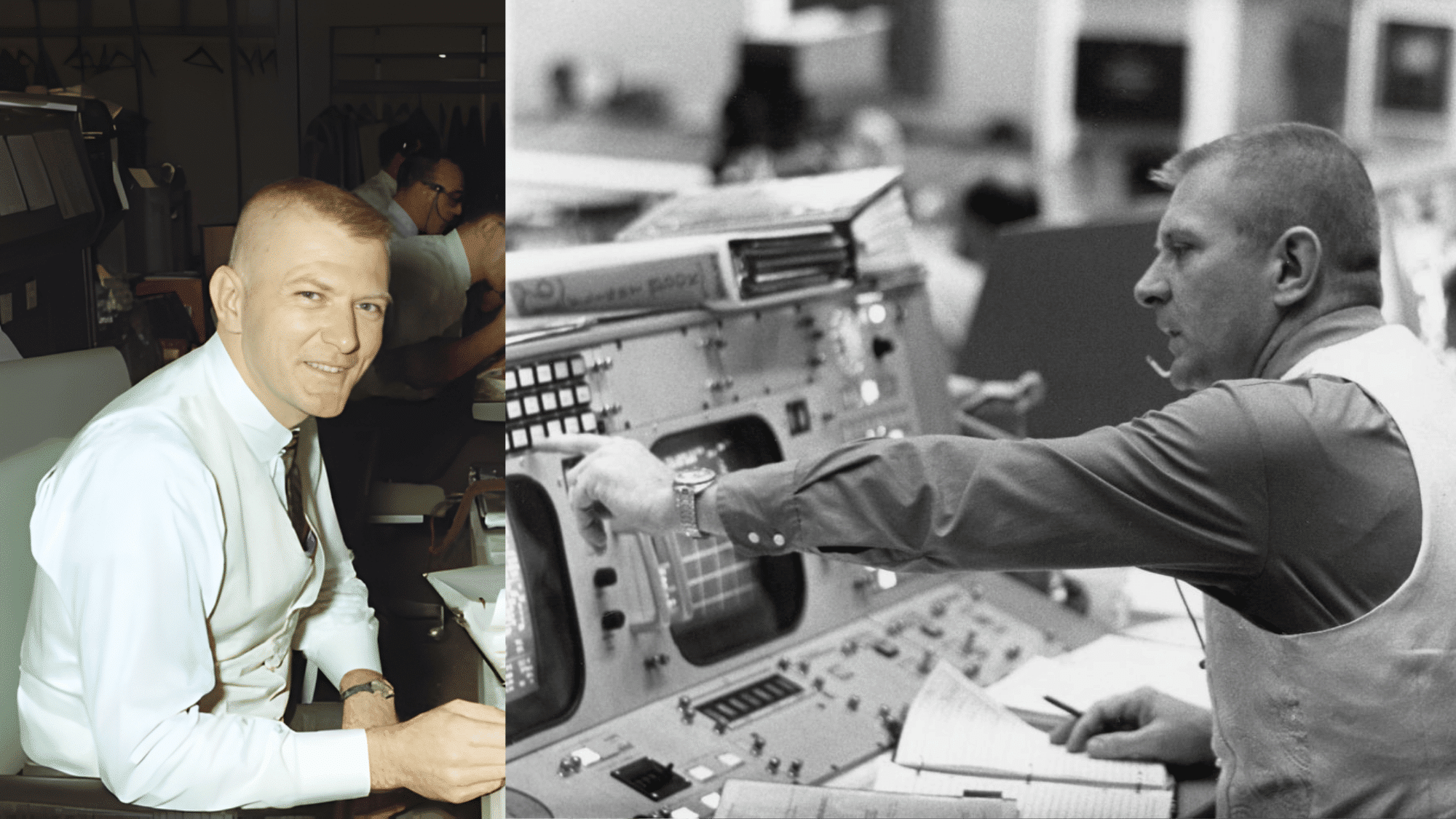
Apollo 13 tested everything Kranz believed about leadership, teamwork, and problem-solving under pressure. The mission became his defining moment in spaceflight history.
1. The Explosion That Changed Everything
On April 13, 1970, an oxygen tank exploded 200,000 miles from Earth. The crew heard a bang, felt vibrations, and watched their spacecraft die.
Kranz received the news that would haunt most leaders. Power levels dropped. Oxygen vented into space. The command module couldn’t sustain three astronauts.
In minutes, the moon landing became irrelevant. Survival became the only mission. Kranz faced a scenario no training had covered, with systems failing faster than engineers could track them.
2. Assembling the Tiger Team
Kranz knew one thing immediately. Bringing the crew home required every expert NASA had, working in perfect coordination.
He gathered engineers, mathematicians, and specialists from across Mission Control. Sleep became optional. Coffee became fuel. Failure became unthinkable.
The team worked on problems nobody had solved before. How to stretch consumables designed for two days across four? How to navigate without proper instruments? How to power up a dead spacecraft?
Kranz directed this orchestra of brilliant minds, keeping them focused when panic threatened to derail progress.
3. The Carbon Dioxide Crisis
The Problem:
- Three astronauts in a lunar module built for two
- Carbon dioxide building to lethal levels
- Incompatible air filtration systems between modules
| Component | Availability | Compatibility |
|---|---|---|
| Command Module filters | Square | Won’t fit LM |
| Lunar Module capacity | Limited | Insufficient for 3 people |
| Time until CO2 poisoning | Hours | Critical |
Engineers on Earth built a makeshift adapter using only materials available on the spacecraft. Plastic bags, cardboard, tape, and socks became life-saving equipment. Kranz’s team talked the astronauts through construction, step by step.
4. Navigation Without Power
The spacecraft drifted off course with nearly every system shut down to conserve power. Normal navigation required computers and instruments that they couldn’t afford to turn on.
Kranz’s team calculated burns using slide rules and basic math. They guided the crew through manual engine firings, using the Earth’s horizon and sun position as reference points.
One mistake in trajectory meant missing Earth entirely or burning up in the atmosphere. The margins for error are measured in fractions of degrees.
5. The Freezing Journey Home
Temperatures inside the spacecraft dropped to near freezing. Water condensation covered every surface. The astronauts couldn’t sleep in the cold darkness.
Kranz had to balance keeping the crew alive against preserving enough power for reentry. Every decision meant choosing between immediate comfort and future survival.
The team rationed power like wartime supplies. They calculated the minimum energy needed for splashdown, then allocated every remaining watt to life support.
For four days, the crew endured conditions that tested their physical and mental limits while Kranz’s team guided them home.
6. Powering Up a Dead Spacecraft
The final challenge loomed largest. The command module had been shut down completely to save power. Nobody had ever restarted a spacecraft in space.
Kranz’s team created startup procedures from scratch in hours, procedures that normally took months to develop and test. They simulated every step in Houston, finding problems before the crew encountered them.
The power-up sequence had to happen in precise order. One mistake could shut down critical systems. Following Kranz’s guidance, the astronauts brought the spacecraft back to life, system by system, for the final descent to Earth.
Other Major NASA Missions Led by Gene Kranz
Gene Kranz’s brilliance extended far beyond Apollo 13. His leadership and contributions shaped multiple missions that defined America’s journey into space.
1. Gemini 4: America’s First Spacewalk
Edward White’s historic spacewalk in 1965 required precise coordination. Kranz’s team monitored life support systems while White floated outside the spacecraft. The mission proved Americans could work in the vacuum of space, a skill essential for future moon landings.
2. Gemini 8: Emergency Recovery
When Neil Armstrong’s spacecraft spun wildly out of control in 1966, Kranz’s quick thinking helped bring the crew home. A stuck thruster nearly killed the astronauts. Kranz’s team guided Armstrong through an emergency landing in the Pacific, saving the mission and the future moon commander.
3. Apollo 11: The Moon Landing
Kranz led the White Team during humanity’s first lunar landing. When computer alarms threatened to abort the descent, his team made the call to continue. Armstrong landed with seconds of fuel remaining. Kranz’s calm leadership during those final moments made history possible.
4. Skylab Rescue Mission
When Skylab launched damaged in 1973, Kranz contributed and helped plan repairs that saved America’s first space station. His team developed procedures for astronauts to fix problems nobody anticipated. The mission turned potential disaster into triumph, extending Skylab’s operational life for years.
5. Apollo-Soyuz Test Project
Kranz coordinated America’s side of the first international space docking in 1975. American and Soviet spacecraft linked in orbit, symbolizing cooperation during the Cold War. His team managed complex technical challenges while navigating political sensitivities between rival nations.
Gene Kranz’s Leadership Philosophy “Kranz Dictum“
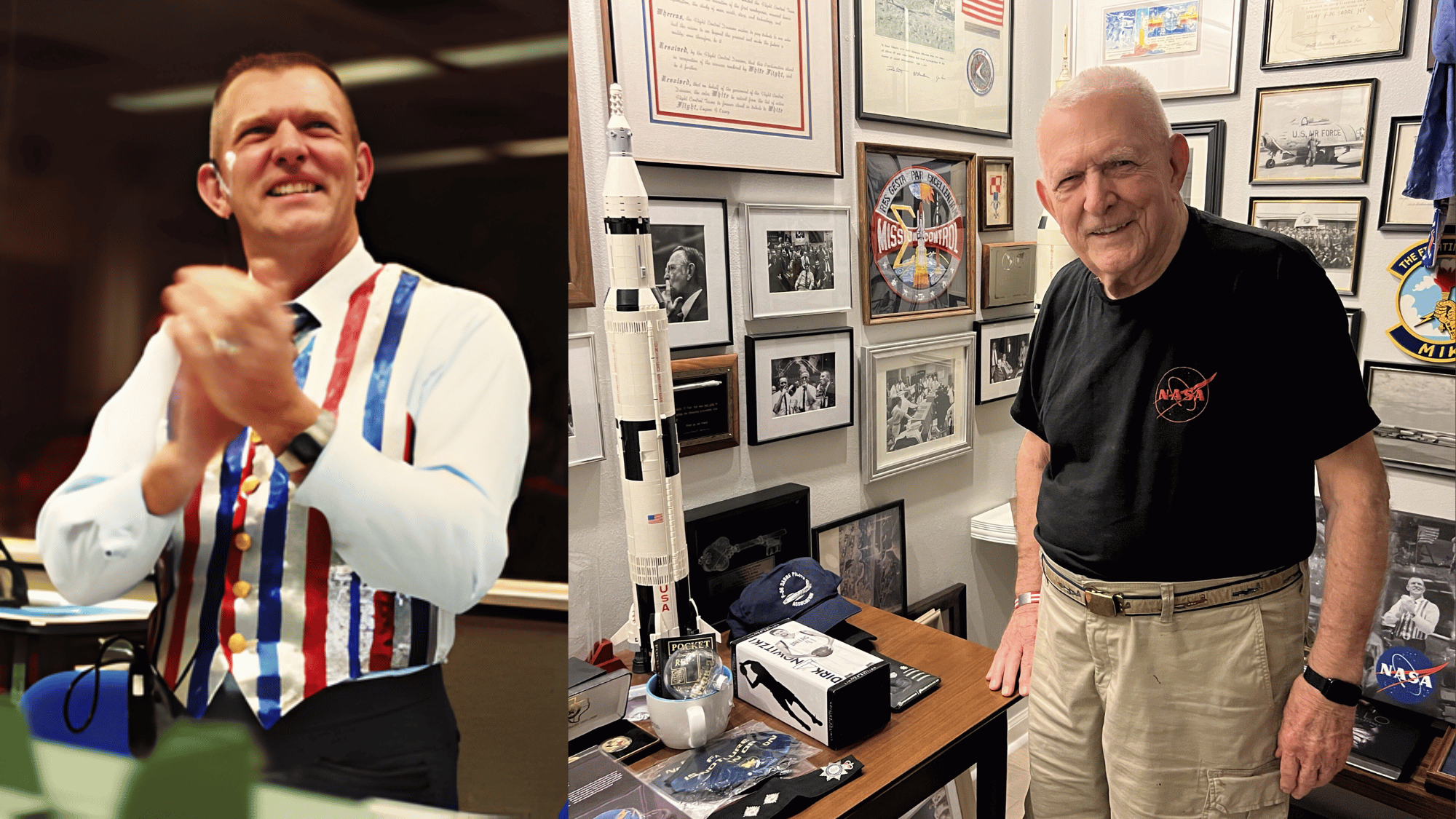
Gene Kranz built his reputation on more than technical skill. He created a leadership philosophy that became known throughout NASA as the “Kranz Dictum.”
After the Apollo fire killed three astronauts in 1967, Kranz gathered his team and delivered a speech that defined Mission Control’s culture forever.
He declared that from that moment forward, they would be “tough and competent,” never taking anything for granted.
His philosophy centered on three principles: discipline, morale, and competence. Teams had to master their systems completely. They had to trust each other absolutely. And they had to accept responsibility without excuses or blame.
This wasn’t a motivational talk. It was the foundation that saved Apollo 13 and countless other missions.
Awards and Honors Received by Gene Kranz
Gene Kranz’s contributions earned recognition from the highest levels of government, academia, and the aerospace community throughout his distinguished career.
- Presidential Medal of Freedom (1970): America’s highest civilian honor for his role in saving Apollo 13.
- NASA Distinguished Service Medal: Awarded multiple times for exceptional leadership during critical missions.
- Congressional Space Medal of Honor: Recognized for outstanding contributions to the nation’s space program.
- National Space Trophy: Honored by the Rotary National Award for Space Achievement Foundation.
- Inducted into the U.S. Astronaut Hall of Fame (2015): Rare honor for a non-astronaut.
- Honorary Doctorates: Multiple universities recognized his leadership and contributions to aerospace.
- • Arthur S. Flemming Award: Given for outstanding federal service during his early NASA career.
- • Aviation Week Laureate Award: Honored for lifetime achievements in aerospace.
- • Director’s Award from NASA: Internal recognition for building Mission Control’s operational excellence.
- • American Astronautical Society’s Space Flight Award: Acknowledged his role in advancing human spaceflight.
Gene Kranz’s Early Life, Education and Personal Life
Gene Kranz grew up in Toledo, Ohio, where his fascination with flight began early. His father’s work as a railroad engineer instilled a respect for precision and systems thinking.
He attended Parks College of Saint Louis University, earning a degree in aeronautical engineering in 1954. The Korean War interrupted his studies, and Kranz served as a fighter pilot in the Air Force Reserve.
After military service, he worked as a flight test engineer before joining NASA in 1960. His wife, Marta, became famous for sewing the vests he wore during missions, each one a different color for different flights.
Kranz raised six children while leading some of history’s most important space missions.
Books Written by Gene Kranz and His Legacy in Media
Gene Kranz shared his experiences through writing and became a prominent figure in documentaries and films about NASA’s historic missions.
| Media | Title/Role | Year | Description |
|---|---|---|---|
| Book | Failure Is Not an Option | 2000 | Autobiography covering his NASA career and Apollo missions |
| Film | Apollo 13 | 1995 | Ed Harris portrayed Kranz in Ron Howard’s acclaimed drama |
| Documentary | When We Left Earth | 2008 | Featured extensively in the Discovery Channel’s NASA history series |
| Documentary | Apollo 11 | 2019 | Appeared in archival footage from the historic moon landing |
| Documentary | Apollo 13: Survival | 2024 | Netflix documentary featuring Kranz’s firsthand account |
| Interviews | Various NASA Archives | Ongoing | Extensive oral histories preserved by NASA and the Smithsonian |
| Lectures | Speaking Engagements | 2000s-Present | Regular talks on leadership and space history nationwide |
| Consulting | Film and TV Projects | Various | Technical advisor for space-related productions |
Conclusion
Gene Kranz proved that heroes don’t always wear spacesuits. Sometimes they wear homemade vests and sit behind consoles, making calls that determine who lives and who dies.
His legacy isn’t measured in moon rocks or mission patches. It lives in every flight director who refuses to accept defeat, every engineer who works the problem until solutions appear, every leader who builds teams stronger than themselves.
The aerospace industry still teaches the Kranz Dictum decades later. His book remains required reading for those who lead under pressure. His methods saved Apollo 13, but his philosophy continues to save missions today.
Excellence never goes out of style. Neither does the standard Gene Kranz set for everyone who followed.