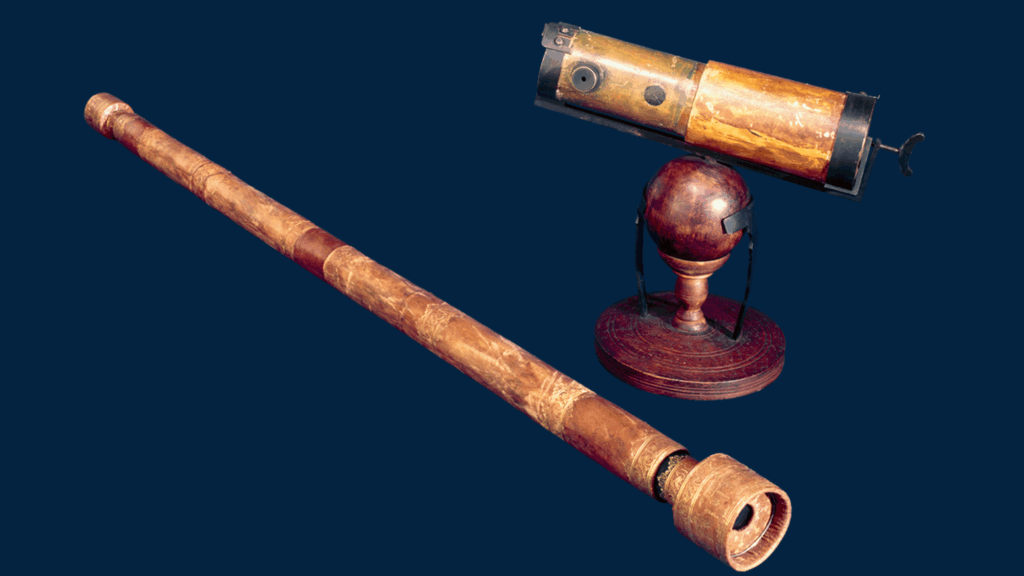
Looking up at the stars has always sparked wonder. But for centuries, people could only see what their eyes allowed. That changed when one man pointed a simple tube toward the heavens in 1609.
The results? Mind-blowing. Galileo Galilei didn’t invent the telescope, but he improved it. And when he turned it skyward, everything humanity thought about space got flipped upside down.
Suddenly, the universe wasn’t what the old books said it was.
This discovery didn’t just change astronomy. It challenged authority, sparked controversy, and laid the groundwork for modern science. Here’s how one device reshaped our understanding of everything above us.
What is Galileo’s Telescope?
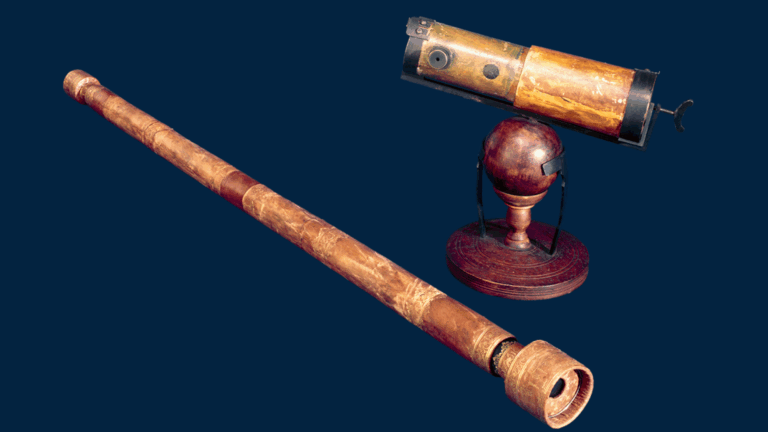
Galileo’s telescope was a refracting instrument that used glass lenses to magnify distant objects.
The earliest version he built in 1609 could magnify things about three times. Not satisfied, he kept improving it. Soon, he had one that could magnify up to 30 times.
The design was simple. A convex lens at one end gathered light, while a concave lens at the other end focused it for viewing.
This setup let him see details in the night sky that no human had ever witnessed before. It was revolutionary for its time.
Galileo Galilei Telescope Design and Features
Galileo’s telescope was surprisingly simple yet powerful. It used two lenses in a long tube to bring distant objects closer, revealing details never seen before.
Key Specifications:
- Magnification: Started at 3x in 1609, quickly improved to 8-20x, eventually reaching 30x.
- Tube Construction: Wooden or cardboard sections held together with copper wire, covered in paper.
- Objective Lens: Plano-convex design, 37-51 mm diameter, focal length 980-1400 mm.
- Eyepiece Lens: Concave diverging lens, 13-22 mm diameter, focal length around 160 mm.
- Dimensions: Approximately 60 cm long, 3.8 cm in diameter.
- Image Type: Produced upright images without needing prisms.
- Field of View: Narrow but adequate for observing celestial bodies.
- Portability: Handheld design, similar to opera glasses.
How Galileo Transformed the Telescope Into a Scientific Tool
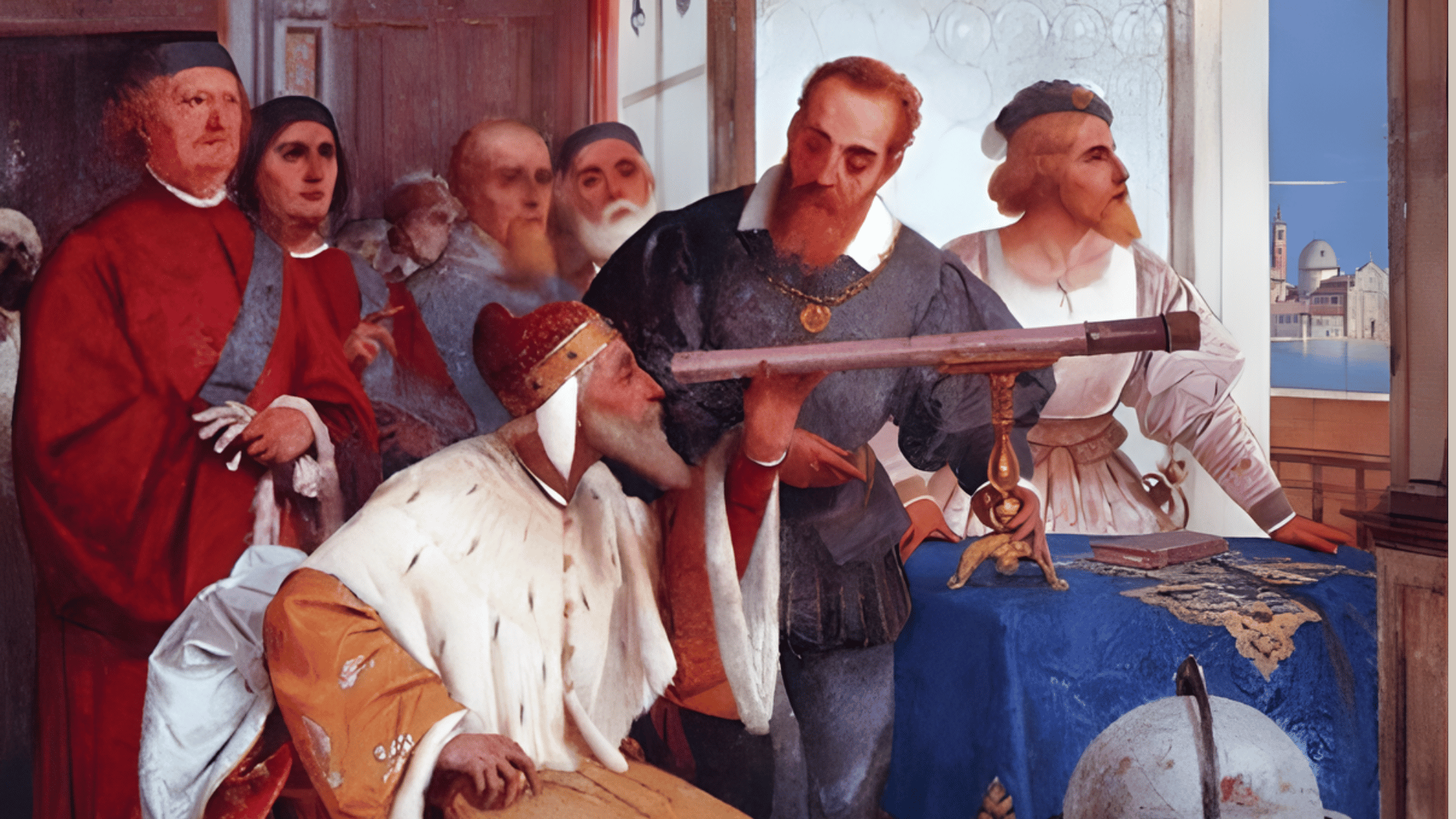
Image Source: Wikipedia
When Galileo first heard about the telescope in 1609, it was just a novelty item sold in markets. Merchants used it to spot ships at sea. But Galileo saw potential beyond commerce.
He immediately set to work improving the design. Better lenses, stronger magnification, steadier construction. Then came the brilliant move; he pointed it at the sky instead of the horizon. That decision changed everything.
Galileo didn’t just observe. He recorded, measured, and documented what he saw. He turned a simple viewing device into a precision instrument for scientific discovery.
Major Discoveries Made With Galileo’s Telescope
Between 1609 and 1610, Galileo made observations that shook the foundations of astronomy and challenged centuries of accepted beliefs.
1. Lunar Mountains and Craters
Galileo turned his telescope toward the Moon and saw something shocking. The surface wasn’t smooth and perfect as everyone believed.
Instead, he observed mountains, valleys, and craters casting shadows as sunlight hit them. This discovery proved celestial bodies weren’t flawless spheres.
The Moon had terrain, just like Earth, breaking down the idea that heavenly objects existed in a realm of perfection separate from our imperfect world.
2. Jupiter’s Galilean Moons
In January 1610, Galileo spotted four points of light near Jupiter. Night after night, they moved around the planet.
He’d discovered Io, Europa, Ganymede, and Callisto; Jupiter’s four largest moons. This was huge. It proved that not everything in the cosmos orbited Earth.
Here was a mini solar system right before his eyes, supporting the idea that planets could have their own satellites while orbiting something else.
3. Venus Phases
Watching Venus over time, Galileo noticed it went through phases just like the Moon: crescent, half, gibbous, and full. This observation was a game-changer.
It could only happen if Venus orbited the Sun, not Earth. The phases provided strong visual evidence for the Copernican model, showing Earth wasn’t the center of everything.
Critics couldn’t easily dismiss what the telescope clearly showed.
4. Milky Way Stars and More
Galileo pointed his telescope at the Milky Way’s hazy band and discovered it wasn’t a cloud or nebula. Instead, it contained countless individual stars too faint for the naked eye.
He also observed dark spots on the Sun that moved, indicating the Sun rotated.
Saturn appeared oddly shaped through his lens; it was later identified as having rings. Each discovery expanded humanity’s view of the universe’s complexity and vastness.
Why Galileo’s Telescope Discoveries Were Controversial
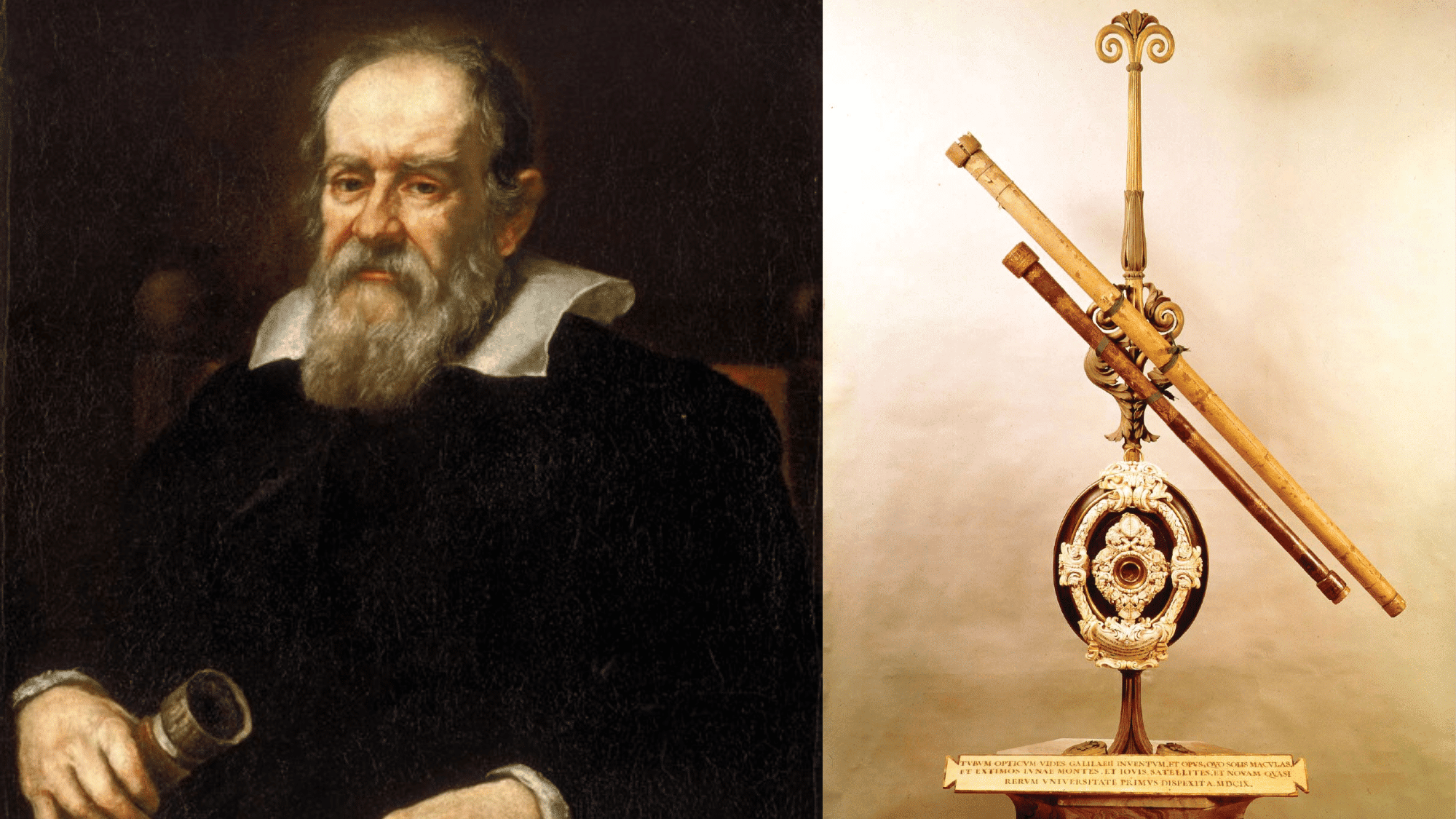
Galileo’s observations didn’t just change astronomy. They ignited one of history’s biggest clashes between science and religion.
For centuries, the Catholic Church taught that Earth sat at the center of the universe. This geocentric view aligned with certain biblical passages and the philosophy of Aristotle, which the Church had adopted.
When Galileo’s telescope revealed Jupiter’s moons and Venus’s phases, it provided hard evidence against this belief.
The problem wasn’t just scientific. It was political and theological. Galileo’s findings challenged the Church’s authority to interpret natural phenomena. If the Church was wrong about the cosmos, what else might it be wrong about?
In 1616, the Inquisition declared heliocentrism “foolish and absurd.” Galileo was warned to stop promoting it as fact. But he couldn’t stay quiet.
His 1632 book mocked geocentrists and landed him in serious trouble, leading to his famous trial and house arrest.
The Lasting Impact of Galileo Galilei’s Telescope on Astronomy Today
Galileo’s telescope didn’t just reveal new celestial objects. It fundamentally changed how humanity studies the universe and our place in it.
- Birth of Observational Astronomy: Galileo established the practice of using instruments to observe, measure, and document celestial phenomena systematically. This shifted astronomy from philosophical speculation to empirical science based on verifiable evidence.
- Validation of the Scientific Method: His approach of forming hypotheses, gathering observational data, and drawing conclusions became the foundation for modern scientific inquiry. Astronomy transformed into a field driven by observation rather than ancient authority.
- Technological Evolution: Galileo’s improvements sparked centuries of telescope advancement. From his simple refractor to today’s massive space telescopes like Hubble and James Webb, the principle remains: better optics reveal deeper cosmic truths.
- Challenged Human Perspective: His discoveries dethroned Earth from the cosmic center, fundamentally altering humanity’s self-perception. This shift paved the way for understanding our true position as one planet among billions in a vast universe.
- Inspired Future Generations: Galileo proved that curiosity combined with technology could unlock nature’s secrets. His legacy inspired countless astronomers, physicists, and scientists to question, explore, and push boundaries, shaping centuries of discovery that followed.
To Conclude
Galileo didn’t set out to start a revolution. He just wanted to see what was really up there. But that simple curiosity changed everything.
His telescope proved that questioning accepted truths wasn’t just acceptable; it was necessary.
Today, every space mission, every astronomical breakthrough, every image from distant galaxies traces back to that moment in 1609.
His story reminds us that progress often comes from challenging what everyone believes is settled. Sometimes, all it takes is to point your lens in a different direction and dare to report what you actually see.