
Most people have heard the word “wormhole” in a sci-fi movie. But very few know it has real science behind it.
Back in 1935, Albert Einstein and Nathan Rosen put forward something that changed physics forever. They described a strange “bridge” connecting two separate points in space. No teleportation. No magic. Just math.
And yet, scientists are still not sure what it all means. Could this bridge actually work? Can anything pass through it? The answers are far stranger than most people expect.
This blog breaks down what the Einstein-Rosen Bridge really is and how it connects to the idea of wormholes.
What is an Einstein-Rosen Bridge?
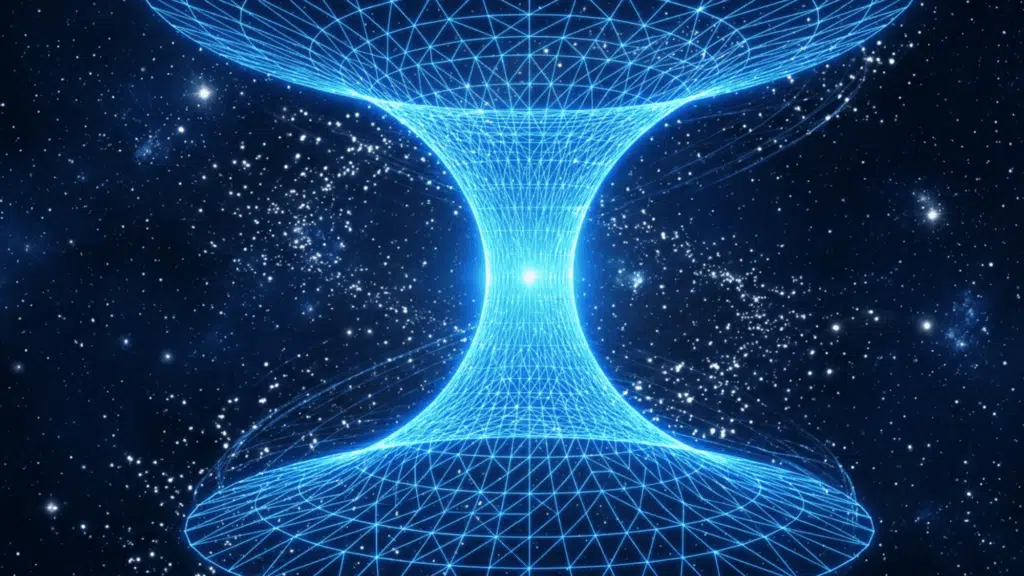
An Einstein-Rosen Bridge is a theoretical tunnel connecting two distant points in spacetime.
Think of it like a shortcut through the universe. It comes from Albert Einstein’s equations of general relativity, specifically the Schwarzschild metric used for non-rotating black holes.
Two separate regions of spacetime are linked through what scientists call a “throat.” This makes it the earliest known model of what people now call a wormhole.
But this is purely theoretical. No one has ever observed one. And as the math shows, passing through it is not actually possible.
The Origins of the Einstein-Rosen Bridge Theory
In 1935, Albert Einstein and physicist Nathan Rosen were working on a major problem in physics. Black hole solutions at the time had a frustrating flaw: a point singularity that broke down the math entirely.
So, the two physicists tried something bold. They used coordinate transformations to reinterpret that singularity as a “bridge” connecting two separate universes.
The term “wormhole” did not exist yet.
It only came into use decades later, between the 1950s and 1980s, as other physicists started building on this idea and looking for versions that could actually be crossed.
Understanding Wormholes and Their Connection to Einstein-Rosen Bridges
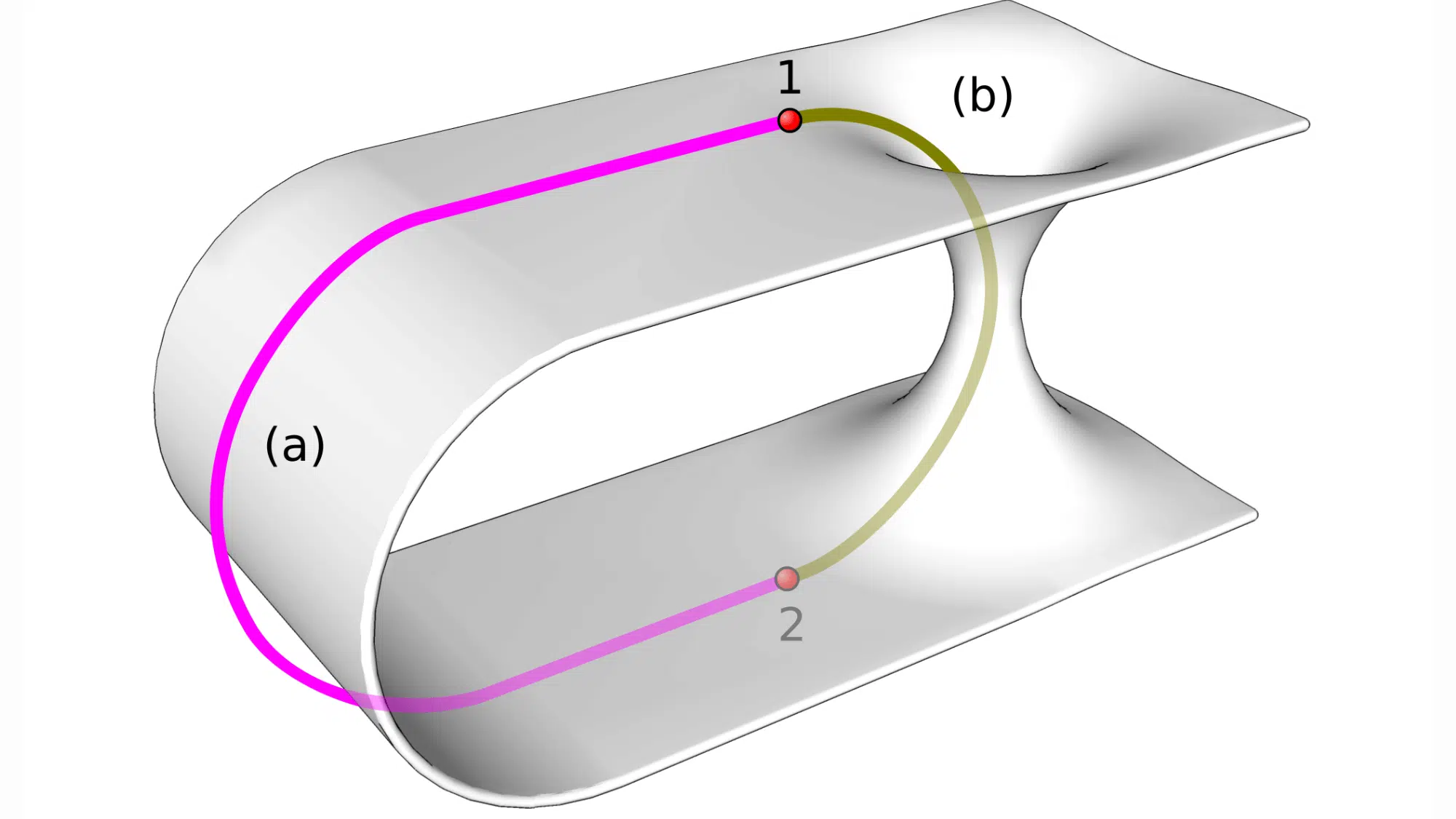
Image Source: Wikipedia
Wormholes sound like pure science fiction. But their roots go back to real physics, and it all starts with Einstein.
What is a Wormhole in Physics?
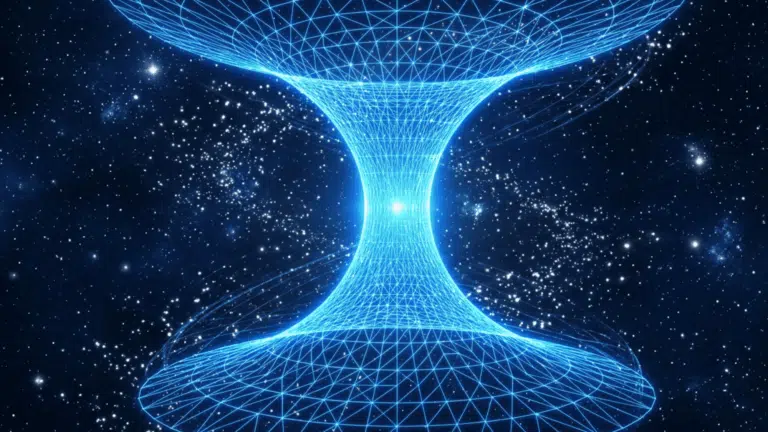
A wormhole is a theoretical tunnel that connects two separate points in spacetime. It acts like a shortcut through the universe.
Scientists describe it as a structure that folds space, bringing two distant regions closer together.
No confirmed wormhole has ever been spotted, but the math behind general relativity does allow for their existence.
How an Einstein-Rosen Bridge Became the First Wormhole Model
The Einstein-Rosen Bridge was the first structure in physics to describe a spacetime tunnel. Einstein and Rosen reinterpreted black hole geometry and found a “throat” linking two flat regions of spacetime.
This made it the original wormhole model. Later physicists borrowed this idea and expanded it into broader wormhole theories.
Einstein-Rosen Bridge vs Wormhole: Are They the Same?
In popular culture, these two terms are often used interchangeably. But they are not exactly the same thing. The Einstein-Rosen Bridge is one specific type, non-traversable and tied to black hole geometry.
Modern wormholes are a broader concept, and some theoretical versions may even allow matter to pass through.
How an Einstein-Rosen Bridge Works
Picture two sheets of paper stacked on top of each other.
Now punch a hole through both and connect them with a tube. That tube is basically what an Einstein-Rosen Bridge looks like in theory.
It works by extending the geometry of a Schwarzschild black hole. At the centre, instead of a dead-end singularity, the math reveals a throat; a minimal surface linking two separate exteriors of spacetime.
Scientists use Penrose diagrams to map this out visually. These diagrams show how two regions share the same horizon.
Particles could theoretically travel along these paths, but the bridge collapses too fast for anything to get through.
Why Einstein-Rosen Bridges are Not Traversable
The throat of an Einstein-Rosen Bridge collapses at an incredibly fast rate.
So fast, in fact, that even light cannot make it through in time. There is simply no way to cross before the structure pinches itself shut.
The original vacuum solution has no exotic matter holding it open. This means the energy conditions required for stable passage are completely violated.
On top of that, quantum effects and gravitational instability make traversal physically impossible. The bridge exists in the math, but nature seems to allow nothing through.
Types of Wormholes Proposed After the Einstein-Rosen Bridge
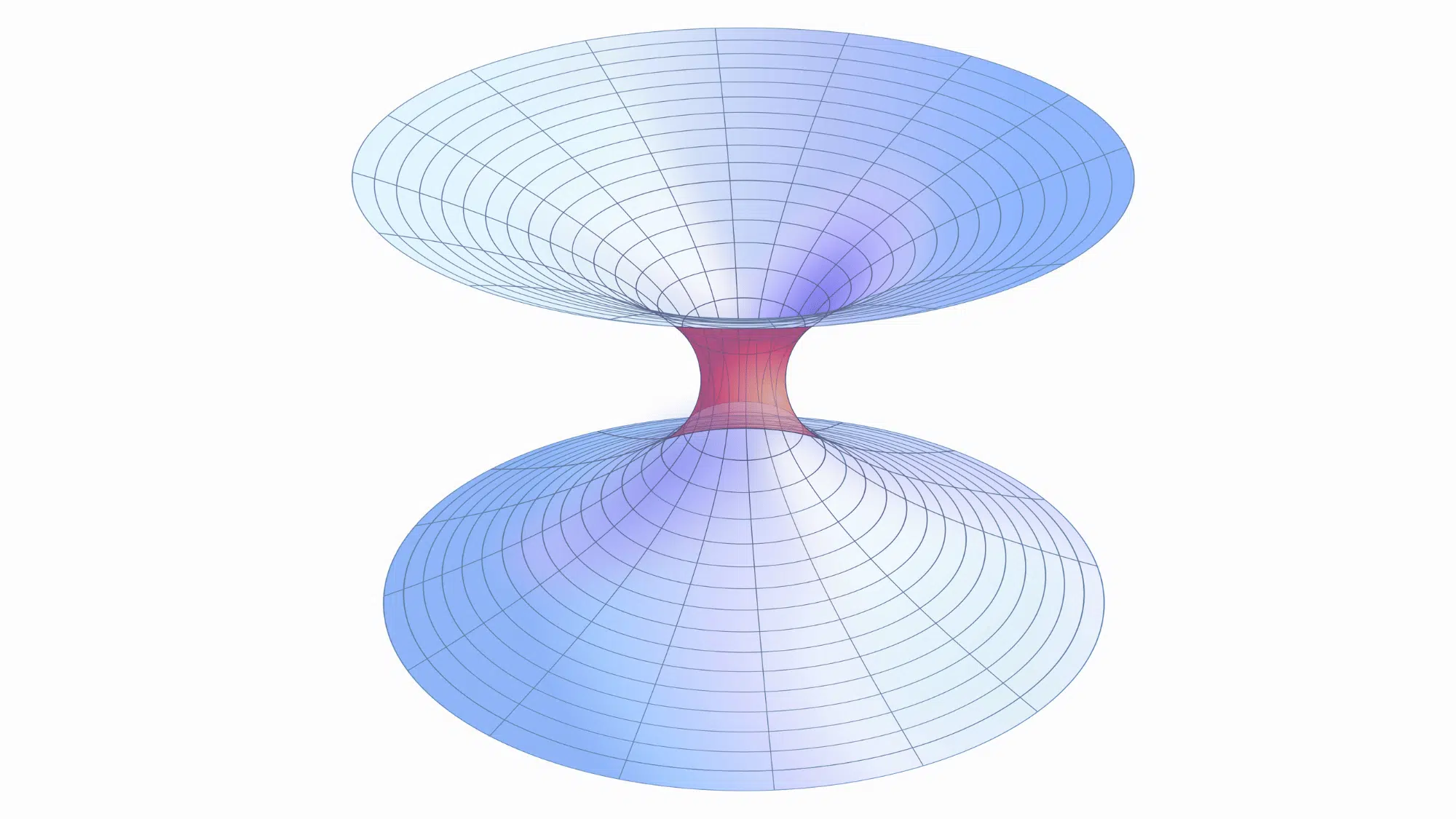
Image Source: Wikipedia
The Einstein-Rosen Bridge was just the beginning. Over the decades, physicists proposed several other wormhole types worth knowing about.
1. Traversable Wormholes
Physicist Kip Thorne proposed this type, which requires negative-energy exotic matter to stay open. Unlike the Einstein-Rosen Bridge, these wormholes could theoretically allow matter to pass through.
They became a popular subject in both scientific research and science fiction, offering the first real possibility of a crossable spacetime tunnel.
2. Lorentzian Wormholes
These wormholes exist within the fabric of spacetime itself, often linked to the concept of spacetime foam. They are theoretical structures that appear at incredibly small scales.
Scientists study them to better understand how space and time behave at the quantum level, making them a key area of modern physics research.
3. Euclidean Wormholes
Euclidean wormholes operate in a different mathematical framework altogether. Instead of regular spacetime, they exist in what is called imaginary time.
Physicists use them primarily in quantum gravity calculations. They are not physical tunnels in the traditional sense but serve as useful tools for understanding deep connections between quantum mechanics and gravity.
4. Intra-Universe Wormholes
These connect two distant points within the same universe rather than linking separate ones. They appear frequently in science fiction as two-way portals.
Unlike the one-way Schwarzschild variant, intra-universe wormholes allow travel in both directions, at least in theory. No physical evidence supports their existence yet.
Einstein-Rosen Bridges in Modern Physics Research
The Einstein-Rosen Bridge never left the conversation. Modern physicists keep returning to it.
- ER=EPR Conjecture: This theory links Einstein-Rosen Bridges directly to quantum entanglement, suggesting wormhole connectivity and entangled particles may be the same phenomenon.
- Quantum Gravity Studies: Researchers use ER bridge models to better understand how gravity behaves at the quantum level, especially near black hole interiors.
- Time Reversal at Horizons: Recent studies for 2025-2026 examine how time reversal works at black hole horizons, using Einstein-Rosen Bridge geometry as a key reference point.
- Black Hole Interior Modelling: Scientists model what happens inside black holes using ER bridge mathematics, helping build a clearer picture of spacetime structure beyond the horizon.
- Cosmic Microwave Background Research: Some researchers explore whether Einstein-Rosen Bridge activity leaves any trace in cosmic microwave background data, thereby connecting early-universe physics to wormhole theory.
- Spacetime Emergence: Modern research investigates whether spacetime itself emerges from wormhole-like connections at the quantum scale, making ER bridges central to this ongoing debate.
Could Einstein-Rosen Bridges Ever Be Real?
Honestly, the odds are not great, at least not with what science currently knows.
No observational evidence of an Einstein-Rosen Bridge has ever been found. Making one work at a large scale would require exotic matter and quantum gravity effects that remain completely unproven.
Most physicists agree that macroscopic versions would break fundamental laws of physics as they stand today.
Some researchers do suggest that microscopic versions might exist within spacetime foam, possibly even playing a role in dark energy.
Others propose that these bridges reflect a deeper time duality rather than functioning as physical portals.
Key Differences Between Black Holes, Wormholes, and Einstein-Rosen Bridges
Black holes, wormholes, and Einstein-Rosen Bridges often get mixed up. Here is a clear breakdown of how they differ.
| Feature | Black Hole | Wormhole | Einstein-Rosen Bridge |
|---|---|---|---|
| Structure | One-way event horizon leading to a singularity | Two-way tunnel connecting distant points | Non-traversable extension of a black hole |
| Traversability | No, crushes all matter | Possible with exotic matter | No; collapses before anything passes |
| Topology | Ends at the singularity | Connects two separate regions | Links two flat spacetimes via a throat |
| Exotic Matter Needed | No | Yes | No |
| Observational Evidence | Yes, directly imaged | None | Purely theoretical |
Conclusion
The Einstein-Rosen Bridge sits at a rare crossroads where hard mathematics meets the biggest questions about the universe. It shapes conversations around quantum gravity, black hole interiors, and even the nature of spacetime itself.
Traversable? No. Observable? Not yet. But irrelevant? Far from it.
Every major wormhole theory that came after traces back to this single 1935 idea. That alone says something about how powerful the concept really is.
For anyone curious about where physics is headed next, keeping an eye on Einstein-Rosen Bridge research might just be worth the time.