
Space measurements can feel overwhelming. When astronomers talk about distances between stars and galaxies, they use terms that sound foreign to most people. One word that often pops up is “parsec.”
But what exactly does it mean? And why do scientists prefer it over familiar units like miles or kilometers?
The universe is vast beyond imagination, so regular measurement systems simply don’t cut it. That’s where the parsec comes in.
This unit helps make sense of cosmic distances that would otherwise be impossible to grasp. Understanding it opens up a whole new way of thinking about space and how we measure the great beyond.
What is a Parsec?
A parsec is a unit of measurement used in astronomy to calculate vast distances in space.
The term itself is short for “parallax of one arcsecond.” It might sound complex, but it’s actually based on a simple geometric concept.
Astronomers use it because traditional units like miles or kilometers become too cumbersome when dealing with stellar distances. One parsec equals approximately 3.26 light-years or about 19 trillion miles. That’s an enormous distance by Earth standards.
This measurement helps scientists communicate more efficiently about cosmic scales. Instead of writing out numbers with countless zeros, they can use parsecs to keep things manageable and clear.
How is a Parsec Calculated
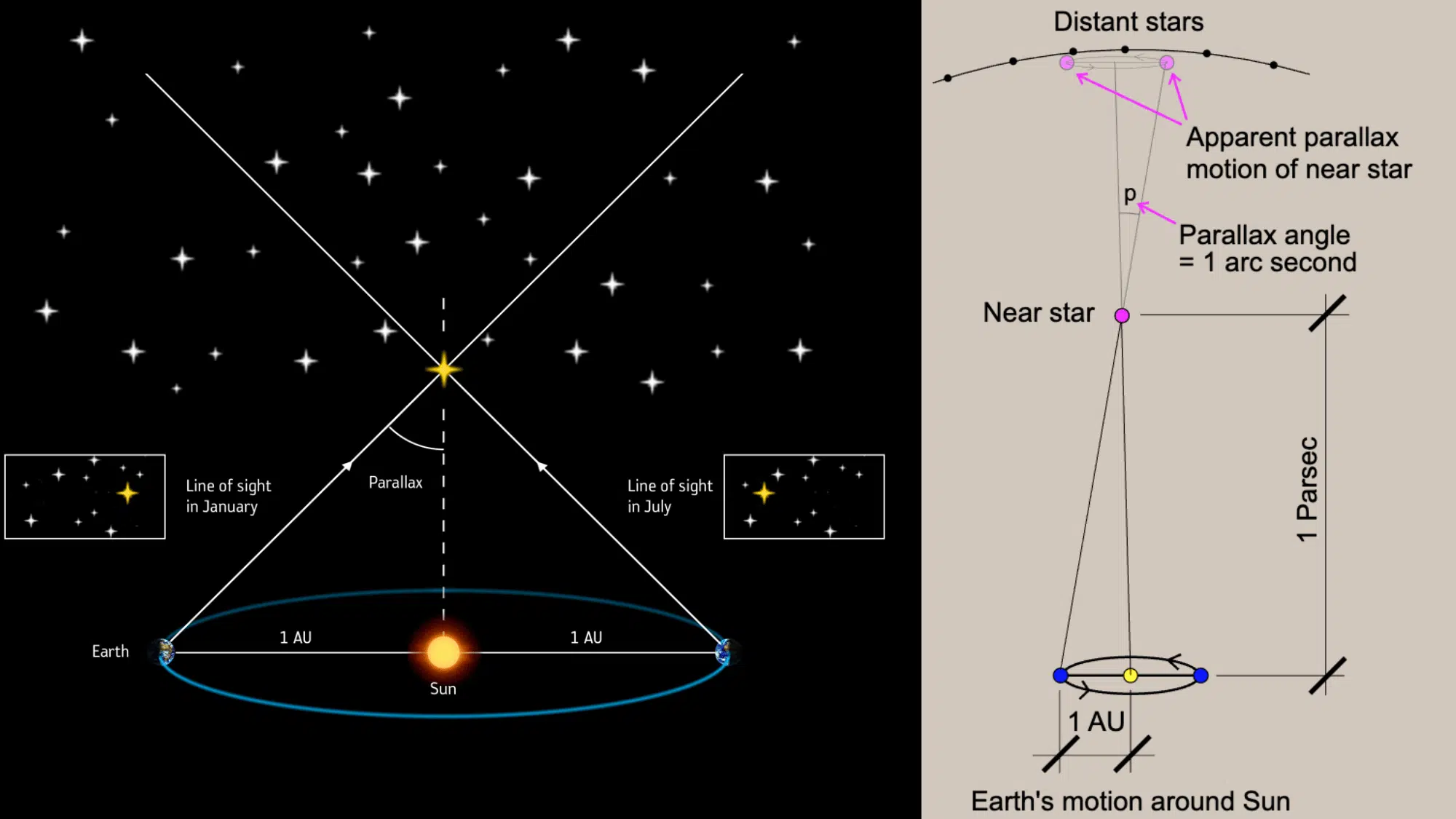
Calculating a parsec involves measuring stellar parallax, the apparent shift of a star’s position as Earth moves around the Sun.
The Parallax Method in Astronomy
The parallax method measures distances to nearby stars by exploiting Earth’s orbit around the Sun, providing a baseline for triangulation. It’s considered the gold standard for the first rung of the cosmic distance ladder, yielding parsecs directly from observations.
How It Works:
Earth’s two opposite orbital positions, taken six months apart, create a baseline of approximately 2 AU (about 300 million kilometers).
A nearby star appears to shift against distant, fixed background stars, forming a small ellipse on the sky. The parallax angle p is half that shift; the angle at the star subtended by 1 AU.
Limitations
Ground-based telescopes struggle with angles smaller than 0.01 arcseconds due to atmospheric distortion. This limits reliable measurements to stars within about 100 parsecs.
Space telescopes like Gaia have pushed this boundary, measuring parallax for stars over 10,000 parsecs away with unprecedented precision.
Beyond these distances, astronomers must rely on other methods, such as standard candles and redshift measurements.
Parsec Formula
Astronomers measure the parallax angle (in arcseconds) from observations six months apart. This forms a skinny triangle with a baseline of 2 AU, Earth’s full orbital diameter.
For small angles, a simple formula applies:
d = 1/p
Where d is the distance in parsecs, and p is the parallax angle.
Example: If p = 0.5 arcseconds, then d = 1/0.5 = 2 parsecs (approximately 6.52 light-years).
Exact Derivation:
1 parsec = 1 AU / tan(1”) ≈ 206,265 AU
Since 1 radian equals 206,265 arcseconds (from 360° × 3600 / 2π), this yields approximately 3.086 × 10¹⁶ meters or 3.26 light-years. No complex functions needed for the 1/p rule due to small-angle approximation.
How Big is a Parsec in Real Space Examples
To truly grasp a parsec’s size, comparing it to familiar cosmic landmarks helps put this astronomical distance into perspective.
- Solar System: Voyager 1, the farthest human-made object, is approximately 0.0013 parsecs away after 48 years of travel. That’s just 0.000001% of 1 parsec. Traversing a full parsec at current speeds would take around 75,000 years.
- Nearest Stars: Proxima Centauri, the closest star to our Sun, is 1.3 parsecs away. The Alpha Centauri system sits at roughly 1.34 parsecs. A dime held at arm’s length subtends about 1/20,000th the angle of Proxima’s 0.77 arcsecond parallax.
- Local Neighborhood: Most stars visible to the naked eye lie within 10 to 1,000 parsecs. Sirius sits at 2.64 parsecs, while Betelgeuse is approximately 197 parsecs or 640 light-years away.
- Milky Way Scale: The galactic center is roughly 8,200 parsecs from Earth. Our entire galactic disk stretches about 50,000 parsecs across. Even the Oort Cloud at the outer Solar System edge spans about 0.6 parsecs in diameter.
Why Do Astronomers Use Parsecs Instead of Light-Years
Light-years might seem more intuitive to the general public, but parsecs offer astronomers a more practical tool for their work. The reason comes down to how distances are actually measured in space.
Parsecs connect directly to the observational method astronomers use.
When they measure stellar parallax, the math becomes incredibly straightforward with parsecs. The distance in parsecs is simply the inverse of the parallax angle in arcseconds.
Light-years, on the other hand, require extra conversion steps. They’re great for public communication, but Parsecs streamline professional astronomical calculations and keep the measurement process efficient and direct.
Parsec vs Light-Year vs Astronomical Unit
Different cosmic distances require different units. Astronomers switch between astronomical units, light-years, and parsecs depending on what they’re measuring and the scale involved.
| Unit | km (trillions) | Light-Years | Typical Use | Example |
|---|---|---|---|---|
| 1 AU | 0.00015 | ~0.00000001 | Solar System | Jupiter: 5.2 AU |
| 1 ly | 9.46 | 1 | Interstellar | Proxima Centauri: 4.24 ly |
| 1 pc | 30.9 | 3.26 | Stellar/Galactic | Betelgeuse: ~197 pc (~640 ly) |
Larger Units: Kiloparsec and Megaparsec
When measuring entire galaxies and beyond, even parsecs become too small. That’s where kiloparsecs and megaparsecs come into play.
1. Kiloparsec (kpc): 1,000 parsecs (pc), which equals approximately 3,260 light-years. Astronomers use this for intergalactic distances, like spiral arms or star clusters.
2. Megaparsec (Mpc): 1 million parsecs, which equals approximately 3.26 million light-years. This becomes the standard for intergalactic voids, galaxy clusters, and Hubble’s law measurements.
Scale Comparison:
| Unit | Parsecs | Light-Years | Milky Way Example |
|---|---|---|---|
| 1 kpc | 1,000 | 3,260 | Distance to galactic center (~8 kpc) |
| 1 Mpc | 1,000,000 | 3.26 million | Andromeda Galaxy (~0.76 Mpc or 765 kpc) |
The Milky Way’s diameter spans roughly 30 kiloparsecs. The Local Group stretches about 1 megaparsec across.
The Virgo Cluster sits approximately 16 megaparsecs away. Gigaparsecs (Gpc), meaning billions of parsecs, measure observable universe structures with a radius of about 14 gigaparsecs.
Conclusion
Parsecs is a practical tool born from how astronomers actually observe the universe. From the simple 1/p formula to kiloparsecs spanning galaxies, parsecs bridge human observation and cosmic reality.
Next time someone mentions a star being “X parsecs away,” that number carries real meaning.
It represents actual parallax measurements, geometric calculations, and humanity’s clever methods for mapping an incomprehensibly large universe. Space no longer feels quite so abstract.
The parsec proves that even the most distant corners of space can be measured, understood, and expressed in ways that connect directly to observable phenomena right here on Earth.