
Space is full of surprises. Most people know about the eight planets, maybe a few moons. But far beyond Neptune, the solar system keeps going and things get strange out there.
The Kuiper Belt and Oort Cloud sit at the very edge of our cosmic neighborhood.
They are cold, distant, and easy to overlook. Yet they hold some of the oldest material in the solar system.
What exactly are these regions? How far do they stretch? And why do scientists care so much about two places no spacecraft has ever fully reached? The answers are worth knowing.
What is the Kuiper Belt?
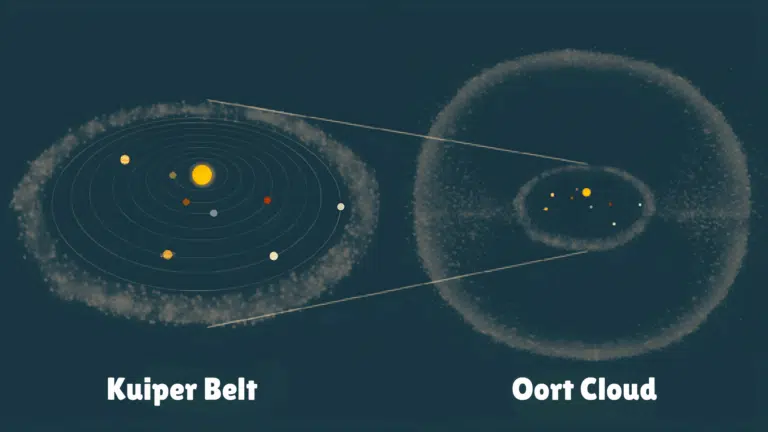
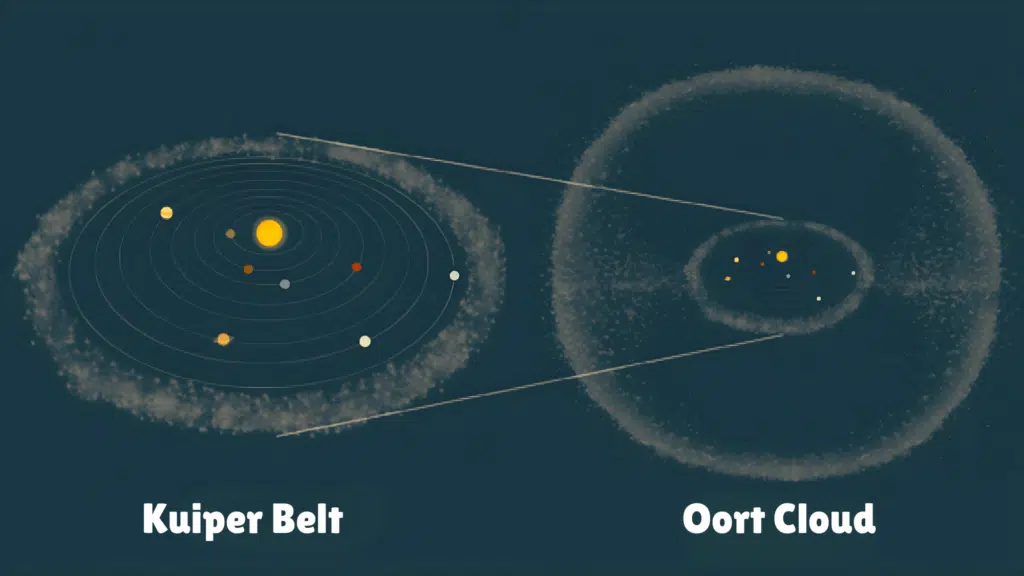
The Kuiper Belt is a wide ring of icy objects sitting just beyond Neptune’s orbit.
It starts at around 30 AU from the Sun and stretches out to about 50 AU. Think of it like an asteroid belt, but much larger and made mostly of ice rather than rock.
This region holds dwarf planets like Pluto, along with countless smaller frozen bodies. These objects are made up of frozen water, methane, and ammonia.
Scientists believe the Kuiper Belt contains hundreds of thousands of icy bodies larger than 100 kilometers. It is one of the largest structures in the entire solar system.
What is the Oort Cloud?
The Oort Cloud is the solar system’s outermost region. It is a massive, spherical shell of icy bodies that surrounds the entire solar system.
Starting at around 2,000 AU from the Sun, it stretches out to nearly 100,000 AU or even farther.
No spacecraft has ever reached it. No telescope has directly spotted it either. Scientists know it exists because of the long-period comets that travel inward toward the Sun. These comets trace back to this distant, frozen shell.
The Oort Cloud holds trillions of icy objects, quietly drifting at the very edge of the Sun’s gravitational reach.
Kuiper Belt and Oort Cloud: Key Differences Explained
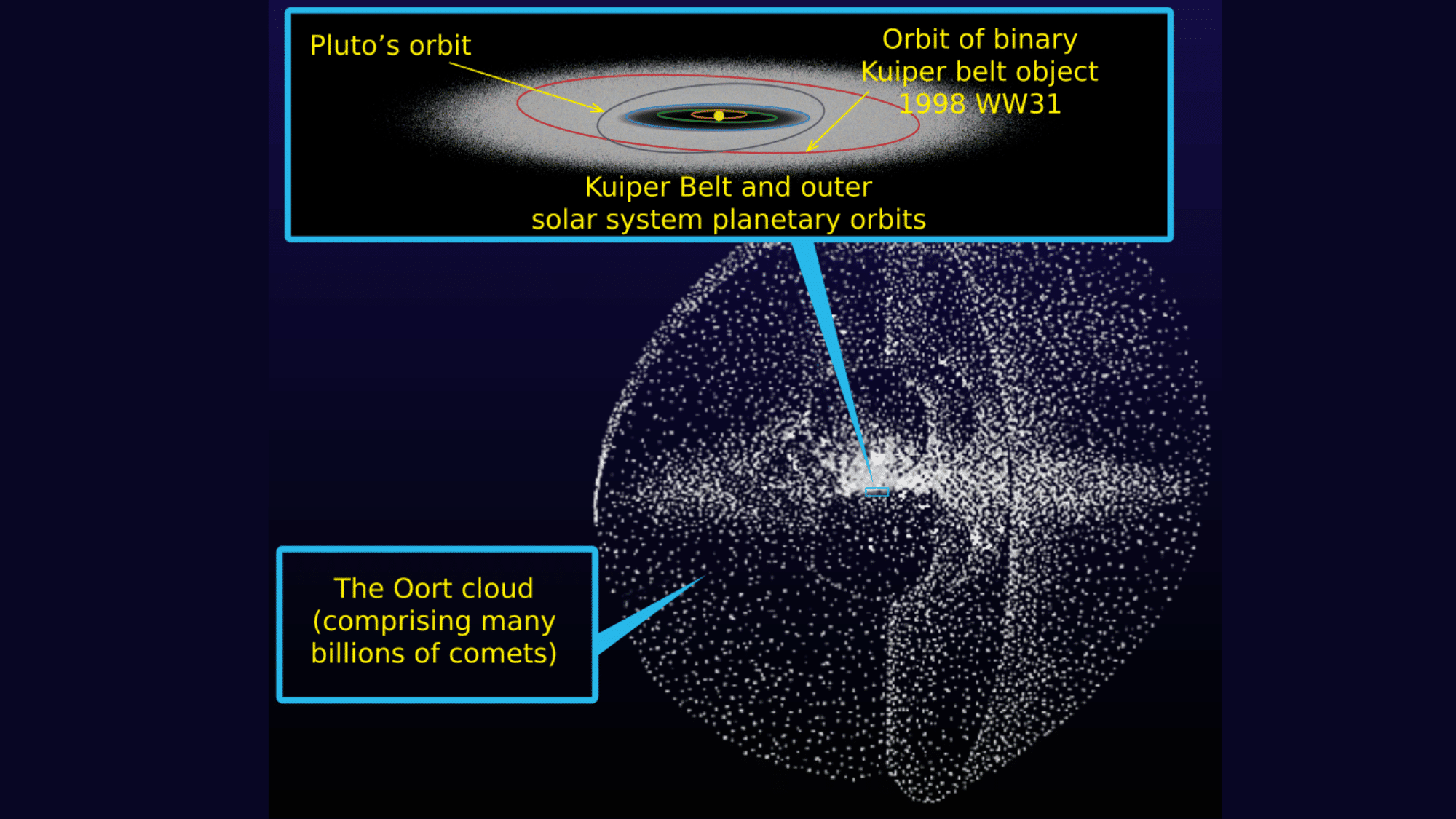
Image Source: Wikipedia
The Kuiper Belt and Oort Cloud are both icy regions, but they differ greatly in location, structure, and the roles they play.
1. Location and Distance from the Sun
The Kuiper Belt sits relatively close, spanning 30 to 50 AU from the Sun. The Oort Cloud begins where the Kuiper Belt ends and stretches up to 100,000 AU. That gap is enormous.
The Kuiper Belt is close enough for telescopes to spot its larger objects directly. The Oort Cloud, on the other hand, sits so far out that no instrument has ever observed it directly.
2. Shape and Structure
The Kuiper Belt forms a flat, disk-like ring aligned with the planetary orbits. It is denser and more organized. The Oort Cloud takes a completely different form a vast, hollow sphere surrounding the entire solar system.
It is thin and spread out, with loosely bound objects that can be easily pulled away by passing stars or other gravitational forces from nearby space.
3. Types of Objects
The Kuiper Belt contains dwarf planets like Pluto and Haumea, along with rocky-icy bodies and short-period comets.
These objects tend to be larger and more varied. The Oort Cloud mostly holds small, icy comet nuclei. It lacks the larger bodies found in the Kuiper Belt.
Both regions preserve frozen material left over from the solar system’s earliest days.
4. Origin of Comets
Short-period comets, those completing an orbit in under 200 years, come from the Kuiper Belt.
Halley’s Comet is a well-known example. Long-period comets, taking over 200 years to complete one orbit, originate from the Oort Cloud. These comets get nudged inward by distant gravitational forces.
Both regions essentially act as comet reservoirs, feeding the inner solar system over billions of years.
5. Formation History
Both regions formed from the same primordial solar nebula about 4.6 billion years ago. Material that stayed near the flat disk plane became the Kuiper Belt.
Objects flung outward by the gravity of giant planets like Jupiter and Neptune formed the Oort Cloud.
Each region reflects a different chapter of the same formation story, shaped by where objects ended up after the early solar system settled.
Similarities Between the Kuiper Belt and Oort Cloud
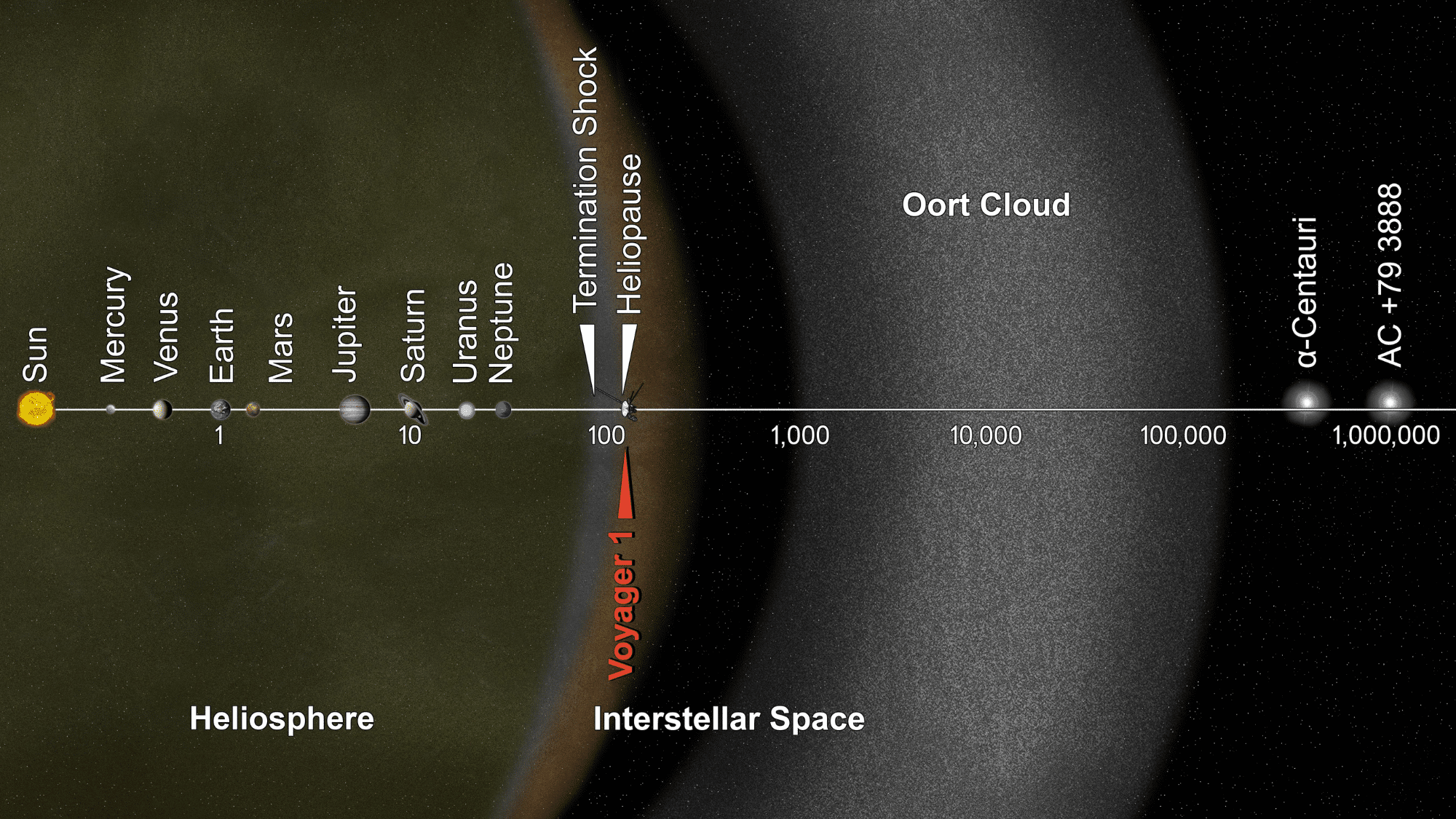
Image Source: Wikipedia
The Kuiper Belt and Oort Cloud are very different in many ways, but they share more common ground than most people realize.
- Icy Composition: Both regions contain objects made of frozen water, methane, and ammonia mixed with rock and dust. This icy makeup makes them time capsules of the early solar system, preserving material that has barely changed in over 4 billion years.
- Comet Sources: Both regions serve as reservoirs for comets. The Kuiper Belt sends short-period comets toward the inner solar system, while the Oort Cloud supplies long-period ones. Without these two regions, far fewer comets would ever reach the inner planets.
- Leftover Planetesimals: Both are made up of planetesimals, small building blocks that never grew into full planets. These leftover pieces give scientists a rare look at what the early solar system was made of before the planets formed.
- Part of the Same Solar System: Despite the huge distance between them, both regions fall within the Sun’s gravitational influence. They are connected parts of the same solar system, just occupying very different corners of it.
- Scientific Importance: Both regions help scientists piece together how the solar system formed and evolved. Studying objects from either region gives clues about conditions that existed billions of years ago, long before Earth took its current shape.
How the Kuiper Belt and Oort Cloud Formed
About 4.6 billion years ago, the solar system was nothing more than a spinning cloud of gas and dust.
Over time, gravity pulled this material together. The Sun formed at the center, and the remaining debris began clumping into planets, moons, and smaller bodies.
Not everything became a planet, though. Countless icy chunks were left behind. Some stayed close to the flat disk of the solar system and formed the Kuiper Belt.
Others were not so lucky. Giant planets like Jupiter and Neptune flung enormous amounts of icy material outward through gravitational interactions. These ejected objects drifted far beyond the planets and slowly settled into the vast spherical shell known as the Oort Cloud.
Both regions are essentially leftovers from the solar system’s building process. They never got the chance to come together into something larger.
Instead, they stayed frozen in place, largely untouched, making them some of the oldest and most well-preserved material anywhere in the solar system
Are the Kuiper Belt and Oort Cloud the Edge of the Solar System?
This is a question that does not have a simple answer. The Kuiper Belt sits at a comfortable distance, ending around 50 AU from the Sun.
For a long time, scientists considered it the outer boundary of the known solar system. Then came the Oort Cloud, stretching nearly 100,000 AU out into space.
Most scientists today consider the Oort Cloud’s outer edge to be the true boundary of the solar system. Beyond that point, the Sun’s gravity becomes too weak to hold objects in place. That is where interstellar space effectively begins.
Recent data even suggests the Kuiper Belt may extend farther than originally thought, pushing the boundaries even further.
To Conclude
The solar system does not end at Neptune. It keeps going, through vast belts of ice and frozen debris, all the way to the outermost edges of the Sun’s gravitational reach.
The Kuiper Belt and Oort Cloud are more than just distant, frozen regions. They are records of how the solar system came to be.
Every comet that streaks across the night sky traces back to one of these two places.
Scientists are still learning about both regions. New missions and better technology continue to reveal fresh details. The outer solar system has plenty more to share, and the story is far from over.