
Each morning begins with light. By evening, darkness settles in. This steady shift between brightness and shadow shapes life on Earth in quiet but powerful ways.
The day and night cycle feels simple because it happens without pause. Every 24 hours, the pattern repeats with remarkable precision. Yet behind this familiar change lies a clear scientific process driven by Earth’s motion in space.
To understand why daylight turns into night, it is important to consider how our planet orbits the sun. The explanation is grounded in basic physics and astronomy, and it reveals how a single motion creates this daily cycle.
The Cause of the Day–Night Cycle
The day and night cycle is caused by Earth’s rotation on its axis. Earth is constantly spinning, even though this motion is not directly felt. As the planet rotates, different parts of its surface move into and out of sunlight.
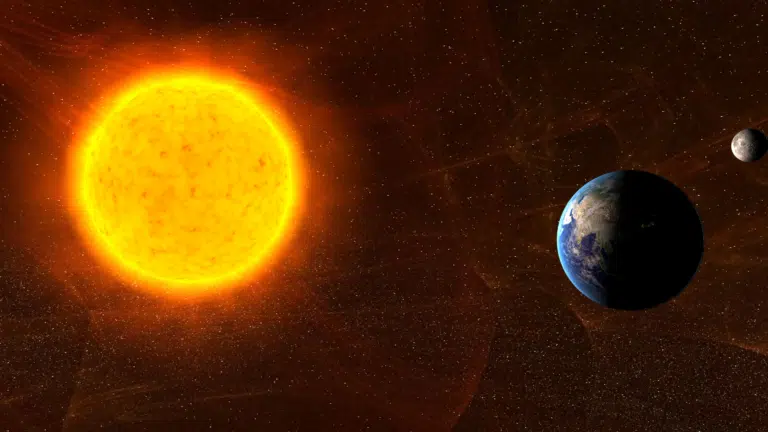
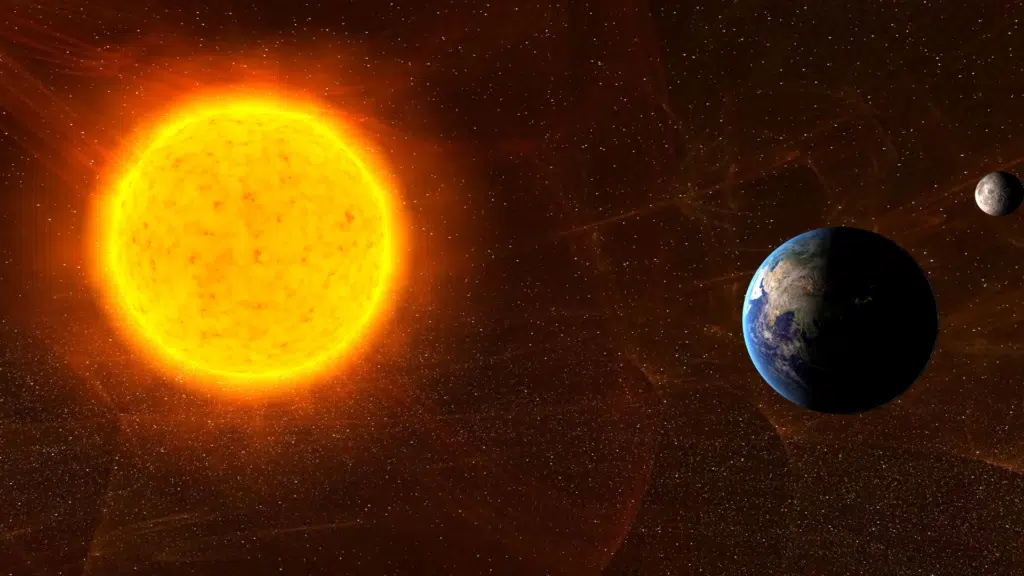
The hemisphere facing the Sun experiences daylight, while the hemisphere turned away from the Sun experiences darkness. This steady rotation produces the regular alternation between day and night every 24 hours.
The process is continuous and predictable because Earth’s rotation is stable. Without this rotation, the pattern of daily light and darkness would not exist.
How Earth’s Motion Creates the Cycle
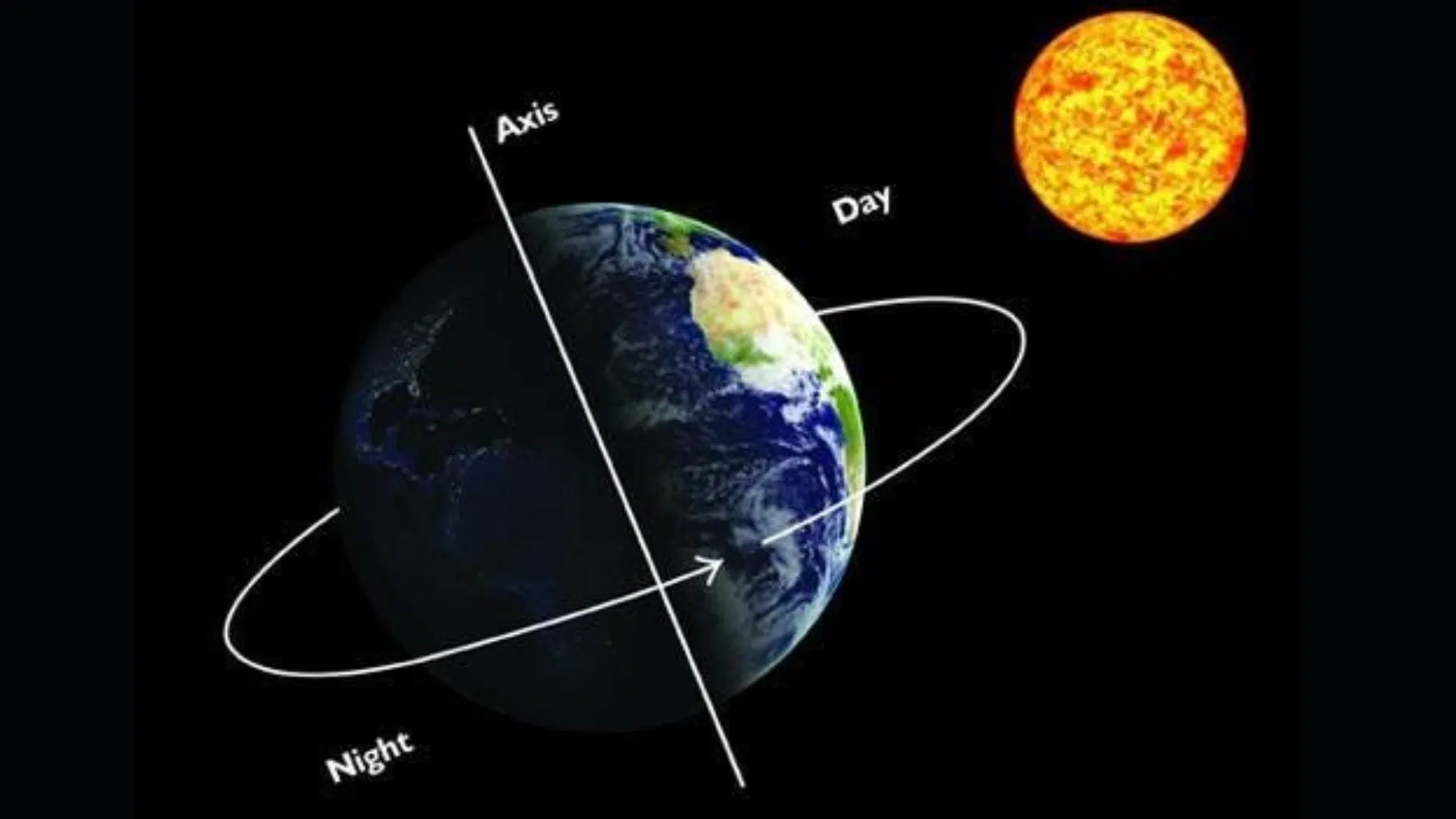
Image Source: Medium
The day-night cycle can be explained by two fundamental characteristics of Earth: its spherical shape and its continuous rotation.
Earth’s Spherical Geometry
Earth is nearly spherical, which means sunlight can illuminate only half of the planet at any given time. Solar radiation travels in straight, nearly parallel rays by the time it reaches Earth. When those rays strike the planet, they light the hemisphere facing the Sun, while the opposite hemisphere remains in shadow.
At every moment, Earth is divided into a sunlit half and a dark half. This division is unavoidable and results directly from geometry.
Earth’s Rotation on Its Axis
Earth rotates around an imaginary axis that runs from the North Pole to the South Pole. This rotation occurs from west to east and takes approximately 24 hours to complete relative to the Sun.
As Earth spins, each location on the surface is carried into the illuminated hemisphere and later into the shadowed hemisphere. The boundary between light and darkness, therefore, shifts continuously across the globe.
Combined Effect of Shape and Rotation
The spherical shape establishes the permanent division between light and darkness. Rotation causes that division to move.
When a region faces the Sun, it experiences daylight. When it turns away, it enters night. The alternation between day and night is therefore a direct consequence of a rotating spherical planet exposed to a distant light source.
Why the Sun Appears to Move Across the Sky
Although Earth’s rotation causes the day–night cycle, it does not feel that way from the surface. To an observer on Earth, it appears that the Sun rises in the east, moves across the sky, and sets in the west.
This apparent motion is a direct consequence of Earth’s eastward rotation. As the planet spins, the observer’s position changes relative to the Sun. The Sun itself is not traveling around Earth each day. Instead, Earth’s rotation creates the illusion of solar movement.
This effect, known as diurnal motion, applies to stars and other celestial objects as well. Their daily movement across the sky is observational evidence of Earth’s rotation.
How Earth Defines a 24-Hour Day
Earth completes one full rotation approximately every 24 hours. This period defines the length of a solar day and forms the foundation of modern timekeeping.
However, the situation is slightly more precise than a simple 360-degree spin. While Earth rotates, it is also moving forward in its orbit around the Sun. Because of this orbital motion, Earth must rotate slightly more than 360 degrees for the Sun to appear in the same position in the sky on consecutive days.
That additional fraction of rotation accounts for the 24-hour solar day.
The consistency of this timing allows sunrise and sunset to follow predictable patterns, which can be calculated with high accuracy using astronomical models.
Rotation and Revolution: Understanding the Difference
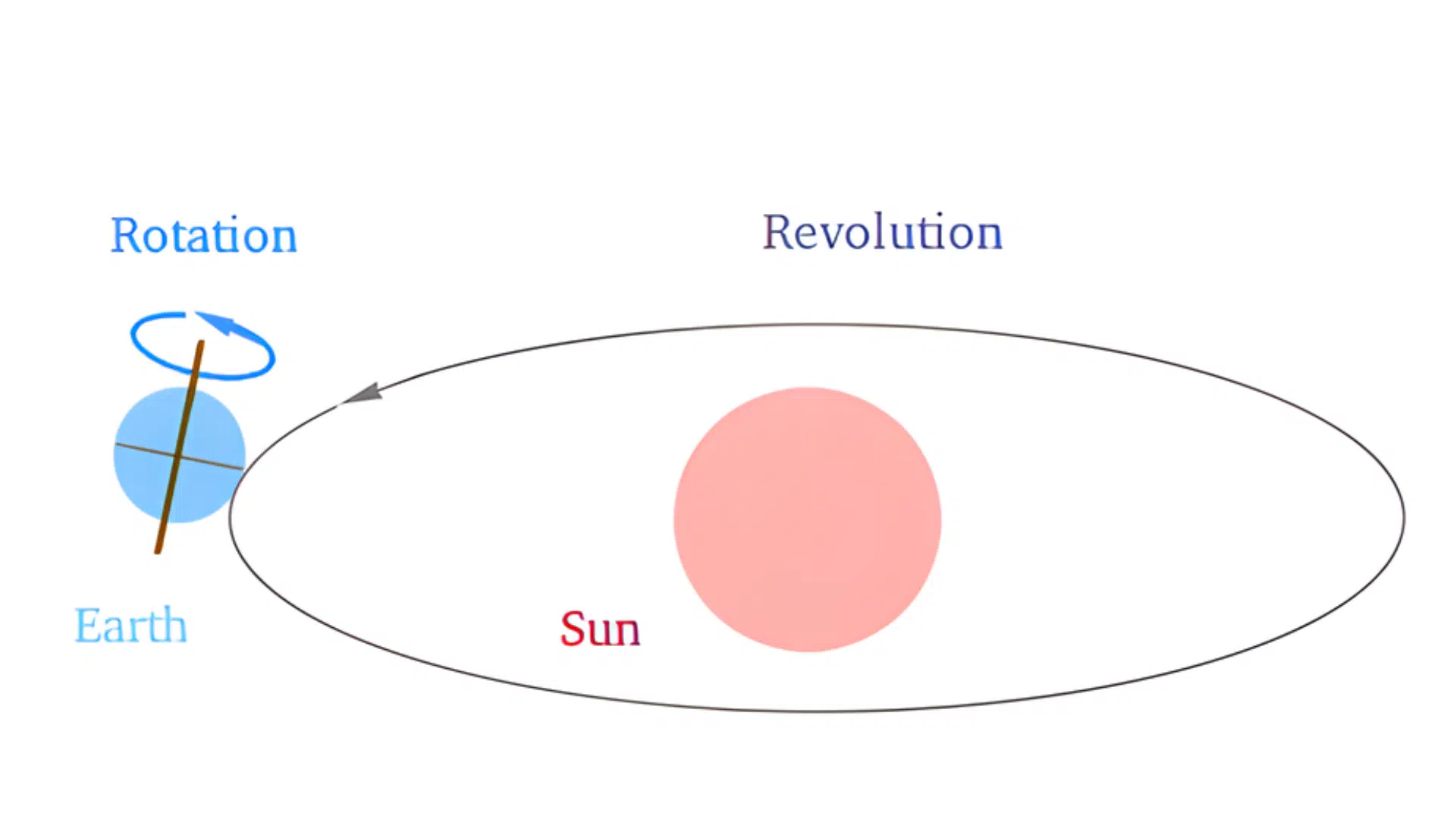
A clear explanation of the day–night cycle requires distinguishing between Earth’s rotation and its revolution. These two motions are often confused, but they describe entirely different movements and produce different results.
| Feature | Rotation | Revolution |
|---|---|---|
| Definition | Earth is spinning on its axis | Earth orbits the Sun |
| Direction | West to east | Counterclockwise (viewed from above the North Pole) |
| Time Required | ~24 hours | ~365.25 days |
| Primary Result | Causes day and night | Causes the year |
| Effect on Sun’s Position | Makes the Sun appear to rise and set daily | Changes the Sun’s apparent position over seasons |
| Role in Seasons | No direct role | Works with axial tilt to produce seasons |
| Type of Motion | Rotational (spin) | Orbital (path around another body) |
Rotation is responsible for the daily alternation between light and darkness. Revolution, by contrast, determines the length of the year and contributes to seasonal variation.
Observational Evidence of Rotation
From ground level, the effects of Earth’s rotation are observed through changing shadows, shifting sunlight angles, and the apparent movement of celestial objects.
As Earth rotates, the Sun’s position relative to the horizon changes gradually. Shadows lengthen or shorten depending on the Sun’s angle. These observable effects provide practical evidence of rotation.
Although the motion is not physically felt, its consequences are measurable and consistent. Instruments, astronomical calculations, and satellite imaging all confirm that Earth’s rotation drives the daily light cycle.
To Conclude
The day and night cycle reflects the steady motion of a rotating planet in space. What appears to be the Sun traveling across the sky is actually the result of Earth turning on its axis.
This simple movement shapes how time is measured and how daily life is organized. The pattern is consistent because the physical laws governing Earth’s motion remain stable.
Understanding this process replaces visual assumptions with scientific explanation. Each sunrise and sunset serves as quiet evidence of Earth’s motion.
Continue learning about planetary science to deepen your understanding of the forces that shape our world.