
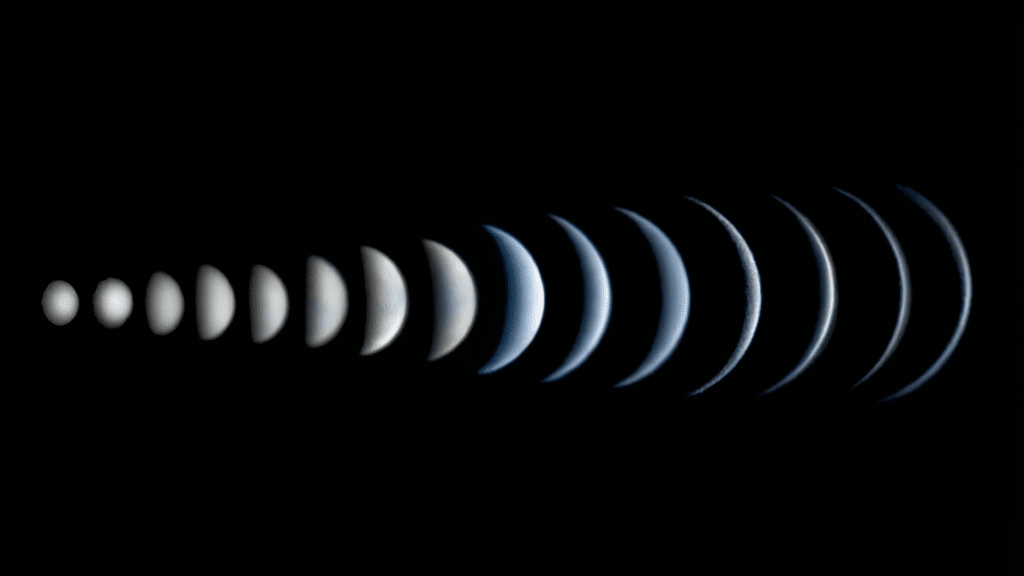
Venus is one of the brightest objects in the night sky. At times it shines just after sunset, and at other times it rises before dawn.
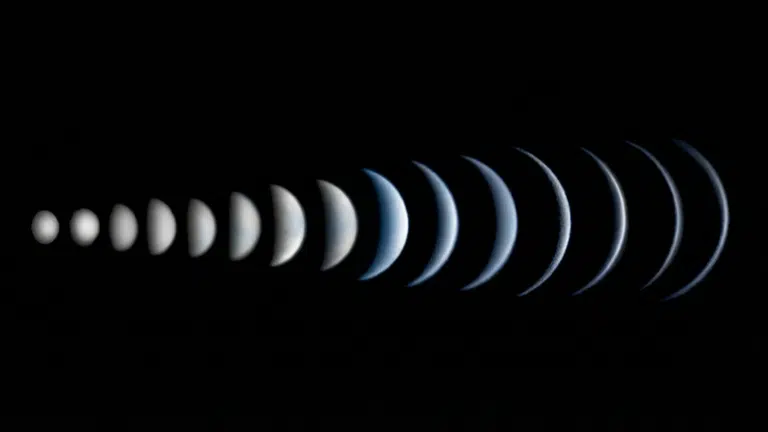
Through a telescope, its shape does not stay the same. It appears to grow and shrink, much like the Moon. These changing shapes are known as the phases of Venus.
For centuries, astronomers carefully watched this pattern and tried to explain it. Their observations played an important role in shaping ideas about how the solar system works.
To understand the phases of Venus, it is necessary to look at both careful observation and the basic motion of the planets in space.
What are the Phases of Venus?
The phases of Venus refer to the changing shapes of the planet as seen from Earth. When viewed through a telescope, Venus does not always appear as a full, round disk.
Instead, it shifts between thin crescents, half-lit shapes, and nearly full forms. These changes are similar to the phases of the Moon, but they occur for different reasons and follow a different pattern.
Venus shines brightly in the sky because it reflects sunlight very efficiently. However, it does not produce its own light.
Like the Moon, it is visible because sunlight falls on its surface and reflects toward Earth. As Venus moves along its orbit around the Sun, the angle between the Sun, Venus, and Earth changes. That shift in angle is what produces the phases of Venus.
The Basic Principle Behind the Phases
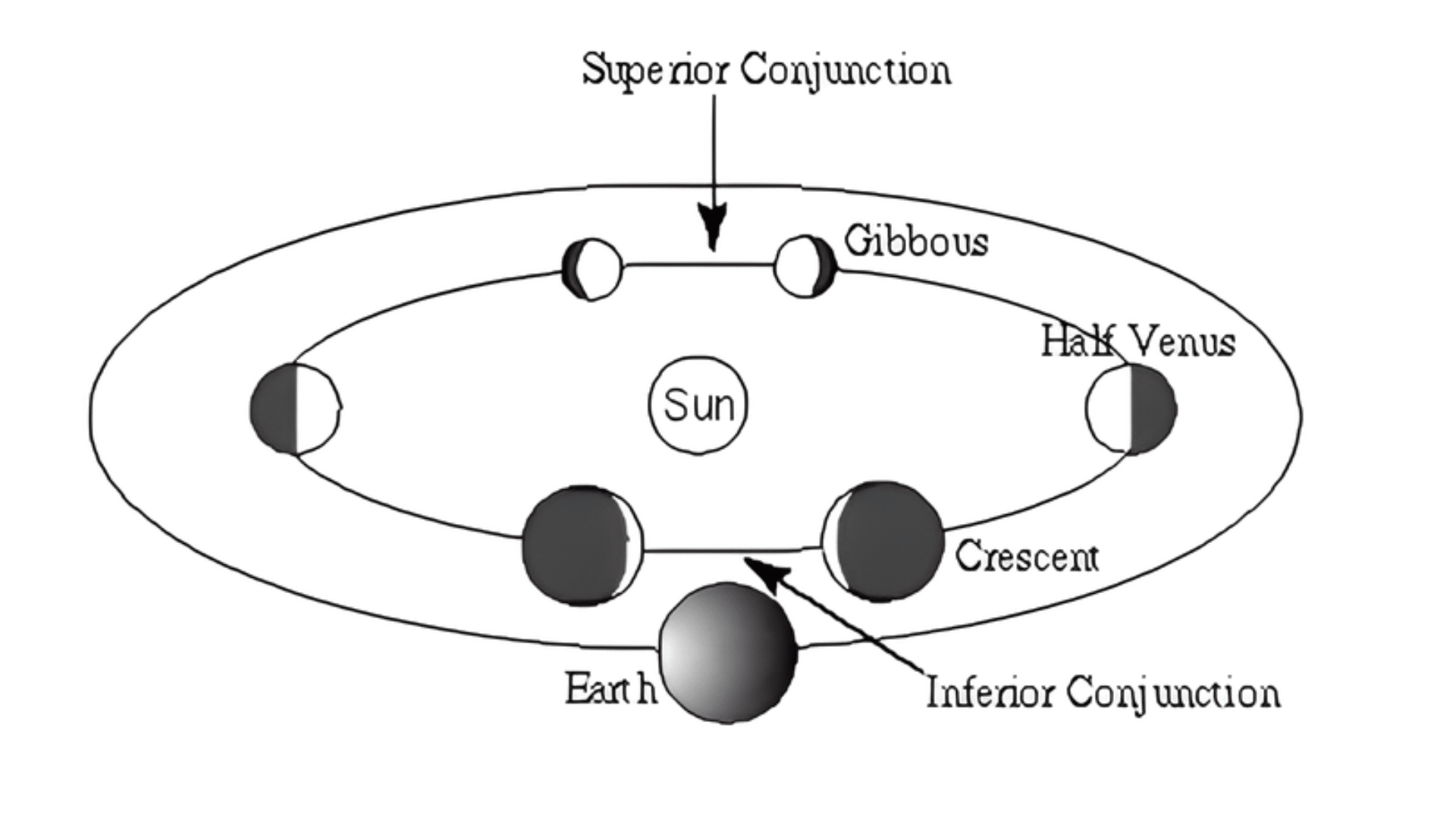
At all times, half of Venus is illuminated by the Sun. That is true for every spherical body lit by a star.
The important question is not how much of Venus is lit. The important question is how much of that lit half we can see from Earth.
As Venus moves along its orbit:
- Sometimes we see most of the sunlit hemisphere.
- Sometimes we see only a thin slice.
- Sometimes we see exactly half.
The phases of Venus are simply the visible fraction of its illuminated hemisphere from Earth’s perspective.
Orbital Alignment: The Core Cause
Understanding what causes the phases of Venus requires looking at three moving objects:
- The Sun
- Venus
- Earth
Their changing alignment determines the visible phase.
The Different Phases of Venus
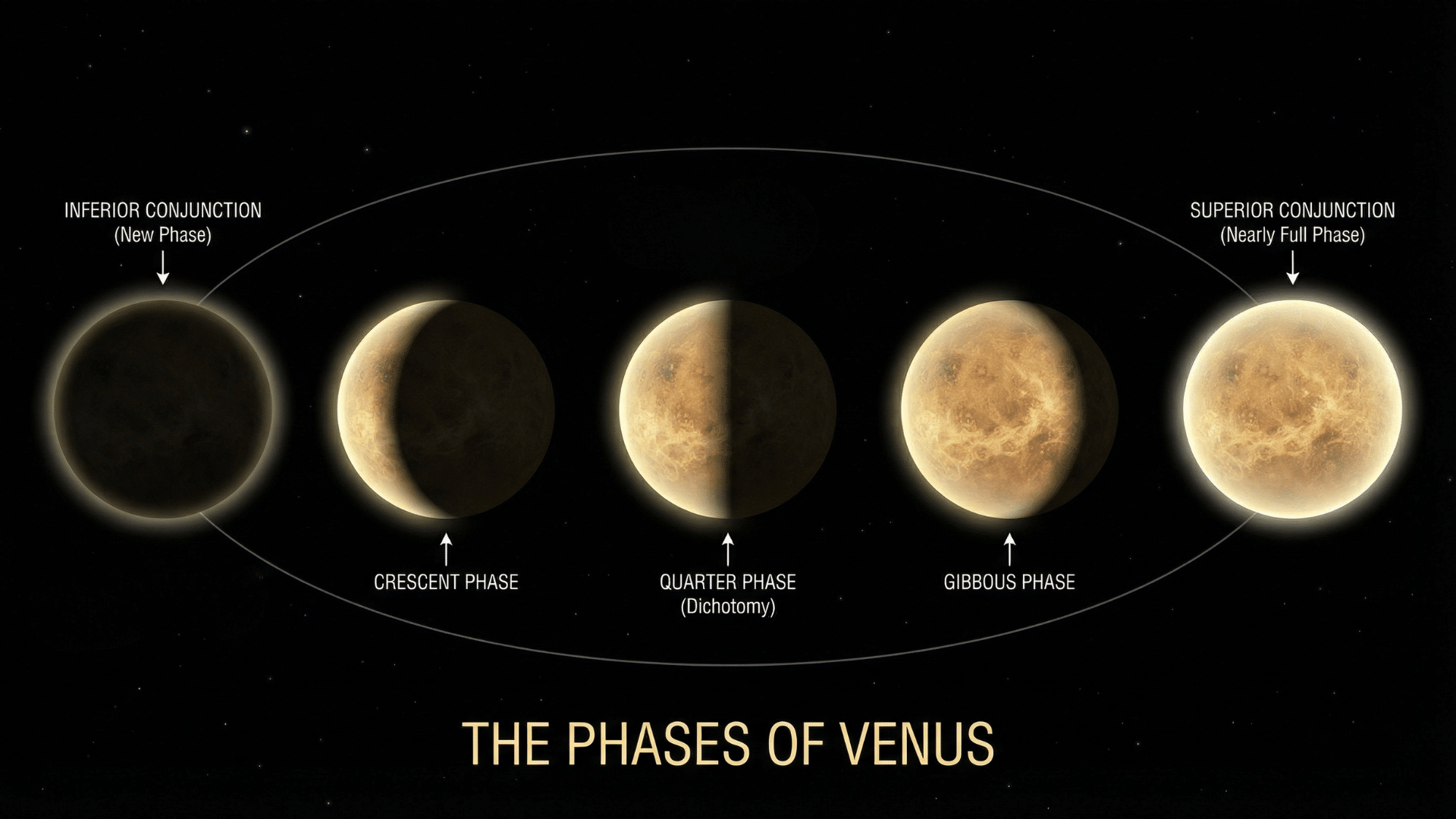
Venus passes through a complete set of phases during its orbital cycle. These phases include:
1. Inferior Conjunction (New Phase)
Inferior conjunction occurs when Venus passes between Earth and the Sun.
In this position:
- The sunlit side faces away from Earth.
- Venus appears dark or nearly invisible.
- It is positioned very close to the Sun in the sky.
Technically, this is the “new” phase of Venus. However, unlike the Moon, Venus does not become fully invisible because its thick atmosphere can scatter light in complex ways. Still, it is extremely difficult to observe at this stage.
2. Crescent Phase
As Venus moves away from inferior conjunction, a thin crescent becomes visible.
Here is something interesting: When Venus appears as a thin crescent, it is actually closest to Earth.
Because of this closeness:
- The planet appears larger in telescopes.
- The crescent can look dramatically curved and bright.
The crescent phase of Venus is often the easiest phase to identify with small telescopes. It can be strikingly sharp against the dark sky.
3. Greatest Elongation (Half Phase)
Venus reaches greatest elongation when it appears farthest from the Sun in the sky. At this point:
- The Sun, Earth, and Venus form roughly a right angle.
- We see half of the illuminated hemisphere.
- Venus appears in a quarter phase.
This is one of the best times to observe Venus safely. It is high enough in the sky after sunset or before sunrise to be seen clearly.
4. Gibbous Phase
As Venus continues along its orbit and moves toward the far side of the Sun, more of its illuminated surface becomes visible.
Now Venus appears gibbous, more than half illuminated. But something else happens. Even though more of its surface is lit, Venus appears smaller. That is because it is moving farther away from Earth.
This size change was historically important. Early astronomers noticed that Venus looked larger when crescent and smaller when gibbous. That variation helped prove that Venus was not orbiting Earth.
5. Superior Conjunction (Full Phase)
When Venus is on the opposite side of the Sun from Earth, it is at superior conjunction. In theory, this is when Venus would appear fully illuminated.
In practice, it is nearly impossible to observe in this phase because it lies too close to the Sun’s glare. Still, the existence of this full phase was one of the strongest arguments against the geocentric model.
The Synodic Period of Venus
The full cycle of the phases of Venus, as seen from Earth, does not match its orbital period around the Sun. Instead, it follows a synodic period. The synodic period of Venus is about 584 Earth days.
This is the time it takes for Venus to return to the same position relative to Earth and the Sun. For example, from one crescent phase to the next similar crescent phase takes about 584 days.
The difference between Venus’s orbital period (225 days) and its synodic period (584 days) exists because Earth is also moving around the Sun.
Both planets are in motion, and the relative positions change in a more complex pattern than a single orbit alone would suggest.
Why the Phases of Venus Changed Astronomy
The phases of Venus were not just a curiosity. They changed the course of science.
In the early 1600s, the dominant theory in Europe was the Ptolemaic geocentric model. According to this system:
- Earth sat at the center.
- All planets orbited Earth.
- Venus moved in a small circle attached to a larger Earth-centered orbit.
This model predicted that Venus could show only crescent and small partial phases. It could never appear fully illuminated.
Then, Galileo used a telescope in 1610. He observed Venus displaying a complete range of phases, crescent, half, gibbous, and nearly full. This observation contradicted the geocentric model.
Only the heliocentric model proposed by Copernicus, where Venus orbits the Sun, could explain the full sequence of phases. This was direct visual evidence that Earth was not the center of the universe.
Why the Geocentric Model Failed
The Ptolemaic system placed Venus on an epicycle between Earth and the Sun. That arrangement meant Venus could never move behind the Sun from Earth’s perspective.
If that were true, Venus would never appear gibbous or full. But telescopes clearly showed otherwise.
The existence of the full set of phases of Venus could not be reconciled with an Earth-centered universe. This evidence became one of the strongest early proofs supporting heliocentrism.
Comparing the Phases of Venus and the Moon
Although the phases of Venus and the phases of the Moon may look similar at first glance, they are caused by different orbital relationships and show important physical differences. The table below highlights the key comparisons in a clear and structured way.
| Feature | Phases of Venus | Phases of the Moon |
|---|---|---|
| What It Orbits | Venus orbits the Sun | The Moon orbits Earth |
| Why Phases Occur | We see different portions of Venus’s sunlit side as it moves around the Sun inside Earth’s orbit | We see different portions of the Moon’s sunlit side as it moves around Earth |
| Position in Solar System | Venus is an inner (inferior) planet | The Moon is Earth’s natural satellite |
| Full Phase Visibility | The full phase exists, but is difficult to observe because Venus is near the Sun | The full Moon is easily visible and occurs once every lunar month |
| Crescent Appearance | Crescent Venus appears larger because it is closer to Earth | Crescent Moon does not significantly change in apparent size |
| Size Change During Phases | Apparent size changes dramatically due to varying distances from Earth | Apparent size remains mostly consistent |
| Synodic Period | About 584 Earth days | About 29.5 days |
| Historical Importance | Provided strong evidence for the heliocentric model | Helped early civilizations track time and create calendars |
| Brightness | Extremely bright due to thick reflective clouds | Bright but less reflective than Venus |
| Visibility Timing | Seen near sunrise or sunset only | Visible at various times throughout the night, depending on the phase |
How to Observe the Phases of Venus?
Modern observers can easily see the phases of Venus using small telescopes. The best time to observe is during the greatest elongation. At that time:
- Venus is separated from the Sun in the sky.
- It is visible in twilight.
- The quarter phase can be clearly seen.
Caution is critical. Observing Venus too close to the Sun can cause permanent eye damage. Proper equipment and timing are essential.
Over several months, patient observers can watch Venus gradually change from crescent to half to gibbous. This slow transformation is direct evidence of orbital motion.
Space Missions That Confirmed Early Observations
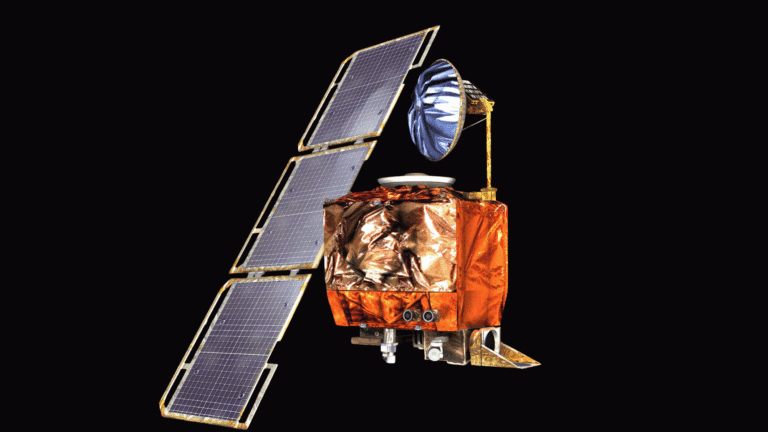
Spacecraft missions have provided direct measurements of Venus’s position, motion, and atmospheric reflectivity: The missions are:
- Mariner 2
- Magellan
- Venus Express
These missions confirmed the orbital mechanics that explain what causes the phases of Venus. High-resolution imaging also shows how sunlight scatters in Venus’s dense atmosphere, enhancing its brightness during crescent phases.
Modern data aligns perfectly with the observations first made through early telescopes.
Final Thoughts
The phases of Venus are a clear result of its orbit around the Sun and its position inside Earth’s orbit. As Venus moves, the portion of its illuminated surface we see changes in a steady, predictable cycle.
These shifting shapes provided powerful evidence that planets orbit the Sun, not the Earth.
From Galileo’s early telescope observations to modern space missions, the explanation has remained consistent and grounded in geometry.
The phases of Venus continue to demonstrate how motion in space shapes what we see from our planet.
Keep watching the sky, and continue learning about the forces that guide our solar system.