
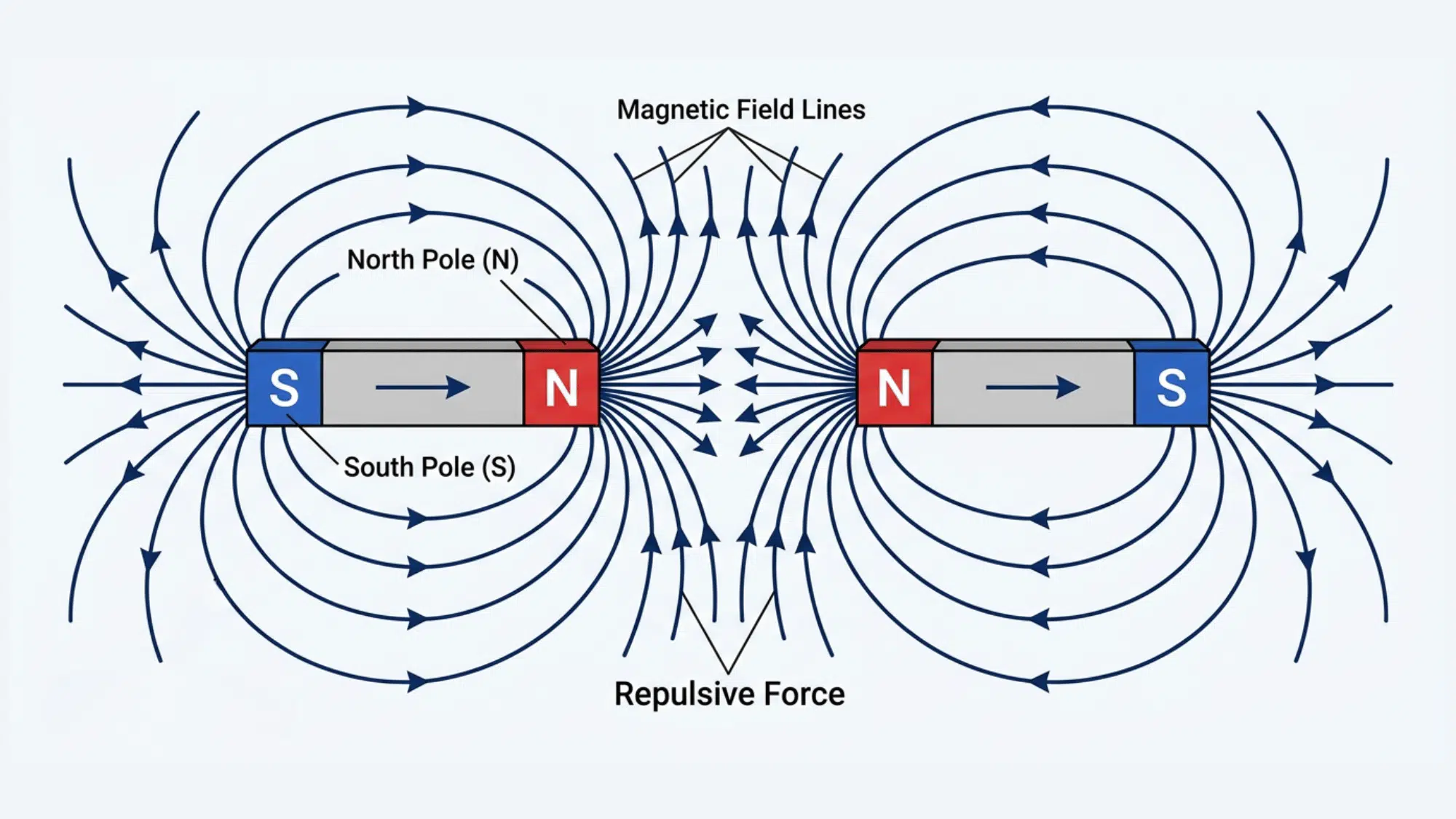
Ever held two magnets close and felt them push apart even without touching? That’s a magnetic field doing its job. It’s one of those things that works all around us, yet most people never stop to think about it.
Magnetic fields are not just a school science topic. They show up in phones, MRI machines, electric motors, and even the earth itself.
So, how does something that can’t be seen or touched have so much power?
That’s exactly what this blog gets into. It breaks down what a magnetic field is, how it works, and why it matters in everyday life.
What is a Magnetic Field?
A magnetic field is a region in space where magnetic forces act on moving charges, electric currents, or magnetic materials. It is represented by the symbol B and measured in tesla (T).
The field has both direction and magnitude, making it a vector field.
Think of it as an invisible zone of influence around a magnet or a current-carrying wire. Anything magnetic that enters this zone feels a force. The stronger the field, the stronger that force gets.
How Does a Magnetic Field Work
A magnetic field works by exerting force on moving electric charges and magnetic materials within its range. This force is described by the Lorentz force law:
F = q(v × B),
where q is the charge, v is the velocity, and B is the magnetic field.
A static charge feels nothing. But the moment it starts moving, the field pushes it sideways.
There is more to it, though. When a magnetic field changes over time, it creates an electric field; a principle known as Faraday’s Law. This back-and-forth relationship between electric and magnetic fields is what makes electromagnetic waves possible.
That’s the engine behind everything from radio signals to visible light.
What Creates a Magnetic Field?
Three main things create a magnetic field: moving electric charges, permanent magnets, and changing electric fields.
When electric current flows through a wire, it generates a magnetic field around it. That’s the basic idea behind every electric motor and generator.
Permanent magnets work differently. Their fields come from the spin of electrons inside atoms. When these spins line up in the same direction, a strong field forms.
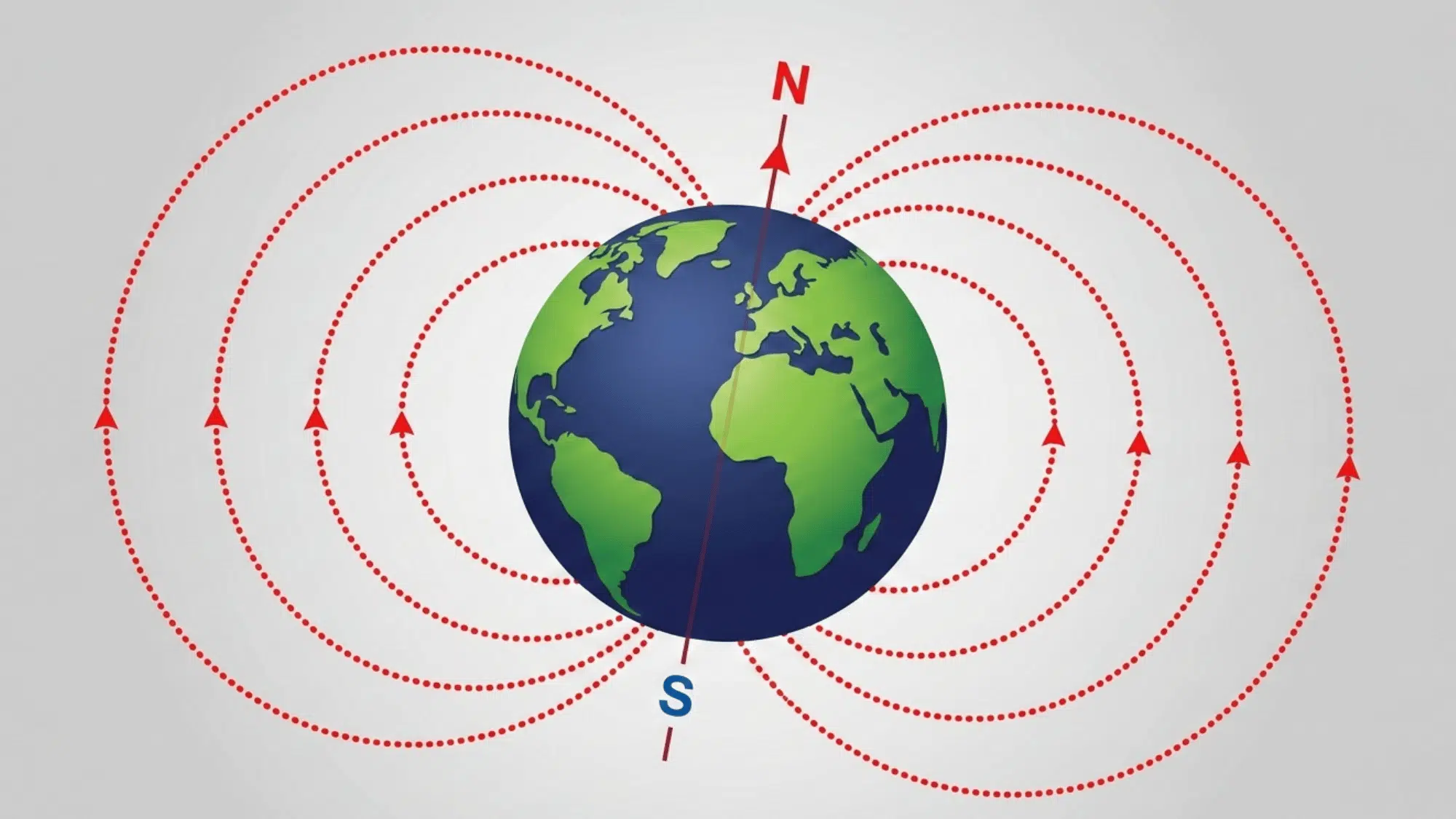
Even the Earth has a magnetic field. It comes from the movement of molten iron deep inside the planet’s core. That’s what makes a compass point north.
Magnetic Field Lines Explained
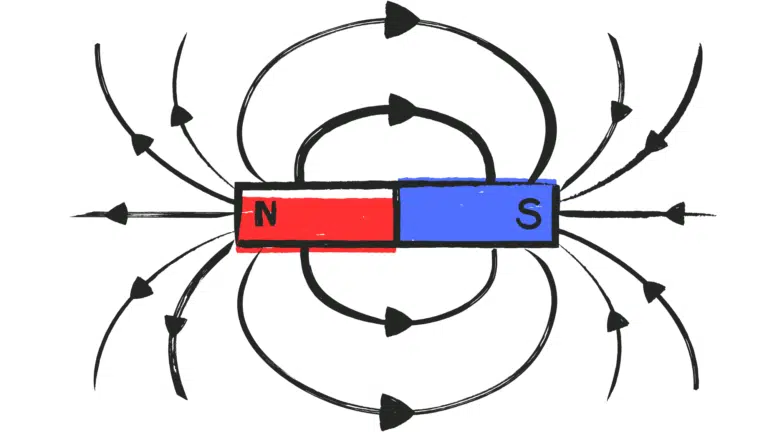
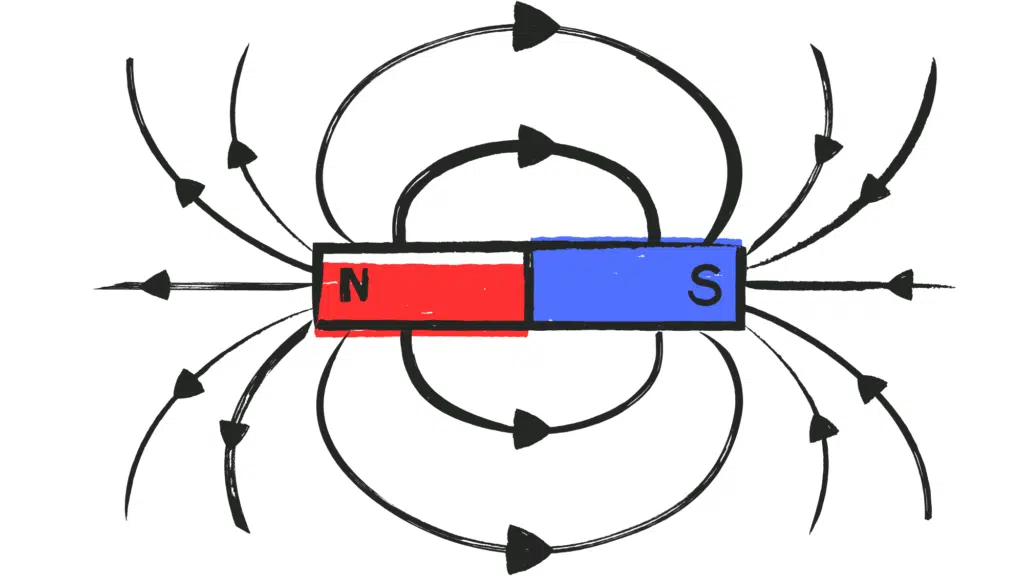
Magnetic field lines are a way to picture how a magnetic field behaves in space. They show both the direction and strength of the field at any given point.
These lines always run from the north pole to the south pole outside a magnet, forming closed loops. Where the lines are packed closely together, the field is strong. Where they spread apart, the field is weaker.
Two important rules apply here. First, field lines never cross each other. Second, the direction of the field at any point is always a tangent to the line at that spot.
It is a simple but powerful tool for understanding how magnetic fields spread and behave around different objects.
Properties of a Magnetic Field
Magnetic fields follow specific rules that define how they behave, interact with materials, and affect charged particles around them.
- No Magnetic Monopoles: A magnetic field always has both a north and south pole. It can never exist as a single isolated pole.
- Follows the Right-Hand Rule: When current flows through a wire, the magnetic field wraps around it in the direction the right hand’s fingers curl.
- Weakens With Distance: The strength of a magnetic field drops as the distance from the source increases. Closer objects experience a much stronger force.
- Stores Energy: A magnetic field carries energy within it. This energy plays a key role in powering motors, transformers, and electrical devices.
- Never Crosses Itself: Magnetic field lines never intersect. Each line represents a unique direction of force at every point in space.
Real-World Applications of Magnetic Fields
Magnetic fields are not just a concept in textbooks. They power some of the most important technologies used every day.
1. MRI Machines: Hospitals use strong magnetic fields in MRI scanners to produce detailed images of the human body without any radiation.
2. Electric Motors: Every electric motor runs on magnetic force. It converts electrical energy into motion, powering everything from fans to electric cars.
3. Hard Drives: Computers store data using tiny magnetic regions on a disk. Each region holds binary information that the system reads and writes.
4. Maglev Trains: These high-speed trains use powerful magnetic fields to lift and propel themselves above the track, cutting friction almost completely.
5. Particle Accelerators: Facilities such as the LHC use magnetic fields to steer and accelerate charged particles to extremely high speeds for scientific research.
Magnetic Field vs Magnetic Force
Magnetic field and magnetic force are closely related but not the same thing. Here is how they differ.
| Aspect | Magnetic Field | Magnetic Force |
|---|---|---|
| Definition | A region in space where magnetic influence exists | The actual push or pull felt by a charge or magnet |
| Symbol | B | F |
| Unit | Tesla (T) | Newton (N) |
| Nature | A cause; it exists independently | An effect; it only appears when something enters the field |
| Depends On | Source like a current or a magnet | Motion, charge, and field strength |
| Static Charges | The field still exists around them | Static charges feel no force at all |
| Role | Sets up the conditions for force | Acts on objects within the field |
To Conclude
Magnetic fields are everywhere; inside phones, hospitals, trains, and even deep within the Earth. They may not be visible, but their effects show up in almost every piece of technology used today.
Understanding what a magnetic field is, how it forms, and what it does makes it much easier to see why it matters.
From powering electric motors to guiding MRI scans, the applications are real and wide-ranging.
For anyone curious about going further, learning about electromagnetism next would be a great step. It builds directly on everything covered here and opens up a much bigger picture of how energy and motion connect.