A nova is one of the most striking light events seen in the night sky. For a short time, a faint star can grow dramatically brighter, drawing the attention of astronomers and skywatchers alike.
This sudden change has been recorded for centuries and has often led to confusion in the past.
Today, scientists understand that a nova is not the birth of a new star, but a powerful event involving an existing one.
It takes place under specific conditions in space and follows a clear physical process.
To understand what a nova truly is, it helps to look at the stars involved and how this sudden burst of light occurs.
What is a Nova?
A nova is a powerful and sudden increase in brightness that occurs in a specific type of star system.
In simple terms, a nova happens when a star that is normally faint becomes dramatically brighter for a short period of time.
The word “nova” comes from the Latin phrase for “new,” because early skywatchers believed a new star had appeared in the sky. In reality, a nova is not a new star at all. It is an existing star that has temporarily flared up.
It is important to understand that a nova is not the destruction of a star. Instead, it is a surface explosion on a dense, compact star known as a white dwarf.
The event can make the star appear thousands or even millions of times brighter than usual, but the system itself survives the explosion.
The Type of Star System Behind a Nova
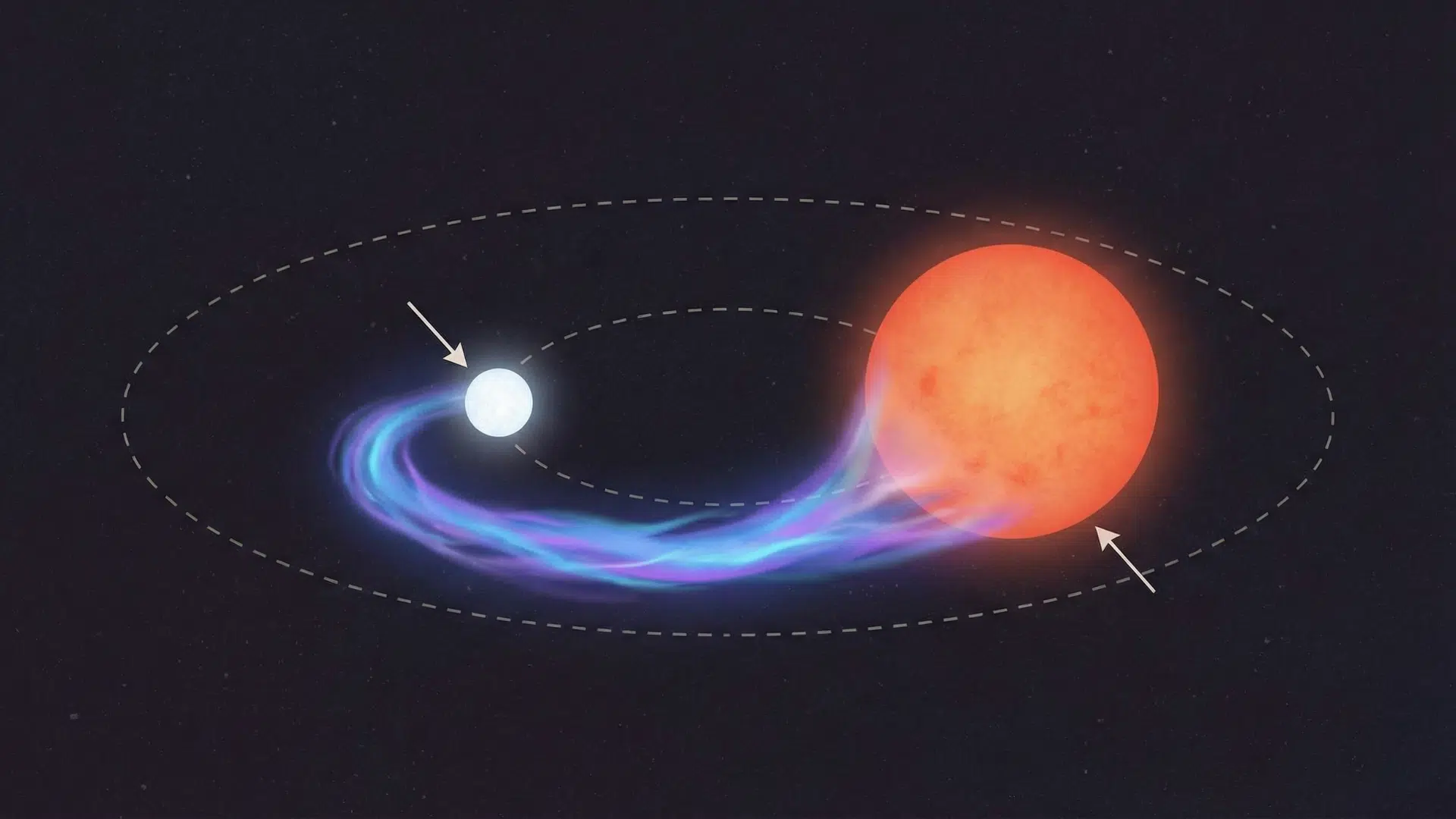
A nova does not happen in a single, isolated star. It occurs in a binary star system. A binary system contains two stars that orbit around a common center of gravity.
In the case of a nova, one of these stars is a white dwarf. The other is often a larger, normal star, such as a red giant or a main-sequence star similar to the Sun.
The two stars are close enough that the white dwarf can pull material away from its companion. This slow transfer of gas is the key condition that makes a nova possible. Without this close pairing and steady flow of material, a nova would not occur.
What is a White Dwarf?
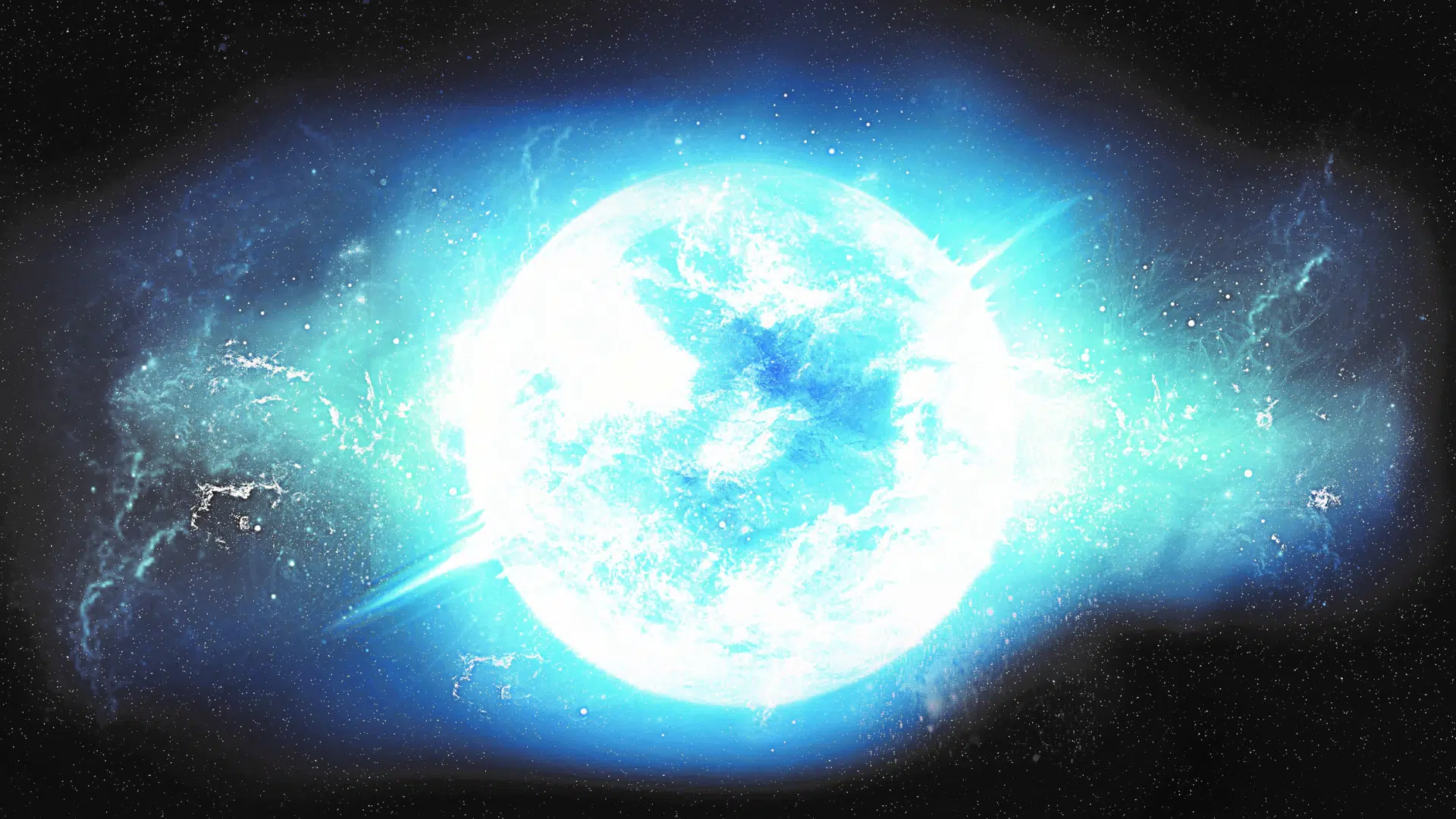
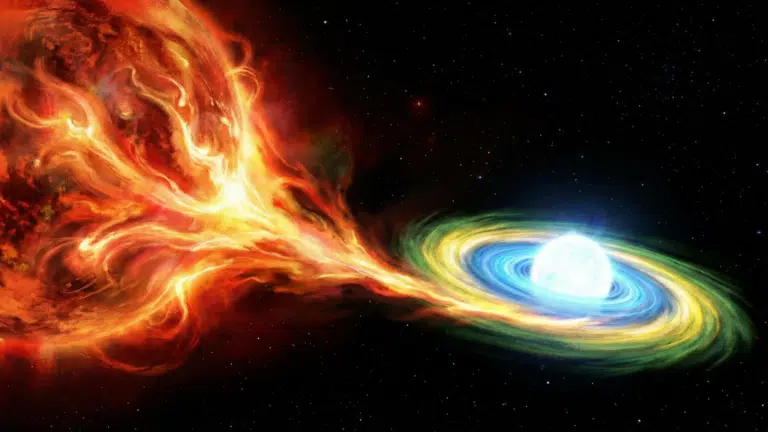
Image Source: Space
A white dwarf is the leftover core of a star that has used up its nuclear fuel. When a medium-sized star like the Sun reaches the end of its life, it sheds its outer layers into space. What remains is a small, extremely dense core. This core is the white dwarf.
White dwarfs are about the size of Earth, yet they contain about as much mass as the Sun. This means their gravity is extremely strong.
Because of this intense gravity, a white dwarf can pull gas from a nearby companion star if the two are close enough. The white dwarf itself no longer produces energy through normal fusion.
How a Nova Forms: From Mass Transfer to Explosion
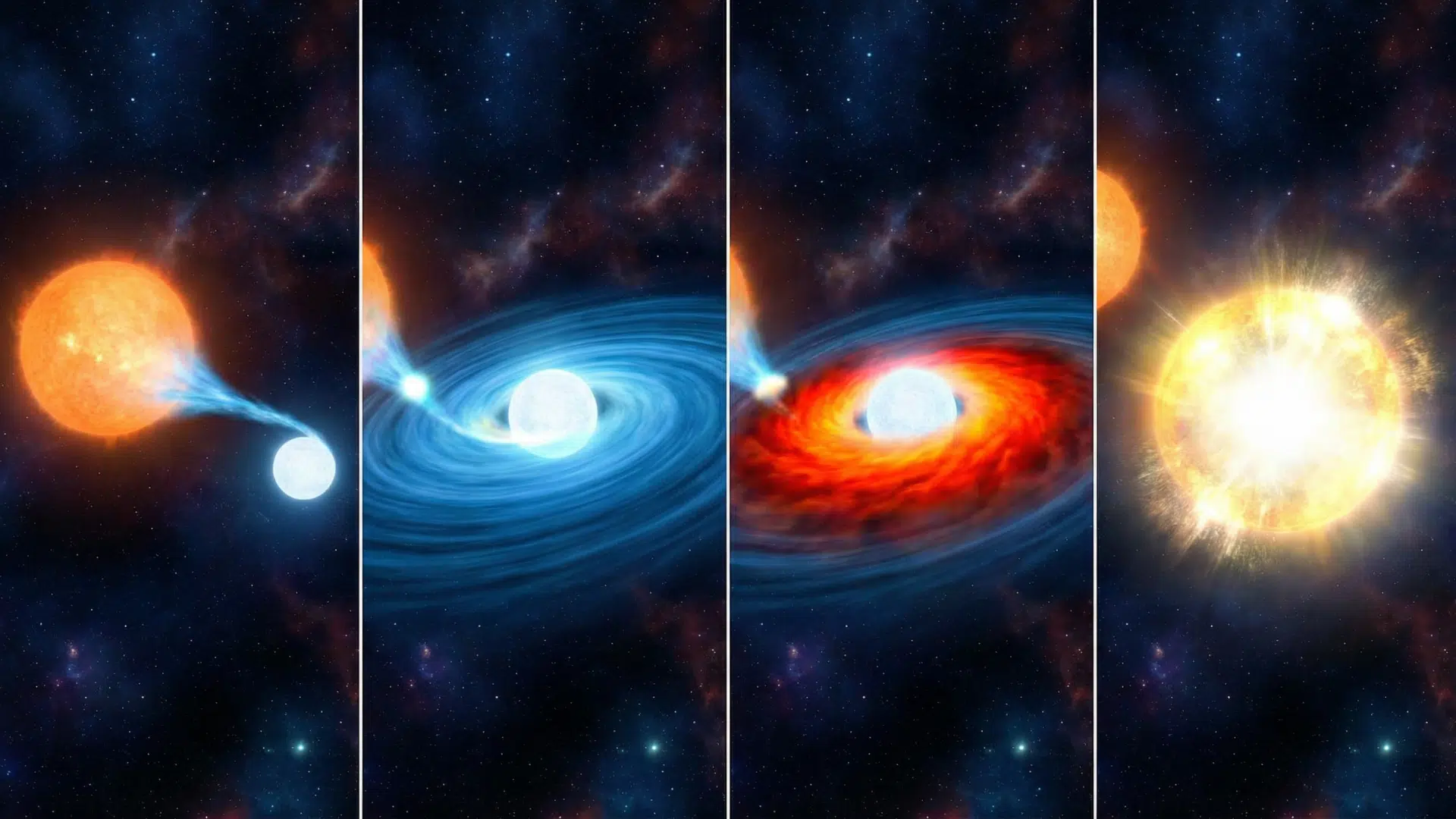
A nova does not happen instantly. It develops over a long period through a series of interconnected stages.
1. Expansion of the Companion Star
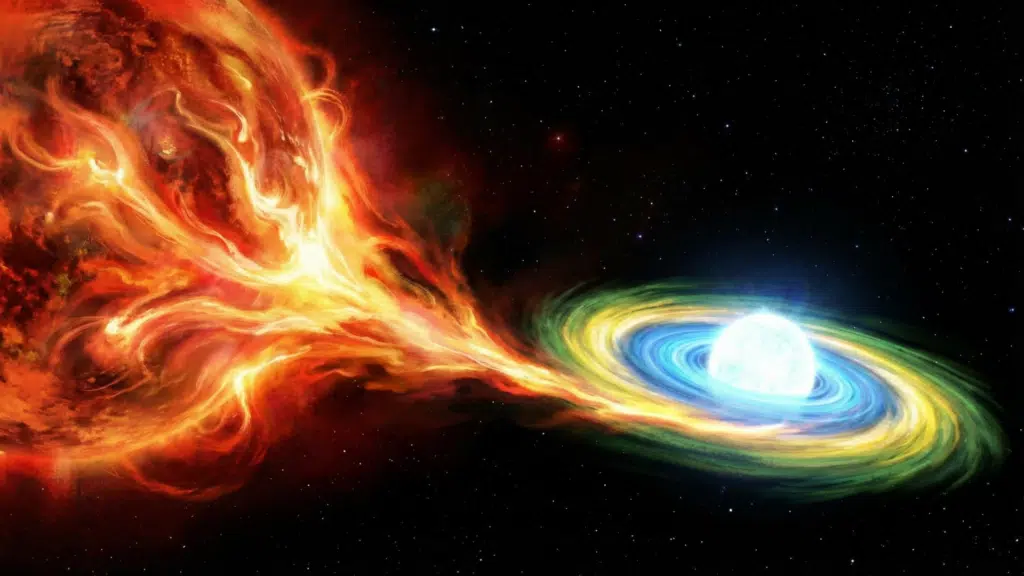
As the companion star ages, it expands. Its outer layers move closer to the white dwarf. Once the stars are close enough, the white dwarf’s strong gravity begins pulling hydrogen-rich gas away from its companion.
2. Formation of an Accretion Disk
The gas does not fall straight onto the white dwarf. Instead, it forms a rotating accretion disk around it. Friction and gravity cause the gas in the disk to slowly spiral inward.
Over time, this material settles onto the surface of the white dwarf. This buildup occurs gradually and may take tens to thousands of years.
3. Compression of the Hydrogen Layer
As more hydrogen collects, the white dwarf’s intense gravity compresses it tightly. Pressure increases steadily. As pressure rises, temperature also increases.
Unlike normal stars, the surface of a white dwarf is supported by electron degeneracy pressure. This means the gas cannot expand easily to cool itself. Heat continues to build without relief.
4. Ignition of Nuclear Fusion
When the temperature becomes high enough, nuclear fusion begins in the thin hydrogen layer. Because the gas cannot expand to regulate the heat, fusion spreads rapidly across the surface.
This reaction becomes explosive rather than stable.
5. The Nova Explosion
The sudden burst of fusion releases a tremendous amount of energy. The outer layer of accumulated gas is blasted into space at high speed.
The system brightens dramatically, sometimes becoming thousands of times more luminous than before. This bright outburst is the nova event.
6. After the Explosion
The white dwarf itself survives the explosion. Only the surface layer is expelled. After the system returns to a quieter state, the process can begin again if the companion star continues to transfer material.
Why a Nova is Not a Supernova
Many people confuse novae with supernovae because of the similar names. However, these events are very different.
A supernova is far more powerful and usually marks the end of a star’s life. In some cases, the entire star is destroyed. In other cases, the core collapses into a neutron star or black hole. The energy released in a supernova is far greater than in a nova.
In contrast, a nova is a surface explosion on a white dwarf. The star survives and may experience multiple nova events over time.
Types of Novae
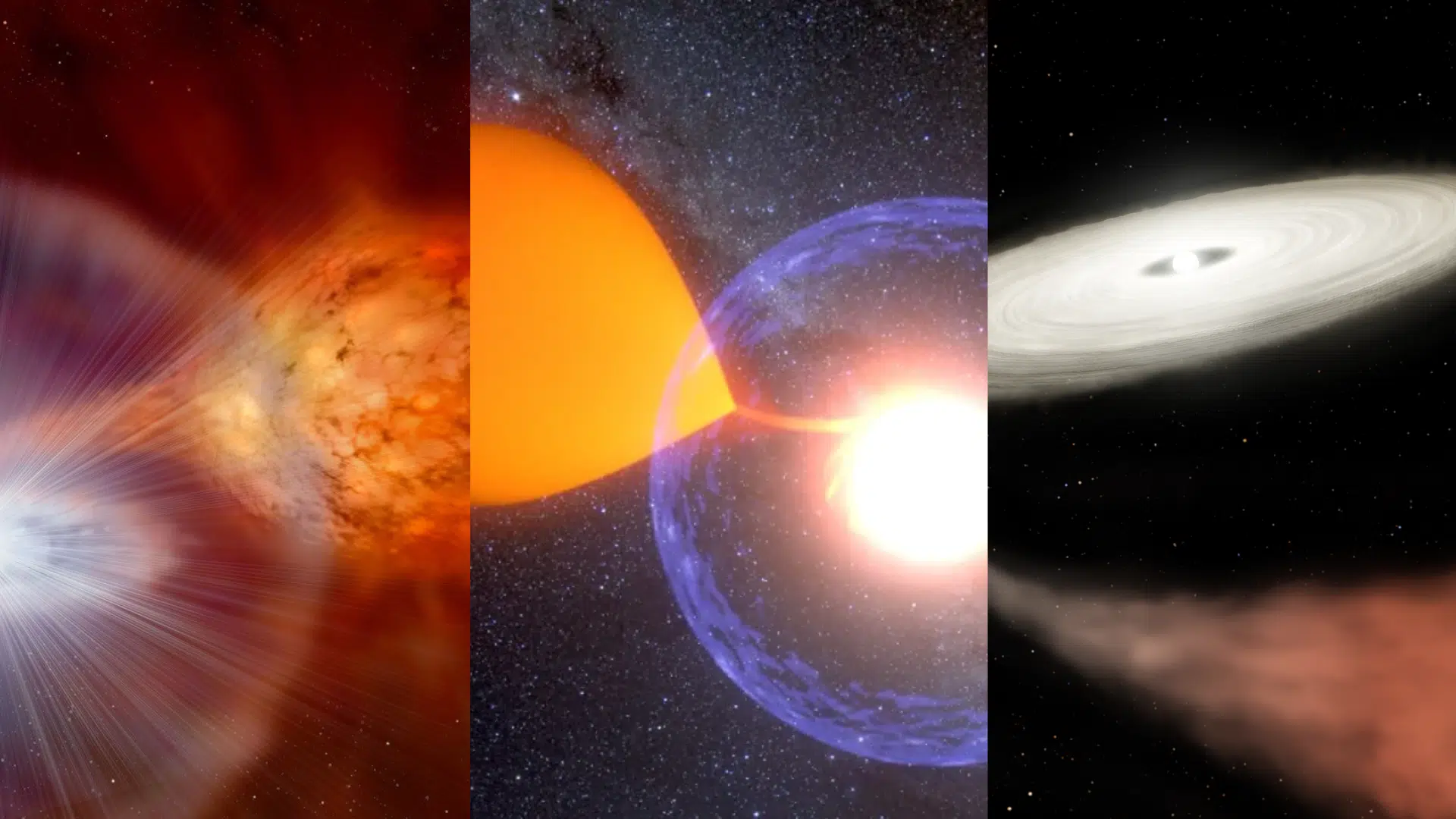
Not all novae behave in exactly the same way. Astronomers classify them based on how often they occur and how their brightness changes over time.
Classical Novae
A classical nova is an event that has only been observed once in a particular system. The time between eruptions may be tens of thousands of years, so it is unlikely that a second eruption will be seen within a human lifetime.
Classical novae can become very bright and then gradually fade over weeks or months. The expanding shell of gas can often be detected long after the visible light has dimmed.
Recurrent Novae
Recurrent novae erupt more than once within a shorter time frame, often decades or centuries apart. These systems usually have a white dwarf near the maximum mass it can hold. Because of this, it takes less time to build up enough material for another explosion.
Recurrent novae are especially important for research because they allow scientists to observe multiple eruptions and compare them.
Dwarf Novae
Dwarf novae are slightly different. In these systems, the brightening is caused by changes in the accretion disk rather than a thermonuclear explosion. The increases in brightness are smaller and more frequent.
Although dwarf novae involve a white dwarf and a companion star, the physical mechanism behind their outbursts is not the same as in classical novae.
How Bright is a Nova?
A nova can increase in brightness by a factor of 10,000 to 100,000. At its peak, it may become visible to the naked eye if it is close enough to Earth.
However, most novae occur at great distances and are too faint to be detected by the naked eye.
The brightness usually rises quickly, sometimes within a few days. After reaching its peak, the light gradually fades over weeks or months.
The rate at which it fades can tell astronomers important information about the mass of the white dwarf and the amount of material ejected.
How Often Do Novae Occur?
Novae are not rare events on a galactic scale, but many go unnoticed because they occur far from Earth or behind dense clouds of dust. Astronomers estimate their frequency by combining direct observations with models of stellar populations.
| Location / Type of Estimate | Estimated Frequency | Additional Details |
|---|---|---|
| Milky Way Galaxy (Annual Estimate) | 30–60 novae per year | Many are hidden by interstellar dust or occur on the far side of the galaxy. |
| Observed from Earth (Per Year) | About 10–15 detected | Detection depends on telescope coverage, sky surveys, and viewing conditions. |
| Large Spiral Galaxies (Similar to Milky Way) | Dozens per year | The rate scales with galaxy size and total number of stars. |
| Classical Nova in One System | Once every 10,000–100,000 years | The white dwarf needs a very long time to gather enough hydrogen for another eruption. |
| Recurrent Nova in One System | Every 10–100 years | These systems contain massive white dwarfs that accrete material more rapidly. |
| Dwarf Novae | Every few weeks to months | These are caused by changes in the accretion disk, not thermonuclear explosions. |
Key Takeaway: While dozens of novae likely occur in our galaxy each year, only a fraction are detected. The actual rate is higher than the observed rate because many events occur in distant or obscured regions of space.
The Life Cycle of a Nova System
A nova system can repeat its cycle many times. After an eruption, the white dwarf cools and returns to its previous state. If the companion star continues to lose material, the buildup process begins again.
In some cases, if the white dwarf gains enough mass over time, it may approach a critical limit known as the Chandrasekhar limit.
If this happens, the system could eventually produce a type Ia supernova. However, this is not the typical outcome for most nova systems.
Final Thoughts
A nova reminds us that space is not still or silent. Even stars that appear faint and steady can undergo dramatic change under the right conditions.
These events reveal how gravity, pressure, and nuclear reactions work together in extreme environments. They also show how closely linked stars can influence each other over long periods of time.
By studying novae, astronomers gain deeper insight into stellar behavior and the life cycles of compact stars.
Each observed eruption adds another piece to a much larger picture of how galaxies evolve.
If you want to keep building your understanding of space, read more about related stellar phenomena and expand your knowledge of the universe.