
At the far edge of the solar system lies a region that few people fully understand. It is called the Oort Cloud. This distant area is not visible through a telescope, and no spacecraft has reached it.
Yet scientists believe it plays an important role in the story of our cosmic neighborhood. The idea of the Oort Cloud helps explain events that take place much closer to the Sun.
It also raises important questions about how the solar system formed and how it continues to change over time.
To understand space more deeply, it is important to understand what the Oort Cloud is and why it matters.
What is the Oort Cloud?
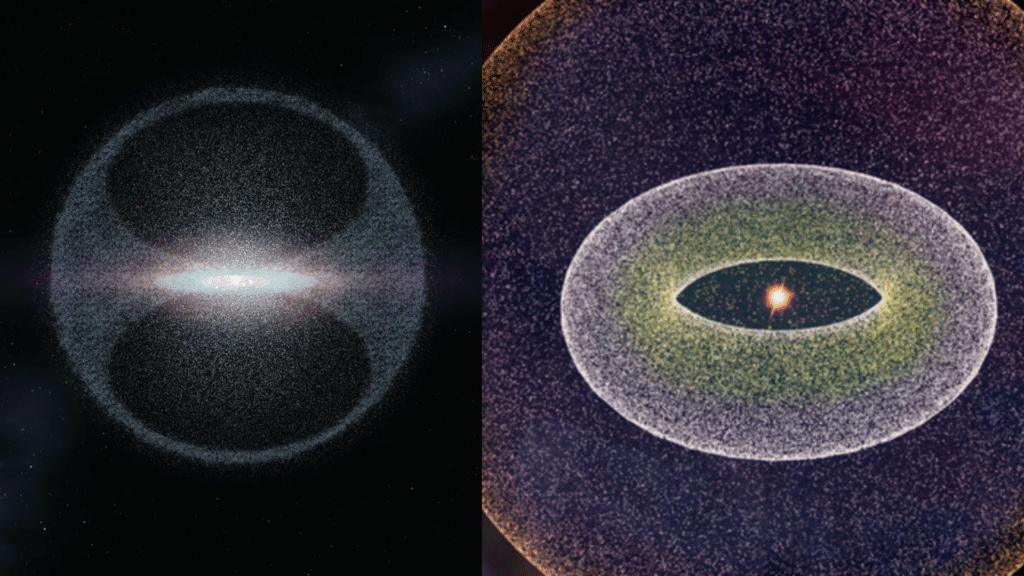
The Oort Cloud is a vast, distant region surrounding the solar system. When scientists describe the Oort Cloud, they refer to a massive spherical shell of icy objects that orbit the Sun far beyond the known planets.
It is not a solid structure, nor is it a clearly visible boundary. Instead, it is a theoretical region supported by strong indirect evidence, especially the behavior of long-period comets.
The Oort Cloud represents the outermost extent of the Sun’s gravitational influence.
Although it has never been directly observed, astronomers widely accept its existence because of consistent patterns in comet orbits and models of early solar system formation.
It is considered one of the most distant and mysterious components of our cosmic neighborhood
Where is the Oort Cloud Located?
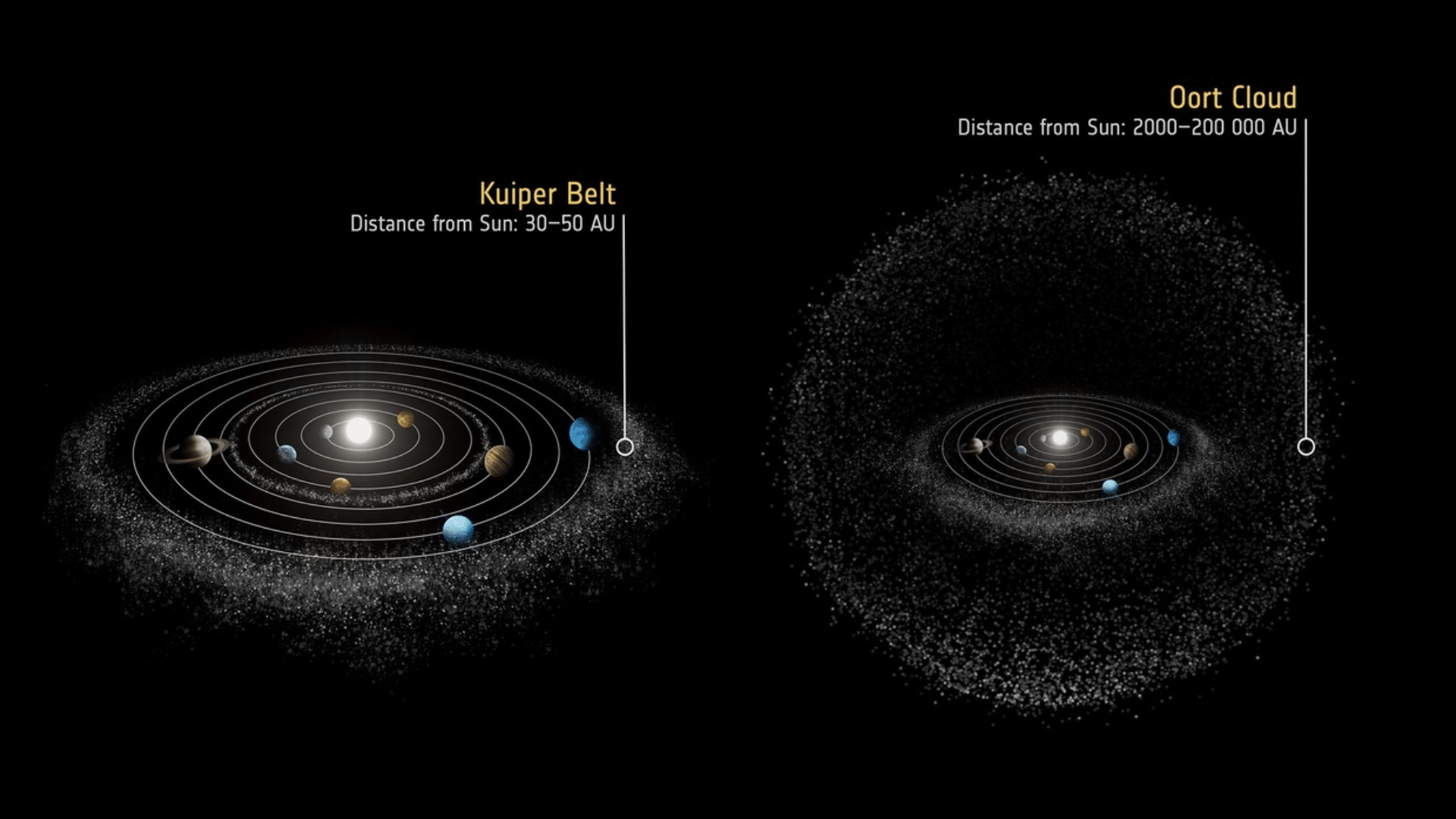
Image Source: Ad Astra
The Oort Cloud lies far beyond Neptune and the Kuiper Belt. While the Kuiper Belt extends from about 30 to 50 astronomical units (AU) from the Sun, the Oort Cloud is believed to begin thousands of AU away.
One astronomical unit equals the average distance between Earth and the Sun, which is about 93 million miles (150 million kilometers).
Estimates suggest that the inner edge of the Oort Cloud may start around 2,000 AU from the Sun. The outer edge could extend to 100,000 AU. At that distance, the Sun’s gravity becomes very weak, and the influence of nearby stars begins to matter more.
Because it stretches so far, the Oort Cloud may mark the outermost limit of the Sun’s gravitational control. Beyond it lies interstellar space.
What is the Oort Cloud Made Of?
The Oort Cloud is thought to contain icy bodies composed of:
- Water ice
- Frozen methane
- Frozen ammonia
- Carbon monoxide
- Dust and rocky material
These materials are similar to those found in comets. In fact, long-period comets that enter the inner solar system are believed to originate from the Oort Cloud.
The objects in the Oort Cloud are often described as “dirty snowballs.” They are mixtures of ice and rock, preserved in extremely cold conditions for billions of years.
Because they have remained so far from the Sun, they may contain ancient material that has changed very little since the solar system formed.
Structure of the Oort Cloud
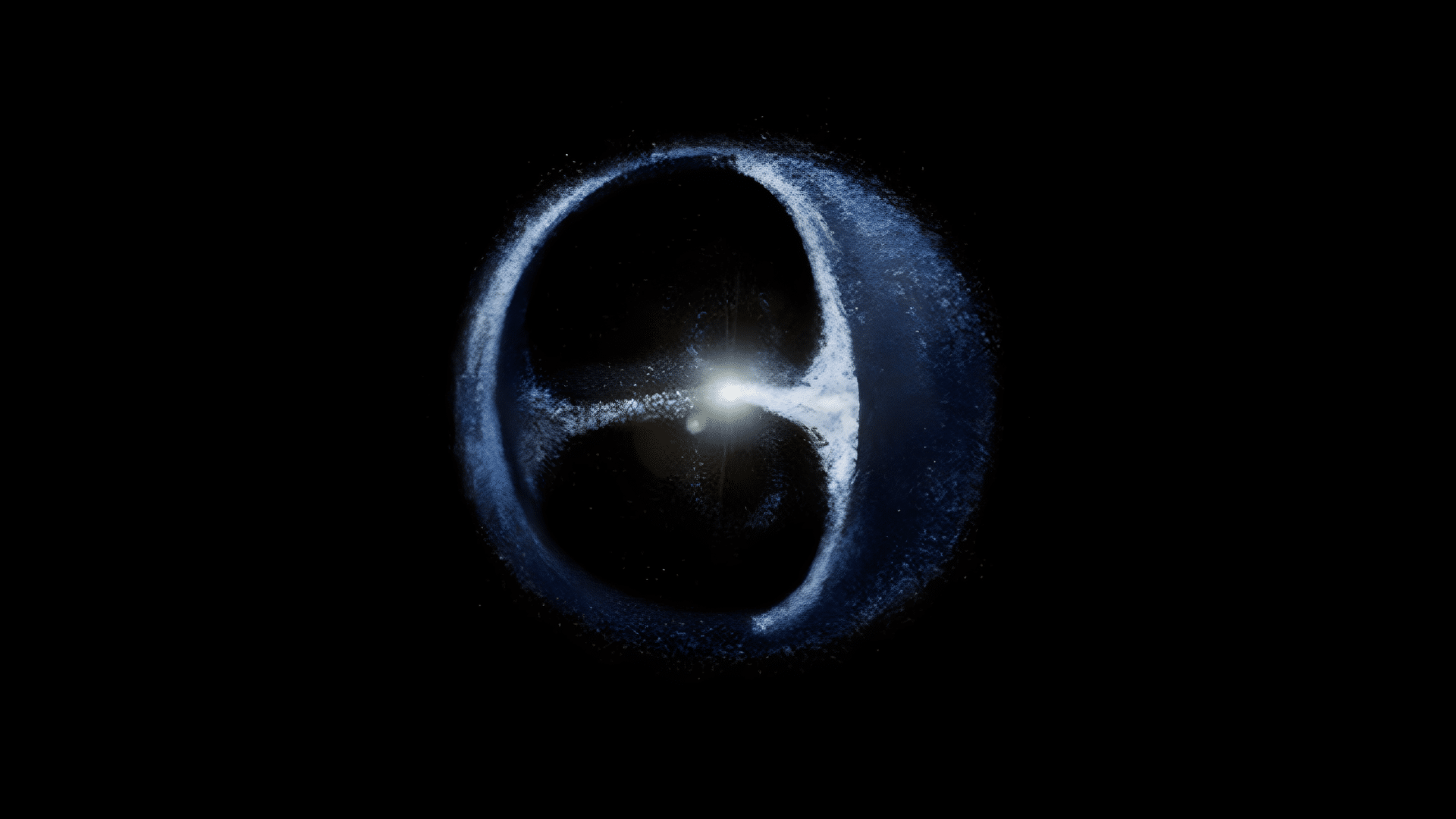
Image Source: Medium
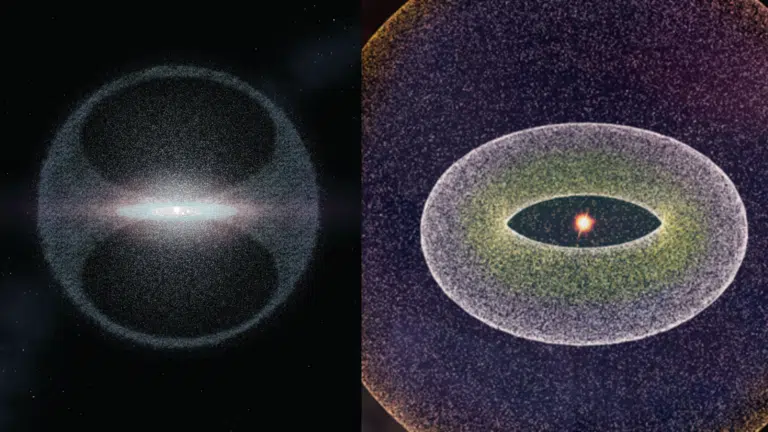
Scientists believe the Oort Cloud is not a single uniform region. Instead, it likely has two main parts with different shapes and characteristics. These regions are often referred to as the inner Oort Cloud and the outer Oort Cloud.
1. The Inner Oort Cloud (Hills Cloud)
The inner region is sometimes called the Hills Cloud, named after astronomer Jack Hills, who proposed its existence. This part of the Oort Cloud lies closer to the Sun than the outer region.
Researchers believe the inner Oort Cloud may have a disk-like or slightly flattened shape, rather than a perfect sphere. It could extend from roughly 2,000 AU to perhaps 20,000 AU from the Sun, although the exact range remains uncertain.
Key characteristics of the inner Oort Cloud include:
- A potentially higher concentration of icy bodies
- Stronger gravitational binding to the Sun compared to the outer region
- A role as a long-term reservoir of comets
Because objects in this region are more tightly bound to the Sun, they are less easily disturbed by passing stars or galactic forces. Some models suggest that the inner Oort Cloud may slowly supply material to the outer cloud over time.
2. The Outer Oort Cloud
The outer Oort Cloud forms the most distant part of the solar system’s gravitational domain. Unlike the inner region, this part is believed to be roughly spherical.
Its estimated distance ranges from about 20,000 AU to possibly 100,000 AU or more. At these extreme distances, the Sun’s gravity is very weak, and outside forces begin to play a larger role.
Important features of the outer Oort Cloud include:
- A spherical distribution of objects
- Orbits that are tilted at many different angles
- Greater sensitivity to gravitational disturbances
The spherical structure is especially important. Long-period comets enter the inner solar system from all directions, not just along the flat plane of the planets. This pattern strongly supports the idea that their source region must also be spherical.
Spacing Between Objects
Even though the Oort Cloud may contain billions or even trillions of icy bodies, it is not crowded. The distances between individual objects are enormous. In many cases, they may be separated by millions of miles.
As a result, the Oort Cloud is extremely diffuse. It occupies a vast volume, but the actual material within it is spread very thinly.
Together, the inner and outer regions form a massive, distant structure that likely represents the outermost boundary of the Sun’s gravitational influence.
How Did the Oort Cloud Form?
Scientists believe the Oort Cloud formed early in the history of the solar system, around 4.6 billion years ago.
When the Sun and planets were forming from a rotating disk of gas and dust, many small icy objects developed in the outer regions. These objects did not become planets. Instead, they remained as leftover building blocks.
As the giant planets, Jupiter, Saturn, Uranus, and Neptune grew larger, their strong gravity scattered many of these icy bodies.
Some were thrown inward and collided with other objects. Others were ejected completely out of the solar system. However, a portion of them were pushed into extremely distant orbits around the Sun.
Over time, the gravitational influence of nearby stars and the Milky Way galaxy reshaped these orbits into a spherical distribution. This process likely created the Oort Cloud.
The Oort Cloud and Long-Period Comets
One of the strongest arguments for the existence of the Oort Cloud comes from the behavior and orbital patterns of long-period comets.
Long-Period Comets
Long-period comets are comets that take more than 200 years to complete one orbit around the Sun. Many require thousands or even millions of years to return.
Unlike short-period comets, which usually orbit along the same flat plane as the planets, long-period comets approach the Sun from every direction. Their orbital paths can be steeply tilted, highly elongated, and oriented at almost any angle.
Orbital Patterns as Evidence
If comets originated only from the flat planetary region of the solar system, their orbits would mostly align with that plane.
Instead, astronomers have observed that long-period comets enter the inner solar system from random directions. This distribution strongly suggests a distant spherical source.
In 1950, Dutch astronomer Jan Oort analyzed data on comet orbits and concluded that a vast, spherical cloud of icy bodies must surround the solar system. This proposed structure became known as the Oort Cloud.
Gravitational Influences on the Oort Cloud
The Oort Cloud is shaped and influenced by several gravitational forces beyond the Sun.
Passing Stars
As stars move through the Milky Way, some pass relatively close to our solar system on astronomical timescales. When this happens, their gravity can disturb objects in the outer Oort Cloud. These disturbances may send icy bodies inward, turning them into long-period comets.
Galactic Tidal Forces
The Milky Way galaxy exerts a steady gravitational influence known as the galactic tide. This force can gradually alter the orbits of distant objects in the Oort Cloud over millions of years.
Molecular Clouds and Stellar Encounters
Large clouds of gas and dust within the galaxy can also affect the outermost objects if the solar system passes near them. Such encounters are rare but possible over billions of years.
These external influences explain why the Oort Cloud is not perfectly stable and why comets occasionally enter the inner solar system.
Scientific Importance of the Oort Cloud
The Oort Cloud is scientifically important because it offers insight into the origin and evolution of the solar system.
Its icy bodies formed during the earliest stages of planetary development and may preserve material that has remained largely unchanged for billions of years. By studying long-period comets that originate there, scientists can examine this ancient matter.
The Oort Cloud also marks the outer reach of the Sun’s gravitational influence, extending far beyond the heliopause.
In addition, understanding its structure improves models of how planetary systems form and how stellar and galactic forces shape them over time.
Conclusion
The Oort Cloud challenges the way distance is understood in astronomy. It stretches the idea of the solar system far beyond the planets and into a region shaped by both solar gravity and the Milky Way.
Though it cannot be seen directly, its influence appears in the paths of distant comets. Ongoing observations and improved simulations continue to refine scientific models of this remote structure.
As technology advances, astronomers may gather stronger indirect evidence about its size and composition.
The Oort Cloud reminds us that the solar system does not end where the planets do. Continue reading and researching to deepen your understanding of outer space.