
Neptune stands as one of our solar system’s most mysterious worlds. This distant ice giant holds secrets that continue to baffle scientists and space enthusiasts alike.
Most people assume Neptune has a solid surface like Earth. But the reality is far more complex and surprising. This planet defies simple classification.
What makes Neptune’s structure so different from rocky planets? How do scientists study a world they’ve never touched? The answers reveal a picture of a planet unlike anything.
This blog breaks down Neptune’s composition, structure, and the challenges of understanding a planet eight times Earth’s size. The truth about Neptune’s surface might just change how you view our cosmic backyard.
Does Neptune Have a Solid Surface Like Earth?
Neptune doesn’t have a solid surface in the traditional sense. Unlike Earth, which has a rocky crust you could stand on, Neptune is classified as an ice giant with no defined ground.
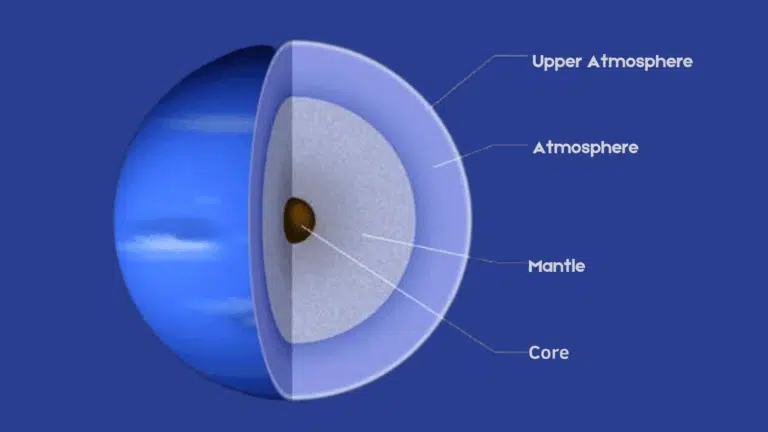
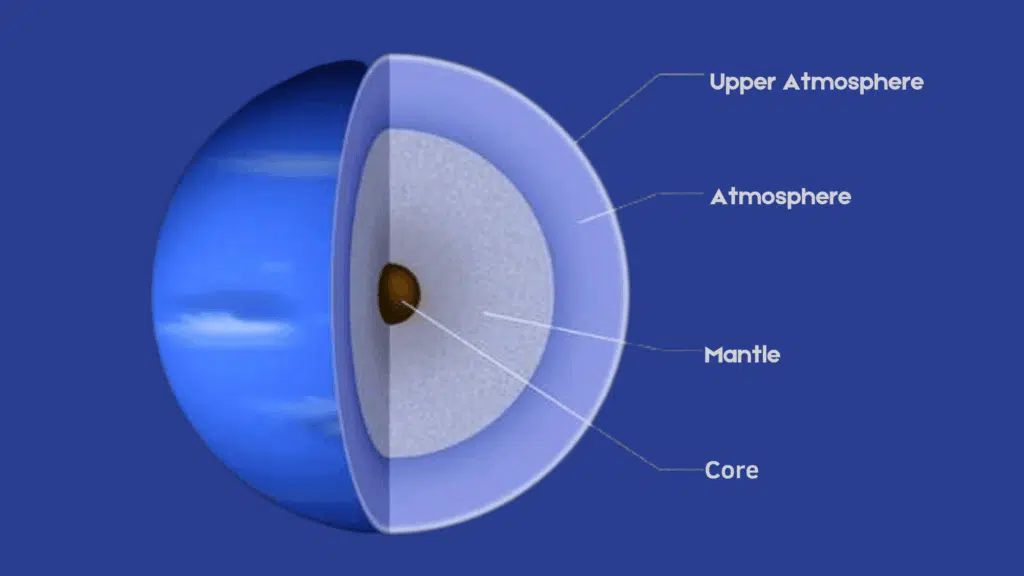
The planet consists of thick layers of gases and ices that gradually become denser as you move toward the core.
There’s no clear boundary where the atmosphere ends and the surface begins. Instead, the atmospheric pressure and temperature increase continuously.
If you tried to land a spacecraft on Neptune, it would simply sink deeper into increasingly dense material. Eventually, it would be crushed by extreme pressure long before reaching anything resembling solid ground.
Atmospheric Composition of Neptune
Neptune’s atmosphere tells a colorful story written in gases and clouds. The distinctive azure hue that makes Neptune instantly recognizable comes from its chemical makeup.
The atmosphere extends thousands of miles deep with no clear boundary separating it from the interior layers below.
Hydrogen dominates the mix at about 80%, with helium making up most of the remainder at 19%. But it’s the tiny 1% of methane that steals the show, absorbing red light wavelengths while reflecting brilliant blue back into space.
Trace amounts of other compounds exist throughout the atmosphere, including hydrogen deuteride and ethane. These chemicals react under Neptune’s extreme conditions to create complex weather patterns.
The atmosphere’s composition directly influences everything from wind speeds to storm formation, making it crucial to understanding this distant world.
Inside Neptune: Mantle, Core, and Extreme Conditions

Neptune’s interior remains largely theoretical, built from scientific models and observations. The extreme conditions inside create materials that behave in ways unfamiliar to us.
The Icy Mantle
Neptune’s mantle extends thousands of miles beneath the atmosphere. This layer contains water, methane, and ammonia compressed into a superionic state.
In this exotic phase, molecules break apart under intense pressure and heat. Oxygen atoms form a crystalline lattice while hydrogen ions flow freely like a liquid.
This creates an electrically conductive fluid that generates Neptune’s unusual magnetic field, which is tilted 47 degrees from its rotation axis.
The Rocky Core
Deep within Neptune lies a solid core made of rock and metal.
Scientists estimate this core measures about 1-2 Earth radii (~4,000-8,000 miles), weighs roughly 1.2 Earth. Temperatures here soar to approximately 9,000°F (5,000°C), hotter than the sun’s surface.
The core likely formed from heavy elements that sank during Neptune’s formation. Its exact composition remains uncertain, but models suggest silicates, iron, and nickel dominate.
Extreme Pressure and Temperature
Neptune’s interior conditions push matter beyond normal limits. Pressure at the core reaches 7 million times Earth’s sea-level atmospheric pressure.
These forces compress carbon atoms so intensely that scientists theorize diamonds might rain through the mantle layers.
The combination of crushing pressure and scorching heat creates states of matter that laboratories on Earth can barely simulate, making Neptune a natural physics experiment.
Neptune’s Discovery History and Voyager 2 Legacy

Image Source: NASA
Neptune holds a unique place in astronomical history as the first planet discovered through mathematical prediction rather than direct observation.
In the 1840s, astronomers noticed Uranus wasn’t following its expected orbit. Something was pulling it off course.
French mathematician Urbain Le Verrier and English astronomer John Couch Adams independently calculated where an unknown planet might be located.
In 1846, German astronomer Johann Galle found Neptune almost exactly where Le Verrier predicted. This discovery proved the power of mathematics in astronomy.
For over a century, Neptune remained a distant mystery.
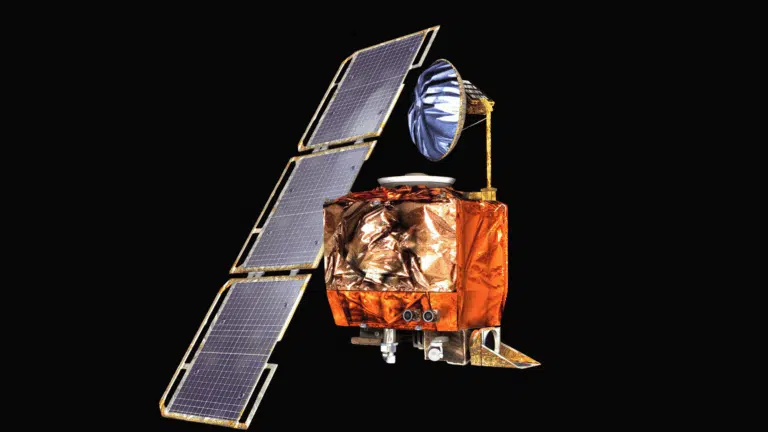
That changed in 1989 when NASA’s Voyager 2 spacecraft made its historic flyby. This mission remains humanity’s only close encounter with Neptune. Voyager 2 captured stunning images, discovered six new moons, and revealed Neptune’s dynamic atmosphere.
The data collected during those few hours still shapes our understanding of this ice giant today.
Neptune’s Rings and Moons: Hidden Surface Companions
Neptune isn’t alone in its distant orbit. A system of delicate rings and diverse moons accompanies this ice giant through space.
Ring System
Neptune has five main rings named after astronomers who studied the planet: Galle, Le Verrier, Lassell, Arago, and Adams. These rings are dark and faint, composed primarily of dust particles with some ice mixed in.
The Adams ring contains unusual bright clumps called arcs, which shouldn’t exist according to orbital mechanics.
Scientists believe small moons act as gravitational shepherds, holding these arcs in place against natural spreading forces.
Triton
Neptune’s largest moon is truly unusual. Triton orbits backward compared to Neptune’s rotation, suggesting it was captured from the Kuiper Belt rather than forming alongside the planet.
Its surface temperature of -391°F (-235°C) makes it the coldest known object in the solar system.
Active nitrogen geysers shoot material five miles high, proving Triton remains geologically active despite its frozen exterior.
Smaller Moons
Neptune has 14 known moons besides Triton. Most are small, irregular chunks of rock and ice captured by Neptune’s gravity. Proteus is the second-largest, measuring about 260 miles across.
These moons orbit closer to Neptune than Triton and likely formed from debris after Neptune captured its giant moon, whose gravity disrupted any original satellite system.
Great Dark Spot: Neptune’s Vanished Storm Phenomenon
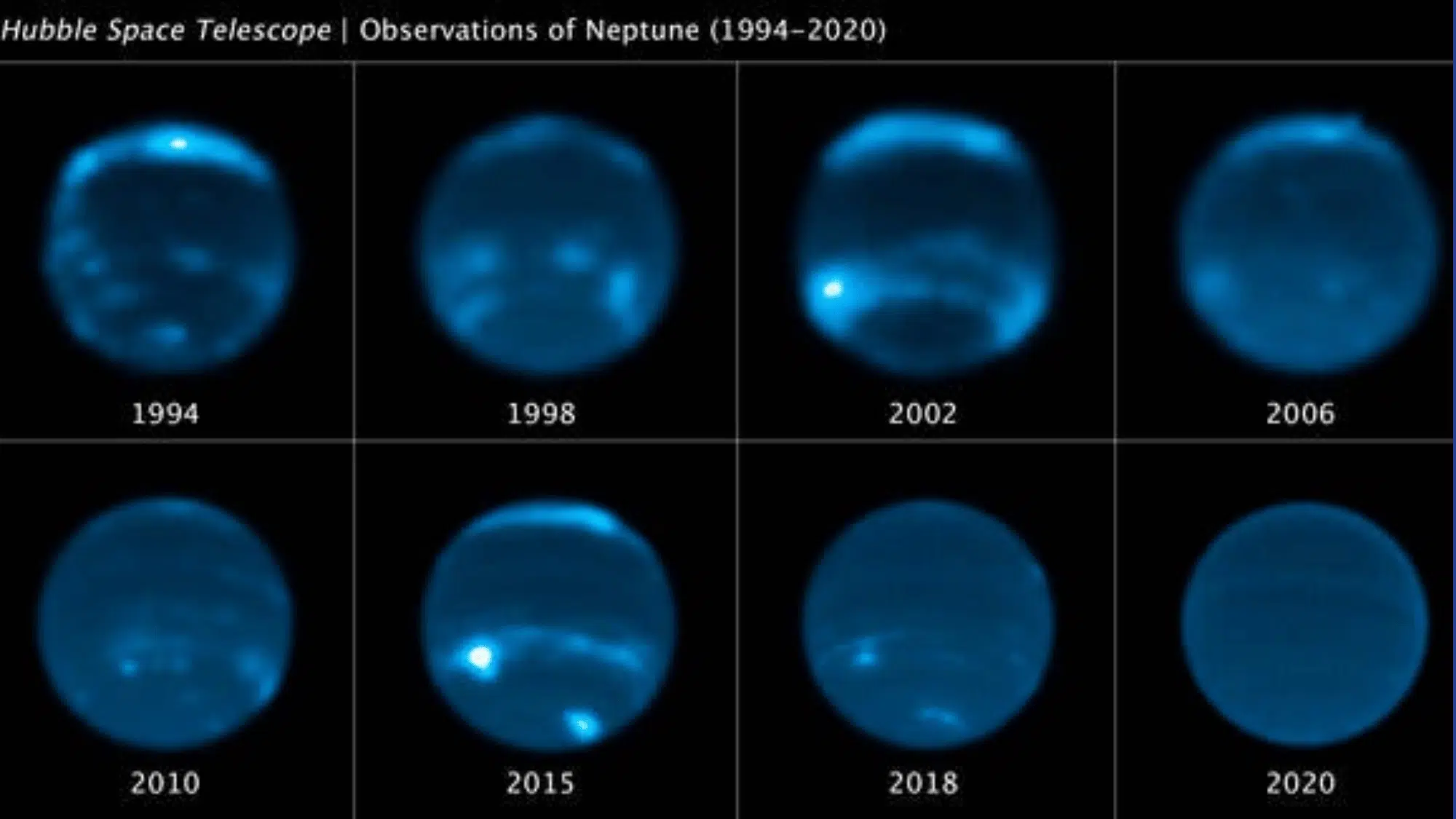
Image Source: The New York Times
When Voyager 2 flew past Neptune in 1989, it spotted something remarkable: a massive storm system called the Great Dark Spot. This anticyclonic storm resembled Jupiter’s famous Great Red Spot and measured roughly the size of Earth.
The Great Dark Spot rotated counterclockwise and moved westward at nearly 700 miles per hour.
White clouds of methane ice crystals hovered above it, creating a striking contrast against Neptune’s blue atmosphere. Scientists were excited to study what seemed like a permanent feature.
But when the Hubble Space Telescope looked at Neptune in 1994, the Great Dark Spot had completely disappeared. This vanishing act shocked astronomers who expected it to last for decades or centuries like Jupiter’s storm.
Since then, other dark spots have appeared and disappeared on Neptune. These transient storms suggest Neptune’s atmosphere is far more turbulent and changeable than initially thought, making it distinct from other gas giants.
Fun Facts About Neptune
Neptune’s extreme distance and unique characteristics make it one of the most intriguing planets. Here are some surprising facts that showcase its remarkable nature.
- Neptune completes one orbit around the sun every 165 Earth years, meaning it has only finished one full trip since its discovery in 1846.
- A day on Neptune lasts just 16 hours, making it one of the fastest-rotating planets despite being the slowest to orbit the sun.
- Neptune radiates more than twice the heat it receives from the sun, suggesting an internal heat source powers its violent weather systems.
- The planet’s gravity is only 17% stronger than Earth’s, so a 100-pound person would weigh just 117 pounds on Neptune’s cloud tops.
- Neptune’s blue color is more vivid than Uranus’ despite having a similar atmospheric composition, and scientists still debate why this difference exists.
- If Neptune were hollow, it could fit nearly 60 Earths inside its volume, yet it contains only 17 times Earth’s mass.
- Neptune’s moon Triton is slowly spiraling inward and will eventually be torn apart by tidal forces, creating a spectacular ring system in several billion years
Conclusion
Neptune challenges everything we think we know about planets. No solid ground exists on this ice giant, just layers of increasingly dense materials that would crush any visitor long before reaching the core.
Each revelation about Neptune raises new questions. Vanishing storms, backward-orbiting moons, and diamond rain represent just a fraction of its mysteries.
This distant world reminds us how diverse planetary bodies can be. While we may never walk on Neptune’s surface, studying it helps scientists understand planet formation and extreme physics.
What other secrets does Neptune hide in its deep blue depths? Future missions might one day provide answers to questions we haven’t even thought to ask yet.