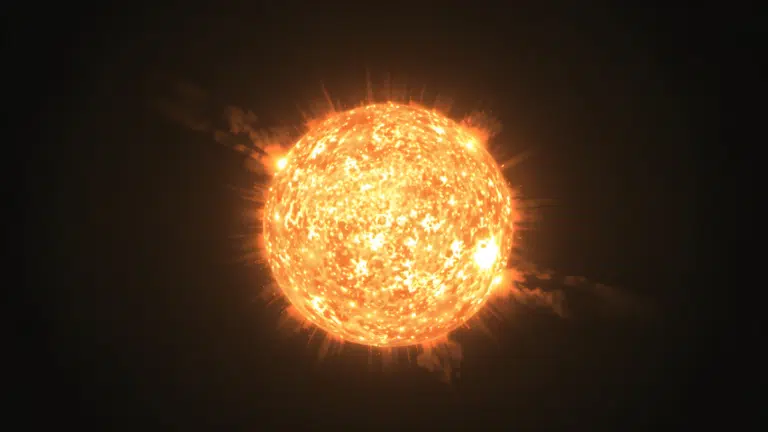

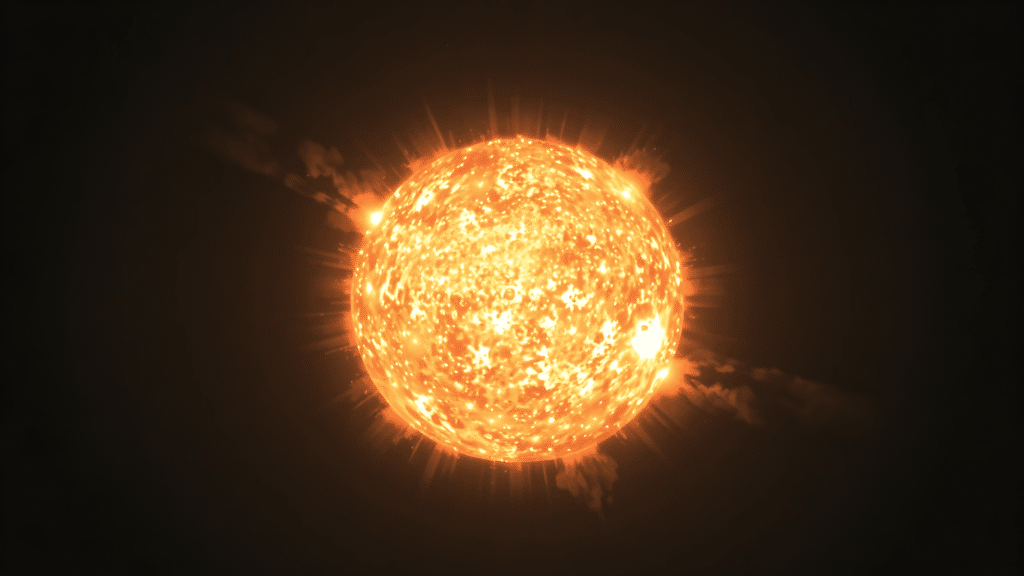
The Sun is the brightest object in Earth’s sky and the center of our solar system. It provides the light and heat that make life possible. Yet many people rarely stop to ask a basic question: what type of star is the Sun?
Scientists have studied this star for centuries to understand its nature and place in the universe.
Its steady glow may seem ordinary, but it holds important clues about how stars form and change over time.
This article explains how astronomers classify the Sun and why its star type matters for Earth and the rest of the solar system.
What Type of Star is the Sun?
The Sun is classified as a G-type main-sequence star, also known as a G2V star. This means it is a medium-sized star with a surface temperature of about 5,500°C and a yellow-white color.
The “G” refers to its temperature class, while the “V” shows that it is in the main stage of its life, where it fuses hydrogen into helium in its core.
This nuclear fusion produces the light and heat that power the solar system.
The Sun is often called a yellow dwarf, but it is actually average in size compared to many stars in the Milky Way galaxy.
How Scientists Classify Stars (O, B, A, F, G, K, M)
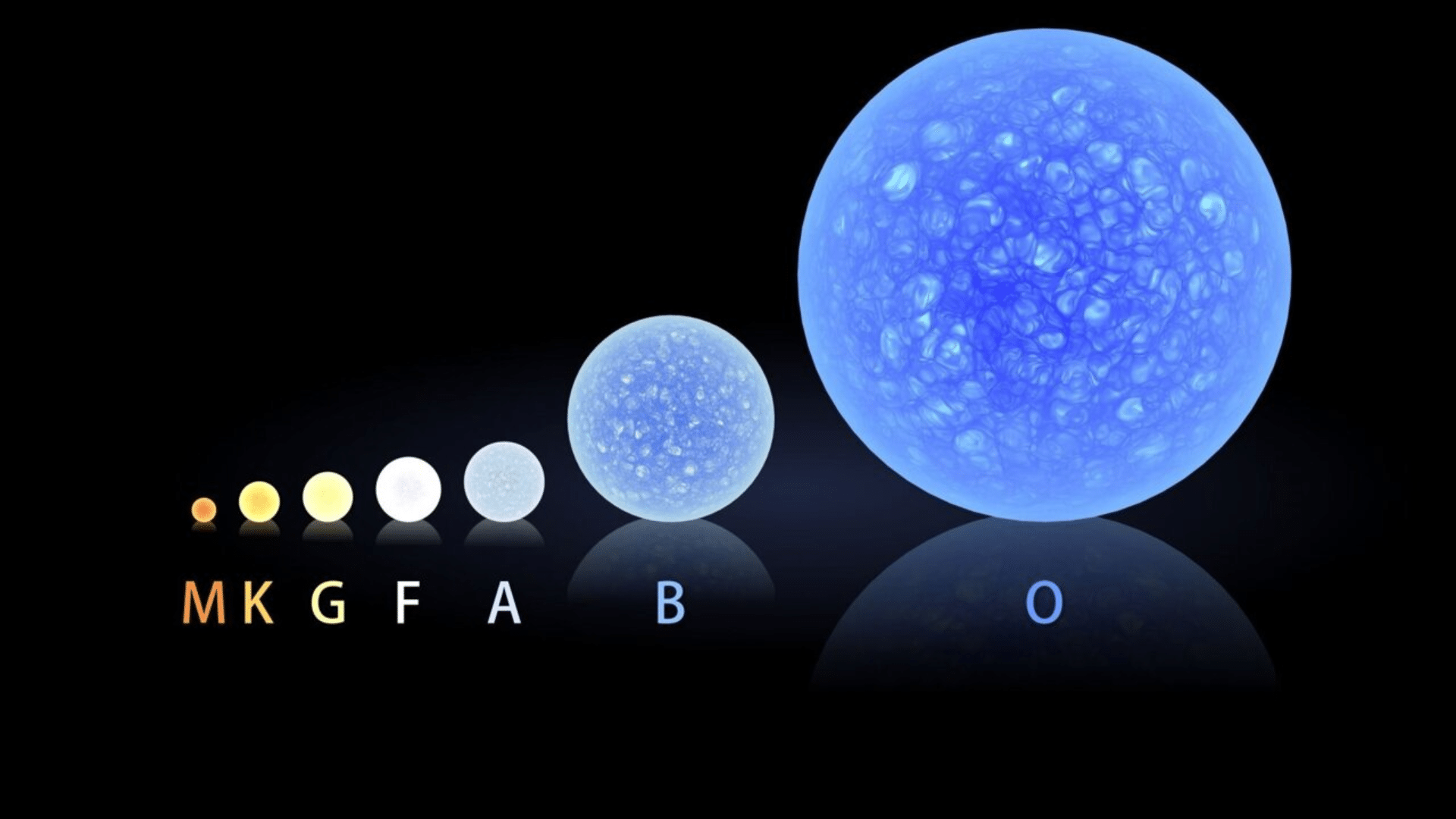
Image Source: Phys.org
Astronomers classify stars by studying measurable physical properties rather than simple visual appearance.
Key factors include:
- Surface Temperature
- Color
- Luminosity (intrinsic brightness)
- Mass
- Size
- Spectral Xharacteristics
When starlight is passed through a prism or spectrograph, it produces a spectrum marked by dark absorption lines.
These lines reveal important information about a star’s temperature and chemical composition. From this data, scientists developed the spectral classification system, which organizes stars into clear temperature-based categories.
The main spectral classes are arranged from hottest to coolest as follows:
| Spectral Type | Color | Temperature Range |
|---|---|---|
| O | Blue | Above 30,000 K |
| B | Blue-white | 10,000–30,000 K |
| A | White | 7,500–10,000 K |
| F | Yellow-white | 6,000–7,500 K |
| G | Yellow | 5,200–6,000 K |
| K | Orange | 3,700–5,200 K |
| M | Red | Below 3,700 K |
The Sun falls into the G-type category. Its surface temperature is about 5,778 K (5,500°C), placing it firmly within the G range.
What Does G2V Mean?
The Sun’s full classification is G2V, and each part of that label carries a specific meaning.
- G refers to its spectral class, which indicates surface temperature and color.
- 2 narrows its temperature within the G category.
- V refers to its luminosity class, meaning it is a main-sequence star.
Luminosity classes range from I (supergiants) to V (main-sequence stars). The Sun’s “V” classification confirms that it is in the stable phase of its life, where it steadily fuses hydrogen into helium in its core.
The Sun’s Physical Characteristics
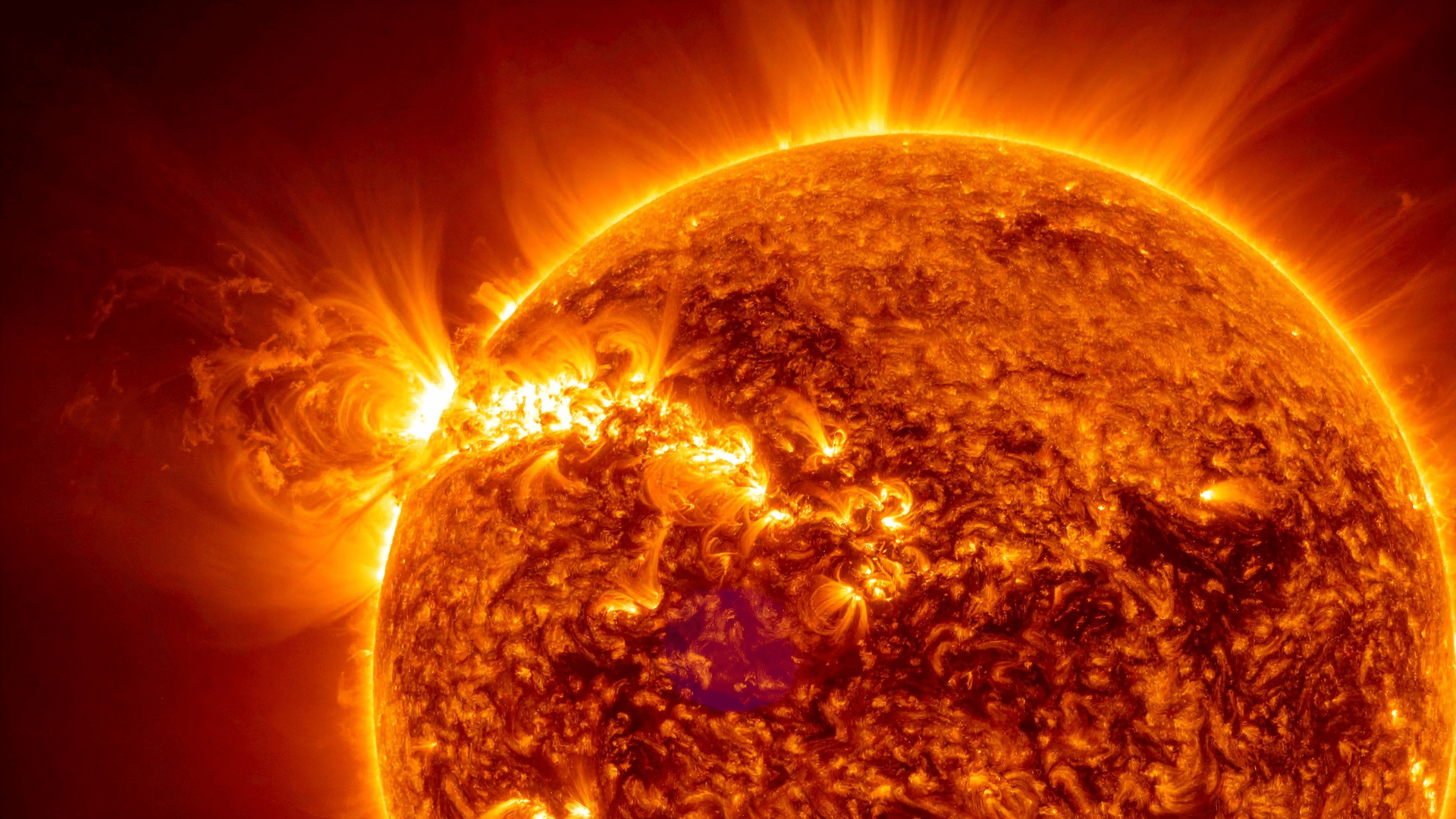
The Sun’s classification is supported by its measurable physical properties. These characteristics confirm its identity as a G-type main-sequence star.
Size and Mass
- Diameter: About 1.39 million kilometers
- Mass: About 1.989 × 10³⁰ kilograms
- Volume: Large enough to contain roughly 1.3 million Earths
Although enormous compared to Earth, the Sun is considered average in size when compared to many stars in the Milky Way. Some stars are hundreds of times larger in diameter, while others are much smaller.
Temperature Structure
The Sun’s temperature varies by layer:
- Core: Around 15 million°C
- Surface (photosphere): About 5,500°C
- Outer atmosphere (corona): Over 1 million°C
The extremely high temperature in the core enables nuclear fusion. The surface temperature, meanwhile, determines the Sun’s spectral classification as a G-type star.
Chemical Composition
The Sun is composed primarily of:
- About 74% hydrogen
- About 24% helium
- About 2% heavier elements (oxygen, carbon, neon, iron, and others)
These proportions are typical for a star of its type and age. The high hydrogen content is essential because hydrogen serves as the fuel for nuclear fusion.
Why the Sun is a Main-Sequence Star?
The defining feature of a main-sequence star is core hydrogen fusion. Inside the Sun’s core, hydrogen nuclei collide under immense pressure and temperature.
Through the proton-proton chain reaction, hydrogen atoms fuse to form helium. During this process, a small amount of mass is converted into energy according to Einstein’s equation:
E = mc²
This energy radiates and convects outward before escaping into space as sunlight.
What Keeps the Sun Steady for Billions of Years
The Sun remains stable because of a balance between two forces:
- Gravity pulls inward, compressing the core.
- Pressure from nuclear fusion pushes outward.
If fusion slows, gravity compresses the core, raising its temperature and pressure until fusion resumes. If fusion becomes too intense, the outer layers expand slightly, cooling the core.
This self-regulating balance allows the Sun to remain stable for billions of years. It has already spent about 4.6 billion years in this phase and is expected to continue for roughly another 5 billion years.
How the Sun Compares to Other Stars
To better understand what type of star the Sun is, it helps to compare it with other major star categories. The table below highlights key differences in size, temperature, lifespan, and overall behavior.
| Star Type | Surface Temperature | Size & Mass Compared to Sun | Lifespan | Key Characteristics |
|---|---|---|---|---|
| Red Dwarf (M-type) | 2,500–3,700 K | Smaller and less massive | Trillions of years | Cool, dim, most common stars in the galaxy |
| Sun (G2V) | ~5,778 K | Baseline | ~10 billion years | Medium temperature, stable hydrogen fusion |
| K-type Star | 3,700–5,200 K | Slightly smaller | 15–30 billion years | Orange color, long-lived and stable |
| A-type Star | 7,500–10,000 K | Larger and more massive | 1–2 billion years | White, brighter, shorter lifespan |
| Blue Giant (O/B-type) | 10,000–30,000+ K | Much larger and more massive | Millions of years | Extremely hot, very bright, short-lived |
| Red Giant | 3,000–5,000 K | Much larger in diameter | Late-life stage | Expanded outer layers, unstable phase |
This comparison shows that the Sun sits near the middle in terms of temperature and mass. It is hotter and more massive than red dwarfs but far smaller and cooler than blue giants.
The Sun’s Future Evolution
The Sun will not remain a G-type main-sequence star forever.
In about 5 billion years, hydrogen in the core will become depleted. The core will contract, and the outer layers will expand. The Sun will enter the red giant phase, growing large enough to engulf the inner planets.
Eventually, it will shed its outer layers, forming a planetary nebula. The remaining core will become a white dwarf, a dense and slowly cooling stellar remnant.
Because the Sun does not have sufficient mass, it will never explode as a supernova. Its evolution is typical for a star of its size.
To Conclude
The Sun may seem ordinary in the vast scale of the galaxy, yet its steady output of energy shapes every part of life on Earth.
Its structure, balance, and lifespan reveal how carefully tuned a star must be to support a stable planetary system.
Studying the Sun also helps scientists understand distant stars and the evolution of galaxies. It serves as both our energy source and our closest laboratory for stellar physics.
As research continues, the Sun remains central to understanding the universe itself. For more insights into space and astronomy, keep reading and explore our related guides.