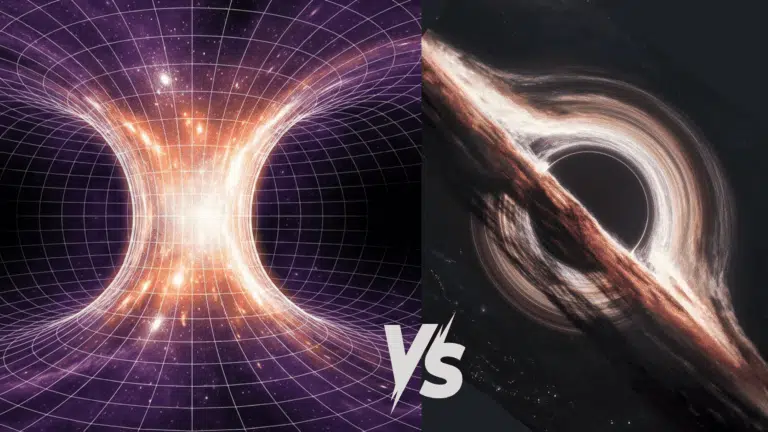
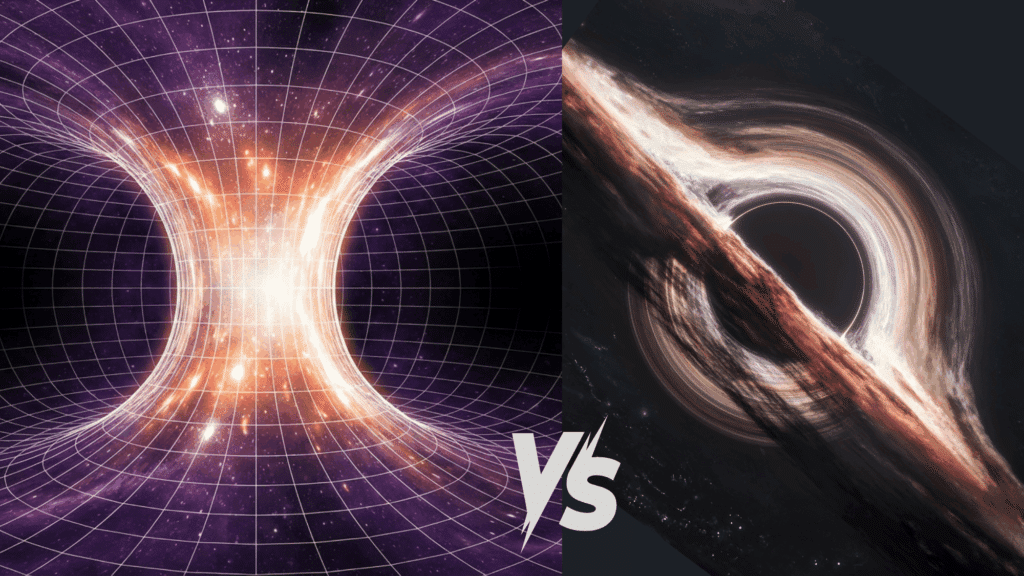
Space is full of mysteries. Some of them are so strange that they sound like something straight out of a science fiction movie. Wormholes and black holes are two of those mysteries.
Most people have heard these terms. But ask them to explain the difference, and things get a little fuzzy. Are they the same thing? Do they work in similar ways? And what makes one so different from the other?
Both involve extreme conditions in space. Both bend the rules of physics as we know them. Yet they are not the same, not even close.
This blog breaks down what sets these two cosmic phenomena apart in the simplest way possible
What is a Black Hole?
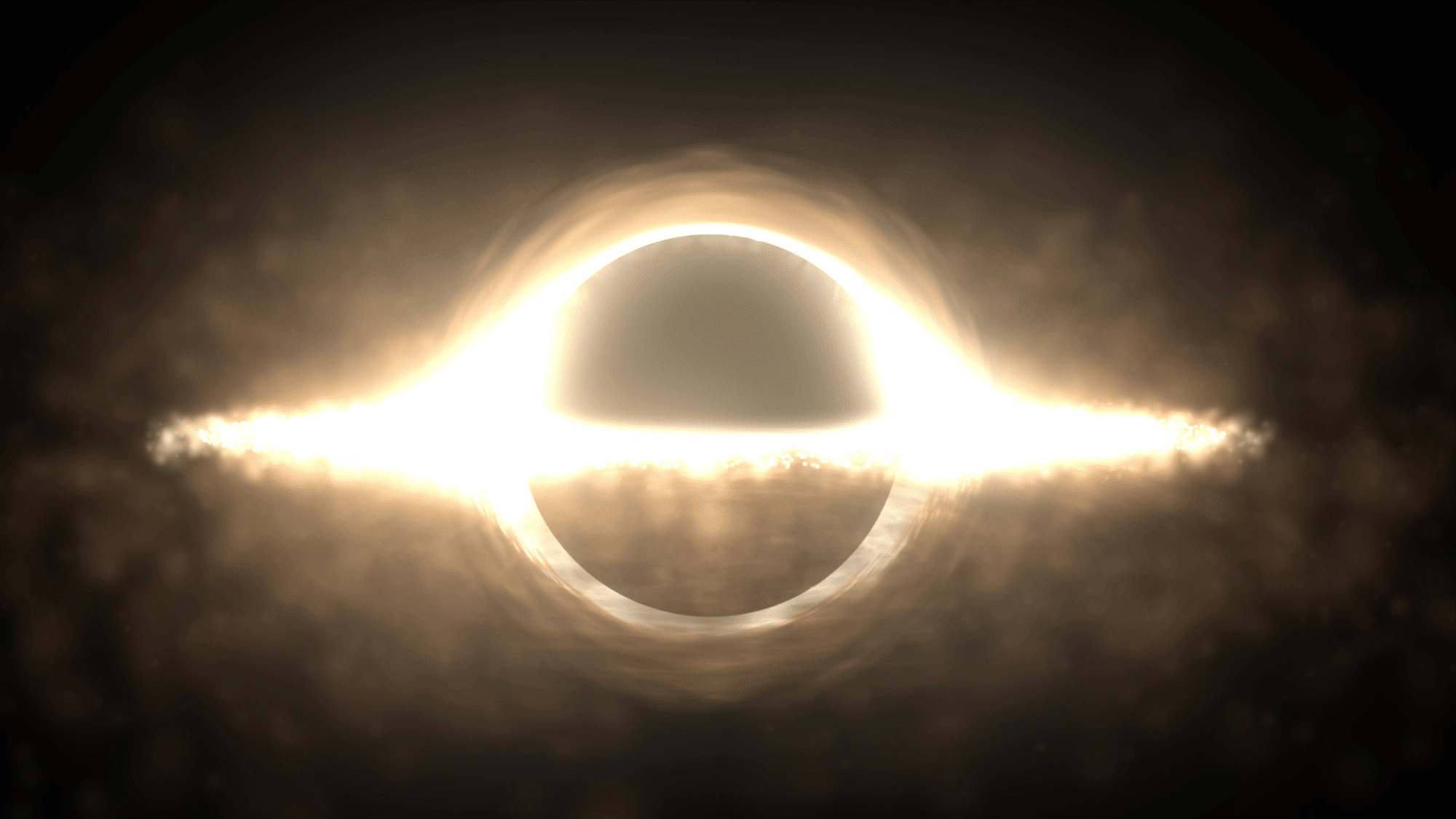
A black hole is a region in space where gravity is so strong that nothing, not even light, can escape it.
How Black Holes Form
Most black holes form when a massive star runs out of fuel. The star collapses under its own weight. This triggers a powerful explosion called a supernova.
1. Collapse of Massive Stars: When a star much bigger than the Sun dies, its core collapses. The outer layers get crushed inward with enormous force. That collapse creates one of the most extreme objects in the universe.
2. Supernova Connection: Not every supernova creates a black hole. The star needs to be massive enough. When conditions are right, the core left behind after the explosion collapses into a black hole.
Key Features of Black Holes
Every black hole shares three defining features that make it unlike anything else in space.
- Event Horizon: The point of no return around a black hole
- Singularity: An infinitely dense point at the center
- Gravitational Pull: Extreme gravity that pulls in everything nearby
What Happens Inside a Black Hole?
Spaghettification: As an object falls into a black hole, the difference in gravitational pull stretches it, like pulling taffy. The feet get pulled faster than the head. Scientists actually call this process “spaghettification.” It sounds funny, but the physics behind it is very real.
Time Dilation: Near a black hole, time slows down. The stronger the gravity, the slower time moves. Someone falling into a black hole would experience time very differently from someone watching from far away.
What is a Wormhole?
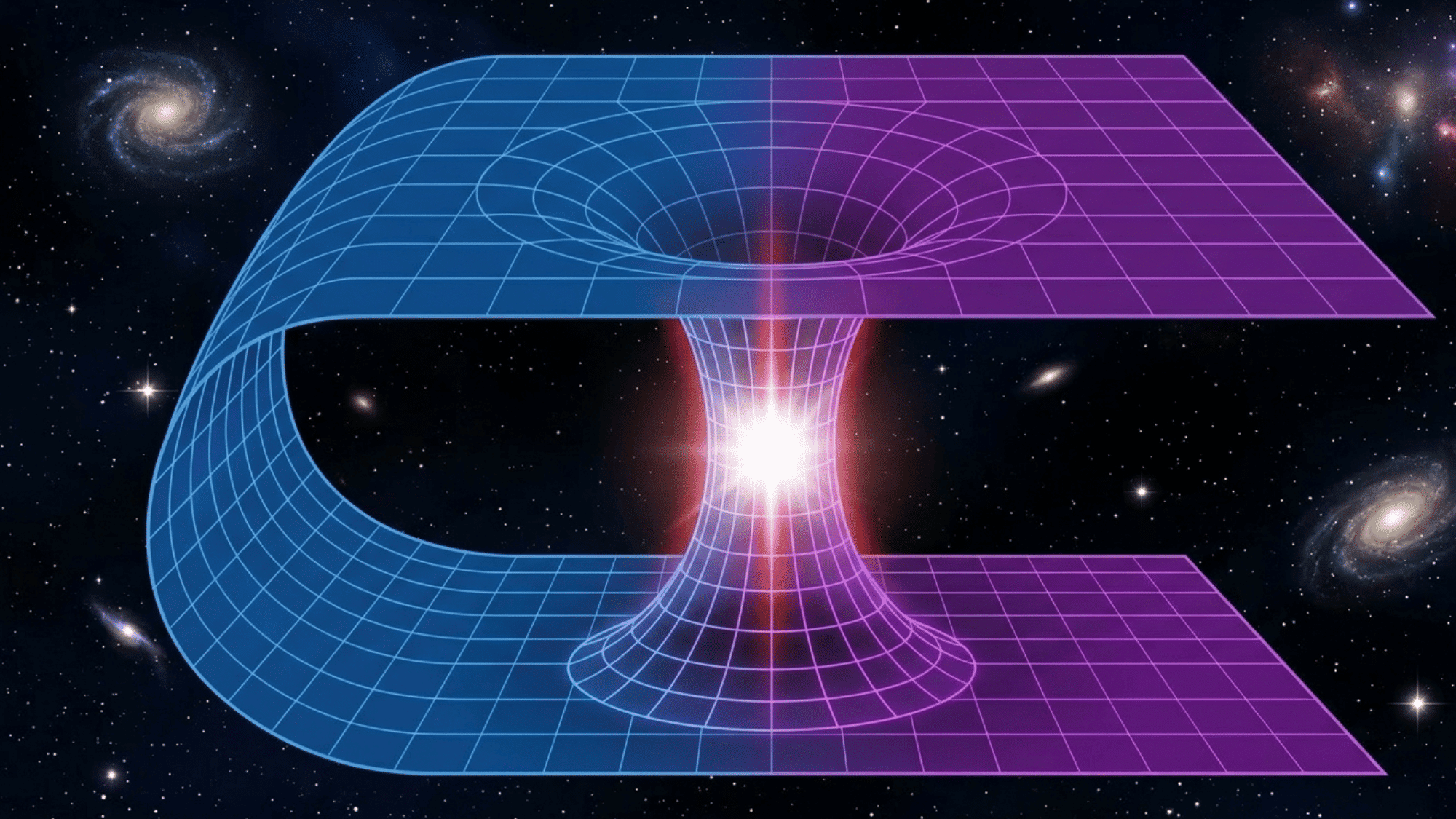
A wormhole is a theoretical tunnel through space-time that could connect two distant points in the universe.
Wormhole Explanation
Imagine a piece of paper with two dots drawn far apart. Normally, traveling from one dot to the other means crossing the entire page. But fold that paper so the two dots touch, and suddenly, the distance disappears.
That folded paper is exactly how a wormhole works. Instead of traveling across space the long way, a wormhole would bend space-time itself.
Two points that are light-years apart could theoretically sit right next to each other through a wormhole tunnel.
Types of Wormholes
There are two main types of wormholes that physicists talk about.
- Einstein-Rosen Bridge: First proposed by Albert Einstein and Nathan Rosen in 1935. This type connects two separate regions of space-time. However, it collapses too quickly for anything to pass through.
- Traversable Wormholes (Theoretical): These are wormholes that could, in theory, stay open long enough for matter to travel through. They would require something called “exotic matter” to hold them open, something that has never been observed in nature.
Are Wormholes Real or Just a Theory?
Scientific Status: Right now, wormholes exist only on paper. No wormhole has ever been detected or observed. Every claim about wormholes comes from mathematical models, not real-world evidence. That does not mean they are impossible, just unproven.
Role in Physics Equations: Wormholes show up naturally in Einstein’s general theory of relativity. The math allows for them to exist. Many physicists take them seriously as a concept worth studying, even though actually finding one remains a distant possibility.
Wormhole vs Black Hole: Side-by-Side Comparison
Both wormholes and black holes involve extreme gravity and warped spacetime, but they behave very differently.
| Feature | Black Hole | Wormhole |
|---|---|---|
| Definition | A region where gravity pulls everything in | A tunnel connecting two points in space-time |
| Existence | Confirmed and observed | Theoretical only |
| Entry | Nothing escapes once inside | Matter could pass through (in theory) |
| Formation | Formed from collapsed massive stars | Unknown — never observed forming |
| Effect on Light | Absorbs all light completely | Could allow light to pass through |
| Event Horizon | Present | Not necessarily present |
| Singularity | Has one at the center | Does not have one |
| Time Dilation | Extreme near the event horizon | Could affect time across connected points |
| Gravitational Pull | Pulls everything inward | Connects regions rather than pulling them in |
| Role in Science | Studied through observation and data | Studied through mathematical equations |
| Danger to Objects | Destroys everything that enters | Could theoretically allow safe passage |
| Real-World Detection | Yes, detected multiple times | No, never detected |
Can Black Holes Turn Into Wormholes?
This is one of the most talked-about questions in theoretical physics. Some scientists have suggested that black holes and wormholes may be more connected than they appear.
A few theories propose that the interior of a black hole could behave like a wormhole linking one region of space-time to another.
Physicist Juan Maldacena even suggested that two entangled black holes could form something similar to a wormhole between them. This idea is known as the ER = EPR conjecture.
Exciting as it sounds, none of this has been proven. It remains a thought experiment, a fascinating one, but still firmly in the territory of theory.
The line between black holes and wormholes is blurry in the math, but clear in reality.
Can Humans Travel Through Wormholes or Black Holes?
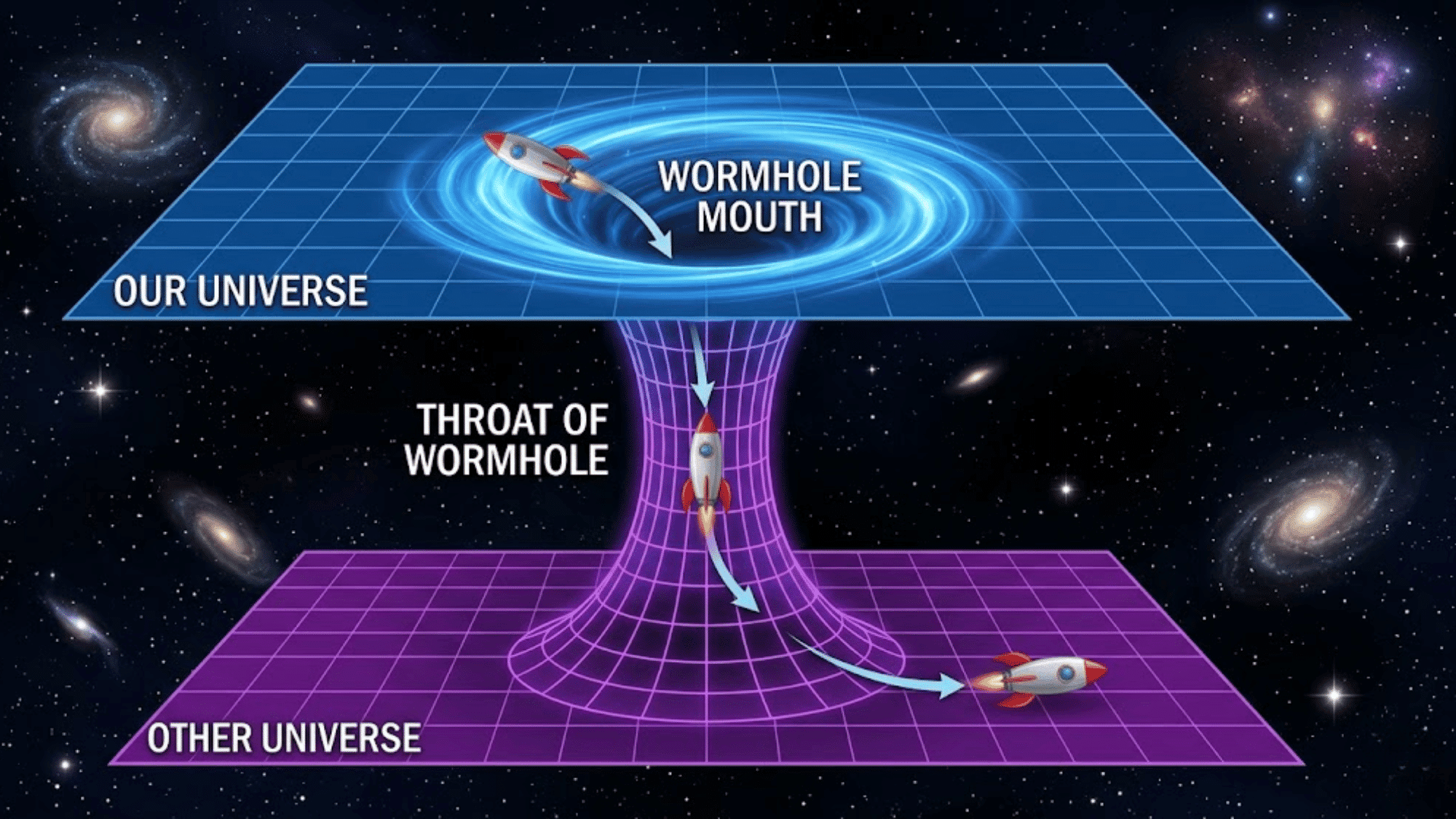
The answer is no, at least not with current understanding. Traveling through a black hole would mean crossing the event horizon, after which survival becomes physically impossible.
The gravitational forces alone would stretch a human body apart long before reaching the center.
Wormholes paint a slightly different picture. If a stable, traversable wormhole existed, some physicists believe matter could pass through without being destroyed.
But keeping one open would require exotic matter with negative energy, something that has never been found.
So while the math leaves a small door open for wormhole travel, black hole travel remains firmly off the table for any living thing.
Similarities Between Wormholes and Black Holes
Despite their differences, wormholes and black holes share several surprising traits rooted in the same laws of physics.
- Both Involve Curved Space-Time: Gravity bends space-time around both objects, making them key subjects in Einstein’s general theory of relativity.
- Both Deal With Extreme Gravity: Enormous gravitational forces play a central role in how both black holes and wormholes are defined and studied.
- Both Affect Time: Time behaves differently near both objects. Gravity, strong enough to bend space-time, also has a direct effect on how time flows.
- Both Appear in Einstein’s Equations: The mathematics of general relativity naturally allows for both objects to exist within the same theoretical framework.
- Both Remain Poorly Understood: Despite decades of research, neither black holes nor wormholes are fully understood. Many questions about both remain unanswered.
- Both cannot Be Directly Observed With Ease: Black holes are detected indirectly, and wormholes have never been spotted. Direct observation of either remains a serious scientific challenge.
- Both Exist at Extremes of Physics: Normal rules of physics break down around both. They sit at the very edge of what current science can explain or measure.
Latest Scientific Research on Black Holes and Wormholes
Science has made some remarkable progress on both fronts in recent years.
In 2019, the Event Horizon Telescope captured the first-ever image of a black hole, a historic moment for astronomy. In 2022, the same team released an image of the black hole at the center of our own galaxy, Sagittarius A*.
These images gave scientists real data to work with. On the wormhole side, researchers at Caltech conducted a quantum experiment in 2022 that simulated wormhole-like behavior using a quantum computer.
It was not a real wormhole, but it showed that the concept holds up in controlled conditions. Both fields are moving fast.
Each new discovery brings physicists one step closer to understanding the deepest secrets of the universe.
The Final Thought
Black holes and wormholes sit at opposite ends of what science knows and what it only imagines. One has been seen, photographed, and studied.
The other exists purely in equations and thought experiments for now.
What makes both worth paying attention to is how much they push the boundaries of human understanding. Every new image captured, every quantum experiment run, adds another piece to a very large puzzle.
The universe clearly has more to say on both subjects. For anyone curious about space, keeping an eye on research in these areas is well worth the time.
The next big discovery could change everything known about how space and time actually work.