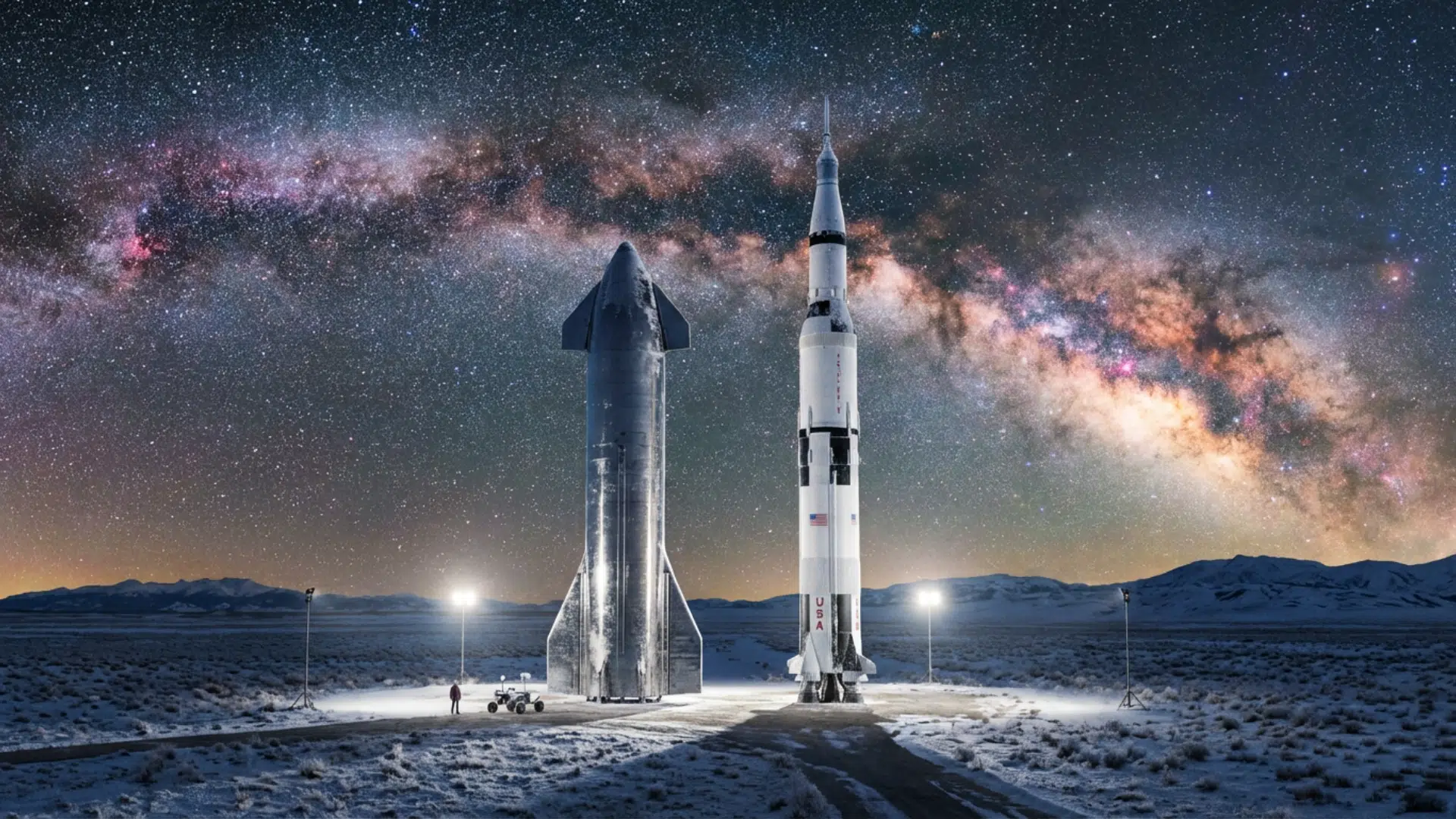



Saturn V and Starship are two of the most talked-about rockets in space history. Saturn V played a central role during the Apollo missions and became a symbol of the early space race.
Many decades later, Starship represents a new direction in rocket development and long-term space travel. Both rockets were designed to carry large payloads and support ambitious missions beyond Earth.
However, they come from very different periods of technology and space goals. This difference raises many questions about their power and abilities.
Comparing them helps show how rocket technology has changed over time and why these two launch vehicles still attract attention today.
What was the Saturn V Rocket?
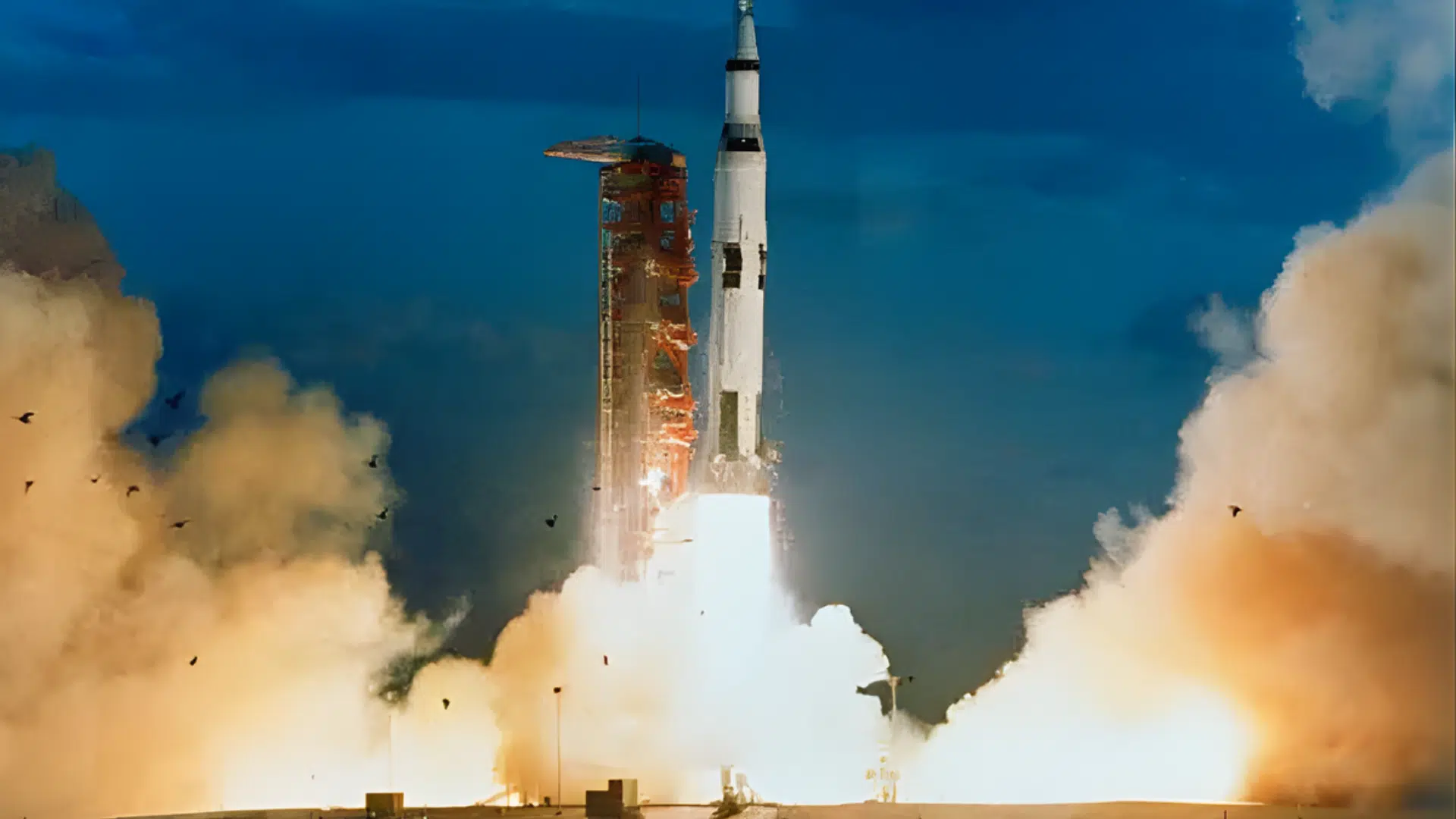
Image Source: Cradle of Aviation Museum
Saturn V was a heavy-lift rocket developed by NASA during the Apollo program. It played a central role in the missions that sent astronauts to the Moon.
The rocket became one of the most recognizable symbols of the space race between the United States and the Soviet Union.
Its main purpose was to launch the Apollo spacecraft, which carried astronauts, equipment, and scientific instruments needed for lunar missions.
Saturn V provided the power required to push these spacecraft beyond Earth orbit and toward the Moon.
Development During the Apollo Program
Saturn V was created to support NASA’s goal of landing astronauts on the Moon. Development began in the early 1960s when the United States committed to the Apollo program.
The rocket launched the Apollo spacecraft, which included the command module, service module, and lunar module.
Key Design Features
- Designed to carry very heavy spacecraft and mission equipment into space.
- Built to support deep-space missions that required large fuel capacity and strong propulsion.
- Equipped with advanced onboard guidance systems for flight control.
- Guidance systems monitored speed, direction, and position during launch.
- Helped maintain stability as the rocket moved through the atmosphere and into space.
Rocket Stages and Engines
Saturn V had three main stages:
- First Stage (S-IC): Five F-1 engines produced most of the launch thrust.
- Second Stage (S-II): Five J-2 engines pushed the rocket higher into space.
- Third Stage (S-IVB): One J-2 engine sent the spacecraft toward the Moon.
Each stage separated after its fuel was used, making the rocket lighter as it climbed.
Major Missions and Achievements
Saturn V launched 13 successful missions between 1967 and 1973. Most of these launches were part of the Apollo program.
One of the most historic flights was Apollo 11 in 1969, when astronauts reached the Moon and returned safely to Earth. Saturn V also launched Skylab, the United States’ first space station.
These missions demonstrated that humans could travel beyond Earth orbit and conduct scientific exploration in deep space.
What is SpaceX Starship?
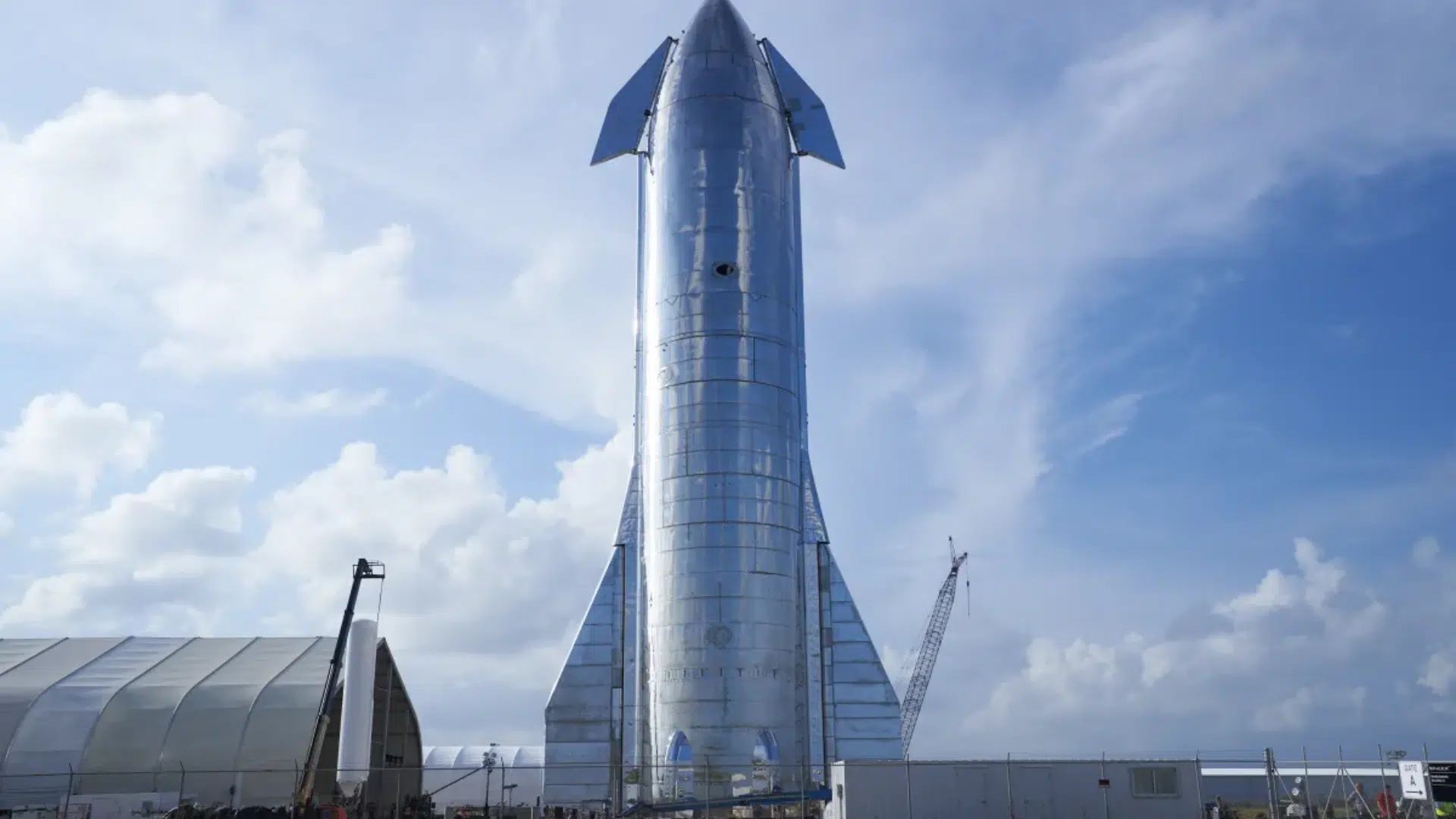
Image Source: TechCrunch
Starship is a modern launch system developed by SpaceX. It is designed to transport large numbers of people and cargo to destinations beyond Earth orbit.
The rocket is part of a broader effort to make space travel more accessible and support long-term exploration missions.
Unlike many earlier rockets, Starship is intended to operate as a reusable spacecraft. This approach aims to reduce the cost of launching missions and allow rockets to fly more frequently.
The Starship and Super Heavy System
Starship launches using two stages:
- Super Heavy booster, the powerful first stage that lifts the rocket off the launch pad
- Starship spacecraft, the upper stage that carries cargo or crew into space
Together, these two stages create one of the largest launch systems ever built.
Design and Engineering Goals
- Built to carry large cargo and payloads into Earth orbit.
- Designed to support lunar missions and long-term space exploration.
- Intended for deep-space travel beyond Earth orbit.
- Includes orbital refueling, allowing spacecraft to transfer fuel in space and travel farther from Earth.
Reusable Rocket Technology
A major difference between Starship and earlier rockets is reusability. Most past rockets were used once and discarded after launch. Starship is designed to land and fly again, which could lower the cost of space travel.
Planned Missions and Future Use
- Expected to launch large satellite payloads into orbit.
- Planned to support NASA’s Artemis lunar missions and other Moon exploration projects.
- Intended for long-term deep-space missions, including possible human journeys to Mars.
- The rocket is still in development, with ongoing testing and engineering improvements.
Starship vs Saturn V: Side-by-Side Comparison
Saturn V and Starship were built for different generations of space exploration. Saturn V supported the Apollo Moon missions, while Starship represents a modern launch system designed for reusable space travel. The table below shows how their major features compare.
| Feature | Saturn V | Starship |
|---|---|---|
| First Launch | 1967 | 2020s testing |
| Height | ~111 meters | ~120 meters |
| Liftoff Thrust | ~7.6 million pounds | ~16+ million pounds |
| Payload to Low Earth Orbit | ~140 tons | ~100–150 tons |
| Rocket Stages | 3 stages | 2 stages |
| Engines | F-1 and J-2 engines | Raptor engines |
| Fuel Type | Kerosene and liquid hydrogen | Liquid methane and liquid oxygen |
| Reusability | Single use | Designed for full reuse |
| Main Purpose | Apollo Moon missions | Future Moon and Mars missions |
Starship vs Saturn V: Performance Differences
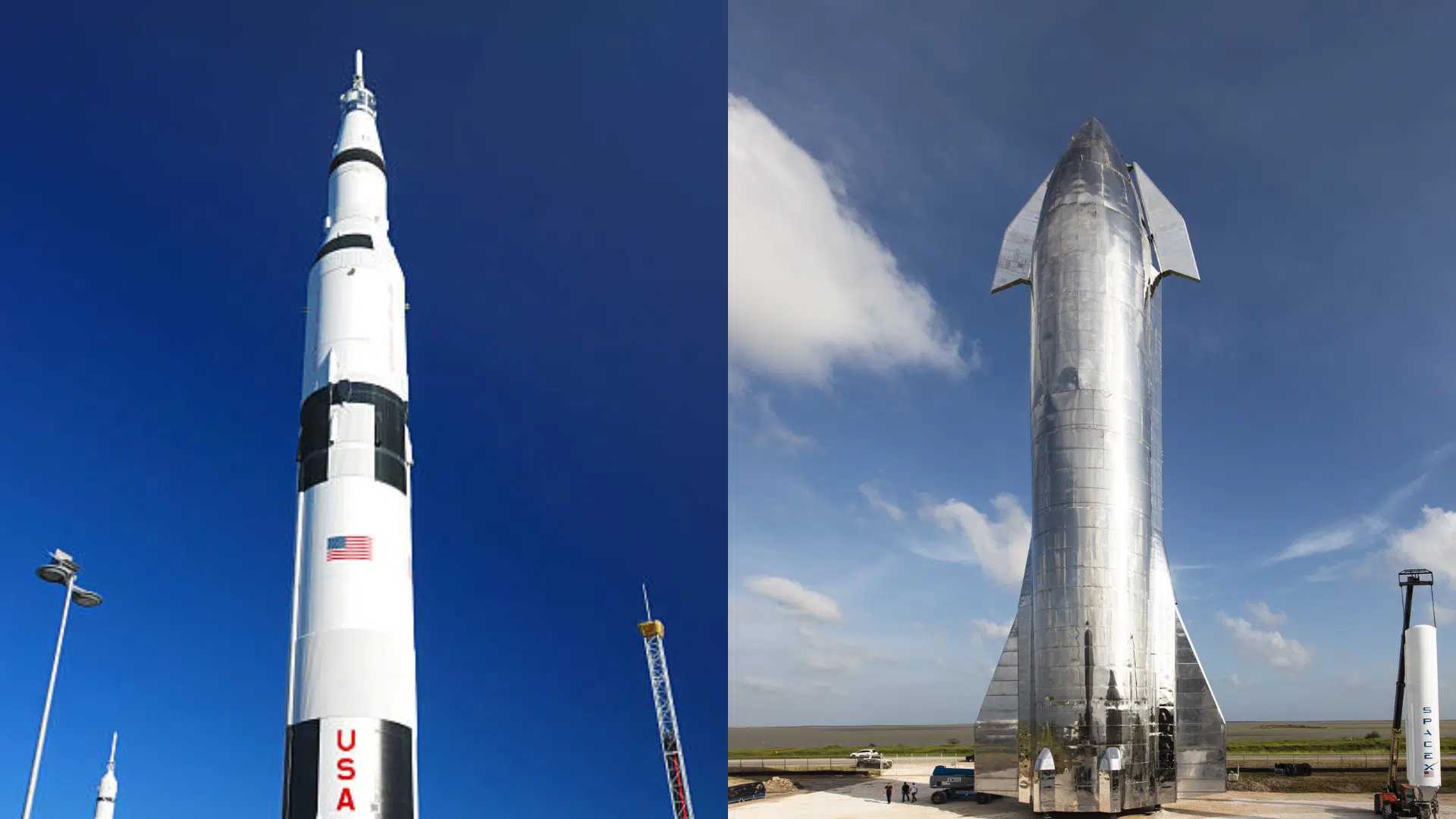
To determine which rocket is more powerful, it helps to consider several factors, including thrust, payload capacity, engine design, and overall engineering approach.
Liftoff Thrust
Liftoff thrust refers to the total force a rocket produces when it leaves the launch pad. This force must be strong enough to lift the rocket’s weight, its fuel, and the payload it carries into space.
Saturn V generated around 7.6 million pounds of thrust at launch using five large F-1 engines. This level of power made it the strongest rocket ever flown for many decades.
Starship’s Super Heavy booster produces significantly more thrust, estimated at over 16 million pounds.
This greater force allows the system to lift a larger rocket structure and carry heavier payloads. Because of this, Starship is considered more powerful in terms of raw launch thrust.
Payload Capacity
Payload capacity describes how much cargo a rocket can carry into orbit or toward deep-space destinations. This includes spacecraft, satellites, equipment, or supplies needed for missions.
Saturn V was capable of carrying very heavy spacecraft used during the Apollo missions. These missions required large payloads, including crew modules, lunar landers, and scientific equipment.
Starship is designed to carry a similar or greater payload, depending on the mission configuration.
The rocket is intended to carry large cargo loads, including satellites and equipment for future space missions. Its design allows flexibility for different mission types.
Engine Technology
Saturn V used F-1 engines in its first stage, which burned kerosene and liquid oxygen. These engines were extremely powerful and remain among the largest single-chamber liquid engines ever built.
The rocket’s upper stages used J-2 engines fueled by liquid hydrogen and oxygen. These engines helped push the spacecraft into orbit and toward the Moon.
Starship uses Raptor engines, which burn methane and liquid oxygen. These engines operate at very high pressure and represent a newer generation of rocket propulsion technology.
The methane fuel also supports the possibility of refueling systems that could be useful for future deep-space missions.
Rocket Design
Saturn V used a three-stage configuration. Each stage carried its own engines and fuel supply, and once that fuel was used, the stage separated from the rocket.
This process reduced the weight as the rocket climbed higher into space.
Starship uses a two-stage system made up of the Super Heavy booster and the Starship spacecraft.
The design is simpler, focusing on efficiency, large fuel capacity, and the ability to support a wide range of missions.
Reusability
Saturn V was designed as a single-use launch vehicle. After each stage completed its job, it separated and was lost during the mission. This approach was common during the early space race.
Starship is designed for full reusability. Both the Super Heavy booster and the Starship spacecraft are intended to land after flight so they can be prepared for future launches.
If this system works as planned, it could significantly reduce launch costs and allow rockets to fly much more often.
Missions and Goals: Moon vs Mars
The purpose behind each rocket reflects the priorities of its era. Saturn V was developed during the Apollo program to support lunar exploration. Starship is designed for future missions that may extend much farther into space.
| Mission Focus | Saturn V | Starship |
|---|---|---|
| Main Program | Apollo Program | Artemis and future missions |
| Target Destination | Moon | Moon and Mars |
| Mission Type | Government lunar missions | Commercial and deep-space missions |
| Exploration Goal | First human Moon landing | Long-term space exploration |
Saturn V helped achieve the historic goal of landing humans on the Moon. Starship aims to support future exploration efforts that could extend to Mars and beyond.
What Space Communities Say About Starship vs Saturn V
Discussions about Starship and Saturn V often appear in online space communities. Common viewpoints include:
For Saturn V:
- Often described as one of the greatest engineering achievements of the 20th century.
- Remembered for powering the Apollo missions that landed humans on the Moon.
- Known for its reliability and successful launch record.
- Considered a symbol of the 1960s space race and NASA’s technological leadership.
- Frequently praised for the massive F-1 engines used in its first stage.
For Starship:
- Often viewed as the next major step in space transportation technology.
- Known for its fully reusable launch system concept.
- Praised for producing far greater thrust than earlier rockets.
- Seen as a key vehicle for future Moon missions and possible Mars exploration.
- Frequently discussed as a rocket that could reduce the cost of launching missions into space.
Final Thoughts
Saturn V and Starship highlight how launch systems evolve as space goals change. Saturn V operated in a government-led era focused on a single historic objective.
Starship is being developed in a period when frequent launches, reusable hardware, and large cargo missions are central to the idea.
As Starship continues testing, more real data will shape this comparison in the future. Until then, the discussion remains open.
Which rocket do you think represents the bigger step forward in spaceflight? Share your thoughts below and join the conversation.