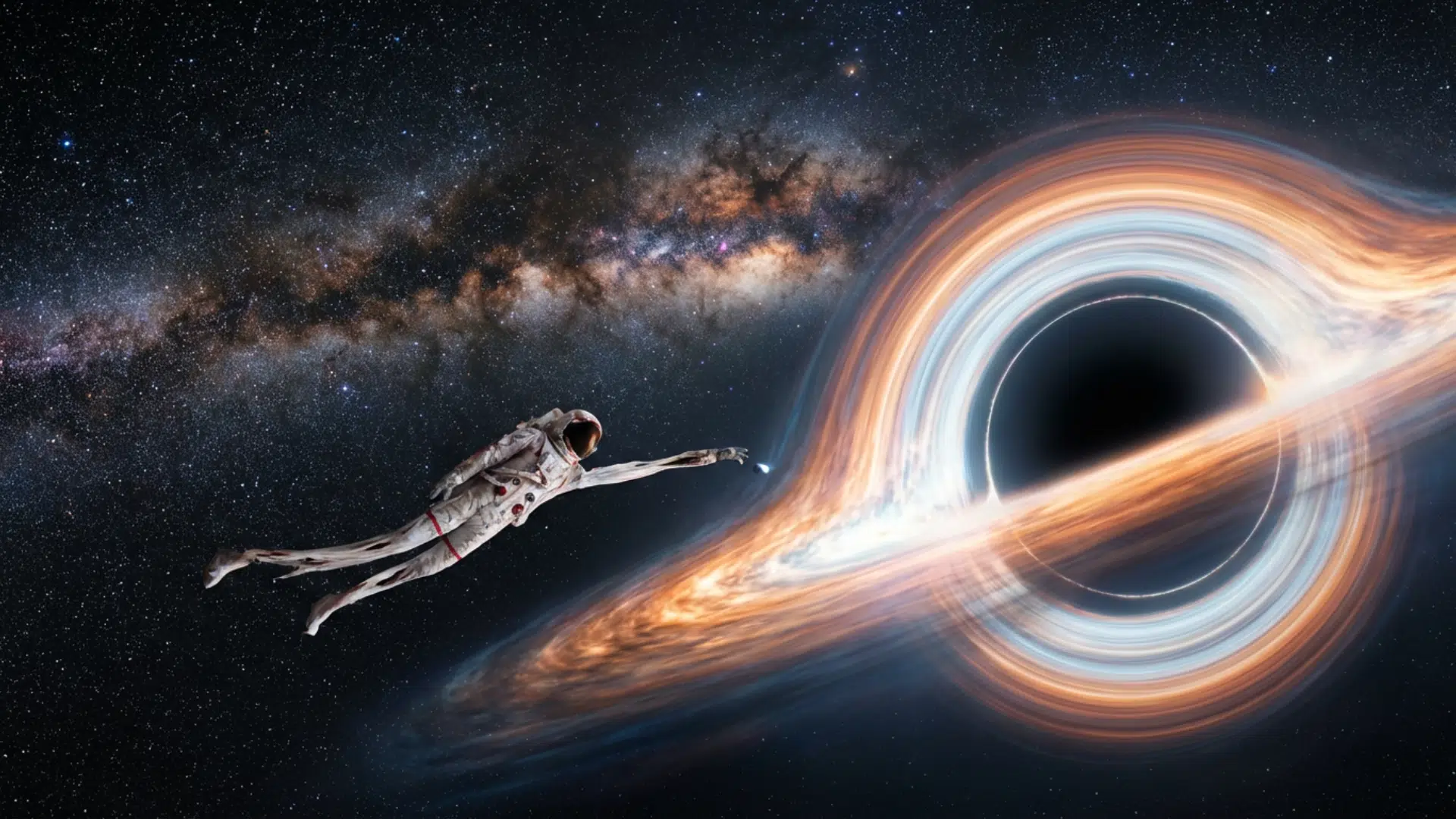



Black holes represent the most extreme environments in the known universe. Their gravity is so intense that once something crosses a certain boundary, it cannot return.
Among the many strange effects linked to these cosmic objects is a process known as spaghettification.
Despite its unusual name, it describes a real and powerful physical phenomenon. When matter moves too close to a black hole, gravity does not pull evenly across it. Instead, it stretches the object in a dramatic and destructive way.
Understanding spaghettification near black holes helps explain how gravity behaves at its limits and what truly happens to objects caught in its force.
What is Spaghettification?
Spaghettification is the stretching of an object into a long, thin shape due to powerful tidal forces. The name comes from the resemblance to spaghetti strands. In scientific terms, it describes the effect of uneven gravity acting across the length of an object.
Gravity weakens with distance. Near Earth, this change is small across the height of a person, so it goes unnoticed.
Near a black hole, however, gravity increases sharply over short distances. The part of an object closer to the black hole feels a stronger pull than the part farther away. This difference creates tension within the object.
In simple terms, spaghettification happens because gravity pulls harder on one end than the other. That difference is what stretches the object.
Why Black Holes Cause Spaghettification

Black holes cause spaghettification because of their extreme gravitational gradients. A gravitational gradient means that gravity changes sharply over a short distance.
The steeper the change, the stronger the tidal forces acting on an object. Near a black hole, this change in gravity is far more intense than anywhere else in the universe.
Gravity and Distance
Gravity depends on two main factors:
- The mass of the object creating gravity
- The distance from that object
Black holes contain an enormous amount of mass compressed into a very small region. Because gravity becomes stronger as distance decreases, the pull near a black hole rises rapidly within a short range. Even a small difference in distance can result in a large difference in gravitational force.
Tidal Forces and Uneven Pull
Tidal forces occur when gravity pulls unevenly across an object. On Earth, tidal forces from the Moon cause ocean tides. Near a black hole, the same principle applies, but the forces are much stronger.
Key characteristics of tidal forces near black holes include:
- The near side of an object feels stronger gravity than the far side
- The object stretches along the direction of the pull
- The object compresses sideways toward the center
This combination of stretching and squeezing defines spaghettification near black holes.
Step-by-Step Process of Spaghettification
Spaghettification does not happen instantly. It unfolds as an object moves closer to the black hole.
1. Initial Approach
As an object approaches, gravity increases steadily. At first, the forces are not strong enough to cause structural damage.
2. Rising Tidal Forces
When the object reaches a critical distance, tidal forces begin to create noticeable stretching. The difference in gravitational pull between the near and far ends grows stronger.
3. Structural Stress
Internal forces within the object try to resist the stretching. For solid objects, this means chemical bonds and structural materials begin to strain.
4. Elongation and Compression
The object stretches lengthwise and compresses sideways. If the tidal forces exceed the object’s structural strength, it begins to break apart.
5. Fragmentation
The object eventually tears into smaller pieces. Each piece continues to experience tidal forces and may stretch further as it falls inward.
This sequence explains how spaghettification near black holes progresses from mild tension to total destruction.
Vertical Stretching vs Horizontal Compression

Spaghettification near black holes is driven by two forces acting at the same time: vertical stretching and horizontal compression. These forces are both caused by tidal effects, but they act in different directions.
Vertical Stretching (Radial Stretching)
Vertical stretching occurs along the line pointing toward the black hole. The part of the object closer to the black hole feels a stronger gravitational pull than the part farther away. This difference creates tension that pulls the object lengthwise.
As the object moves closer:
- The near end accelerates faster than the far end
- Internal forces struggle to hold the structure together
- The object becomes longer and thinner
- Structural failure eventually begins
This lengthwise pulling is the main reason the object starts to resemble a strand of spaghetti.
Horizontal Compression (Lateral Squeezing)
At the same time, gravity pulls matter inward from the sides toward the center. While the object stretches vertically, it is also being squeezed horizontally. This happens because gravity draws all parts of the object toward the black hole’s central point.
During horizontal compression:
- The width of the object decreases
- The sides are pushed inward
- The object becomes narrower as it elongates
Combined Effect
The combination of vertical stretching and horizontal compression defines spaghettification near black holes. The object does not simply get pulled apart in one direction.
It is stretched along its length while being squeezed from the sides. When tidal forces exceed the material’s strength, the object breaks apart and continues to deform as it falls inward.
This dual action explains why spaghettification is a process of extreme distortion rather than simple crushing.
Does Black Hole Size Matter?
Yes, the size of the black hole plays a critical role in how spaghettification occurs. There are two main categories:
- Stellar-mass black holes (a few times the mass of the Sun)
- Supermassive black holes (millions to billions of solar masses)
The difference between them affects where spaghettification happens.
Comparison Table
| Feature | Stellar Black Hole | Supermassive Black Hole |
|---|---|---|
| Mass | 3–20 times Sun’s mass | Millions to billions of solar masses |
| Event horizon size | Small | Extremely large |
| Tidal forces at the horizon | Extremely strong | Can be weaker at the horizon |
| Where spaghettification occurs | Often outside the event horizon | May occur inside the event horizon |
In smaller black holes, tidal forces become intense before the object crosses the event horizon. In supermassive black holes, an object might cross the event horizon before experiencing extreme stretching.
This shows that spaghettification near black holes depends not only on distance but also on mass.
How Different Objects Respond to Spaghettification

Spaghettification affects objects based on their size and structural strength. The same tidal forces act on everything, but the outcome depends on what is falling toward the black hole.
Effects on the Human Body
If a person were to fall toward a small black hole feet first, the lower body would feel stronger gravity than the upper body. This uneven pull would create intense stretching along the body’s length.
As tidal forces increase:
- The body would elongate rapidly
- Bones and tissues would fail under stress
- Structural breakdown would occur
Once gravitational differences exceed biological strength, the body would tear apart.
Effects on Stars
When a star passes too close to a black hole, it can experience a tidal disruption event.
During this process:
- The star stretches into a long stream of gas
- Some material falls into the black hole
- The rest may be flung outward
- Bright radiation is released
Astronomers have observed these energetic flares, providing evidence of spaghettification near black holes.
Effects on Planets and Spacecraft
Planets would fracture under extreme tidal stress, breaking into smaller pieces as they approach. Spacecraft made of metal would also fail once structural limits are exceeded. No known material could withstand the tidal forces near a stellar-mass black hole.
Where Spaghettification Meets the Event Horizon
The event horizon is the boundary around a black hole beyond which nothing can escape. It marks the point of no return for matter and light.
Spaghettification can occur either before or after this boundary, depending on the black hole’s size.
In smaller black holes, tidal forces are strong enough to stretch and tear objects apart before they cross the event horizon. In supermassive black holes, the stretching may happen after crossing it.
While the event horizon defines escape, tidal forces are what cause the actual stretching in spaghettification near black holes.
Real Scientific Evidence: Tidal Disruption Events
Spaghettification near black holes is supported by astronomical observations.
When a star is torn apart:
- Gas forms an accretion disk around the black hole
- Friction within the disk produces intense heat
- X-rays and ultraviolet radiation are emitted
- Telescopes detect sudden bright flares
These events allow scientists to estimate the mass of black holes and study how matter behaves in extreme gravity.
Tidal disruption events confirm that spaghettification is not just a theoretical idea. It is a real astrophysical process observed across distant galaxies.
Common Misconceptions About Spaghettification
Several misunderstandings exist about this phenomenon.
Misconception 1: Objects are instantly crushed.
In reality, stretching dominates the process. Compression happens sideways, but elongation is the defining feature.
Misconception 2: It happens far from black holes.
Tidal forces weaken with distance. Extreme stretching only occurs very close to the black hole.
Misconception 3: All black holes behave the same way.
Mass changes how tidal forces act near the event horizon.
Final Thoughts
Spaghettification highlights just how extreme black holes truly are. It is not simply a dramatic idea from science fiction, but a real outcome of gravity pushed to its limits.
Near these objects, space and time behave differently, and matter cannot remain intact. Studying this process helps scientists better understand how black holes grow and how galaxies evolve over time.
It also confirms key predictions about gravity under intense conditions. Spaghettification reminds us that the universe operates on scales far beyond everyday experience.
To deepen your understanding of black holes and other cosmic phenomena, explore more of our space science articles.