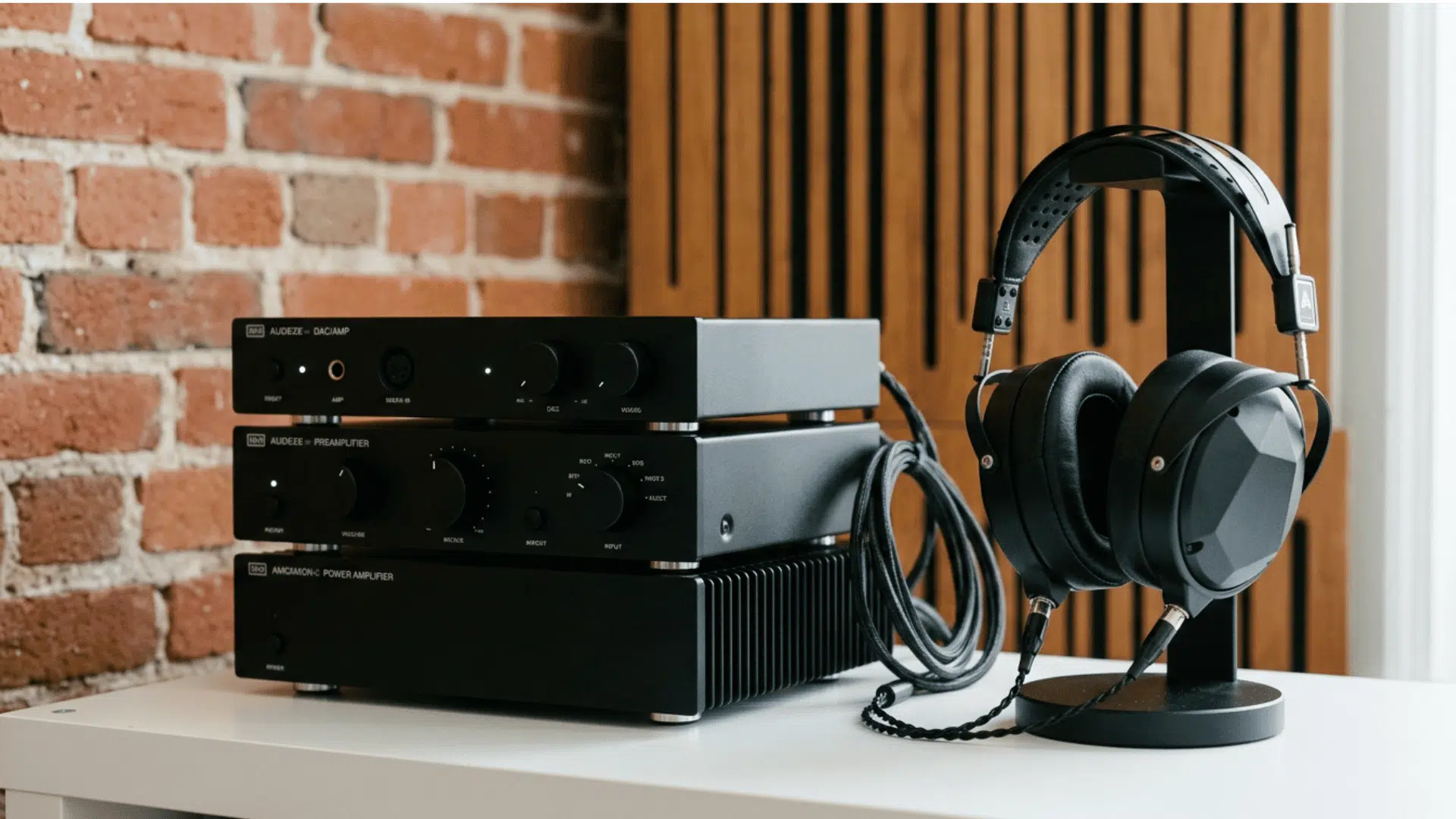



Finding the best headphone amp can completely change the way your music sounds.
From compact portable models to powerful desktop setups, there are many options designed for casual listeners, gamers, and serious audiophiles alike.
Choosing the right one depends on your headphones, listening habits, and budget.
In this guide, we’ll cover the best headphone amps available today, highlighting their features, sound quality, and overall value so you can find the perfect match for your audio set.
Why Do You Need the Best Headphone Amps?
Headphone amps are essential for unlocking the full potential of your headphones, especially high-impedance and audiophile-grade models.
A dedicated headphone amplifier provides the power to drive these headphones efficiently, improving overall sound fidelity, especially when paired with the best open-back headphones.
Even when headphones seem loud enough, a quality amp delivers cleaner and more precise audio with lower distortion, eliminating muddy sound and enhancing detail retrieval.
They also improve bass response and dynamics by providing stable power, particularly with demanding planar magnetic headphones that require strong current delivery.
Additionally, a good headphone amp maintains an optimal damping factor by keeping its output impedance low, giving better control over headphone drivers and producing tighter, more accurate bass without distortion.
Do All Headphones Need an Amplifier?
No, not all headphones need an amplifier.
You need an amp if you’re:
Not getting enough volume from your current amp (which would be the sound card – which is also the DAC – if you’re using a computer to feed the headphones).
Upgrading to a standalone DAC that doesn’t include a built-in amp.
Headphone Amp vs DAC: What’s the Difference?
The table below highlights the key difference between a digital-to-analog converter and a headphone amplifier:
Feature | DAC (Digital-to-Analog Converter) | Headphone Amplifier |
Primary Function | Converts digital audio signals into analog audio signals | Amplifies analog audio signals to provide more power and volume |
Main Purpose | Improves clarity, detail, and reduces digital noise | Enhances loudness, bass response, and overall dynamics |
Input & Output Type | Accepts digital inputs and outputs analog audio | Accepts analog input and outputs amplified analog audio |
Best For | Fixing muddy or noisy onboard audio | Powering high-impedance and demanding headphones |
Effect on Sound Quality | Produces cleaner, sharper, and more accurate sound | Delivers stronger bass, better dynamics, and improved control |
When You Need One | When your audio lacks clarity or has hiss/noise | When your headphones sound too quiet or underpowered |
Best Headphone Amps Compared
Comparing top models helps identify the right balance of power, sound quality, features, and compatibility.
1. Pyle PHA40 Headphone Amp

This headphone amp supports only basic analog audio and lacks support for high-resolution digital formats. It also lacks wireless features, relying entirely on wired connectivity. Connectivity & Outputs
- Ports & Outputs: Includes four 1/4-inch TRS headphone outputs with a single input.
- Balanced Output Support: No balanced outputs available.
Performance
- 600 Ohm Headphone Compatibility: Not recommended for high-impedance headphones. Performs best with standard, easy-to-drive models.
- Sound Quality: Delivers clear audio for casual studio monitoring with decent bass response, acceptable soundstage, and basic instrument separation.
Pros
- Affordable pricing
- Compact and lightweight design
Cons
- No built-in DAC
- Lacks balanced connectivity
- Limited power for demanding headphones.
2. FIFINE N6 Headphone Amplifier

This headphone amp supports standard stereo audio but does not support high-resolution audio formats. It features a fully wired setup with no wireless audio capabilities.
Connectivity & Outputs
- Ports & Outputs: Features four-channel stereo outputs with TRS/TS connectivity support.
- Balanced Output Support: No balanced output option available.
Performance
- 600 Ohm Headphone Compatibility: Limited power output makes it less suitable for high-impedance headphones. Best used with low to mid-impedance models.
- Sound Quality: Produces clean, low-noise audio with decent soundstage, bass response, and instrument separation for everyday listening.
Pros
- Durable metal construction
- Clean audio performance
Cons
- No built-in DAC
- No balanced output support
- Limited power for demanding headphones
3. Mackie HM-4 Headphone Amp

This headphone amp provides professional-grade analog monitoring but does not support high-resolution digital audio formats. It also lacks wireless functionality and is designed for wired connections only.
Connectivity & Outputs
- Ports & Outputs: Features four independent headphone outputs with separate level controls for each channel.
- Balanced Output Support: No balanced output or built-in DAC available.
Performance
- 600 Ohm Headphone Compatibility: Designed mainly for studio monitoring and not suitable for driving high-impedance headphones.
- Sound Quality: Provides accurate and detailed monitoring sound with decent clarity and instrument separation for studio use.
Pros
- Sturdy and durable build quality
- Individual headphone level controls
Cons
- No built-in DAC
- No wireless connectivity
- Not intended for audiophile-grade performance
4. Audioengine D1 DAC Amp

This headphone amp supports 24-bit/32-bit DAC audio playback, delivering improved sound quality compared to basic analog-only amplifiers.
It uses a wired USB connection and does not include Bluetooth or wireless audio support.
Connectivity & Outputs
- Ports & Outputs: Includes USB input, RCA output, and a headphone output for convenient desktop connectivity.
- Balanced Output Support: Limited balanced connectivity options available.
Performance
- 600 Ohm Headphone Compatibility: Moderate power output works well with mid-range impedance headphones, but struggles with 600-ohm models.
- Sound Quality: Produces smooth and detailed audio with improved clarity, good bass response, and solid instrument separation.
Pros
- Compact desktop footprint
- Smooth and clear sound quality
Cons
- Limited balanced connectivity
- Not ideal for 600-ohm headphones
5. FiiO K9 Pro ESS

This headphone amp offers excellent support for high-resolution audio, including up to 384kHz PCM, native DSD256, and MQA playback.
It also features Bluetooth 5.1 with LDAC and aptX Adaptive support, providing high-quality wireless audio performance alongside wired connectivity
Connectivity & Outputs
- Ports & Outputs: Includes XLR, 4.4mm balanced, 6.35mm, USB, optical, and coaxial inputs for highly versatile connectivity.
- Balanced Output Support: Supports multiple balanced output options, including XLR and 4.4mm connections.
Performance
- 600 Ohm Headphone Compatibility: Easily powers 600 Ohm headphones and handles demanding high-impedance models.
- Sound Quality: Delivers an excellent soundstage with deep bass, outstanding clarity, and precise instrument separation for premium listening performance.
Pros
- Premium audiophile sound quality
- Wide range of connectivity options
- Excellent power output for demanding headphones
Cons
Expensive compared to an entry-level amp
How to Choose the Best Headphone Amp?
Picking the right headphone amp means knowing your headphones well and matching them to the right power and design.
1. Check Your Headphone Impedance and Sensitivity: High-impedance headphones need more voltage while planar magnetics need strong current delivery, making a pairing like the Sennheiser Momentum 4 worth considering for your setup.
2. Choose Between Solid-State or Tube Amp: Solid-state amps give a neutral, accurate sound while tube amps add warmth and character to your listening experience.
3. Decide Between Desktop or Portable Unit: Desktop amps offer more power for home use, while portable amps give flexibility for on-the-go listening without sacrificing quality.
4. Match Power Output to Your Headphones: Too little power causes distortion while too much can damage drivers, so always match output carefully to your specific headphones.
5. Consider Your Source and Budget: Your amp should match your source device well and fit your budget without forcing you to overspend on unnecessary features.
Balanced vs Unbalanced Outputs
Knowing the difference between balanced and unbalanced outputs helps you get the most out of your headphone amp setup.
| Feature | Unbalanced | Balanced |
|---|---|---|
| Connector Type | 3.5mm or 6.35mm jack | 4.4mm, 2.5mm, or XLR |
| Signal Path | Single signal per channel | Separate signals per channel |
| Noise Rejection | Lower | Higher |
| Crosstalk | More likely | Greatly reduced |
| Power Output | Standard | Often higher |
| Best For | Everyday casual listening | High-end headphone setups |
| Cable Requirement | Standard cables | Special balanced cables |
Common Mistakes to Avoid When Buying a Headphone Amp
Avoiding these simple buying mistakes saves you money and makes sure your amp works perfectly with your headphones from day one.
- Ignoring Headphone Sensitivity and Impedance: Skipping impedance and sensitivity checks leads to poor volume, distortion, or an amp that simply cannot drive your headphones properly.
- Assuming More Power is Always Better: Too much power can harm low-impedance headphones and cause distortion, so always match power output to your specific headphone requirements.
- Confusing a DAC with an Amplifier: A DAC converts digital audio to analog, while an amp boosts that signal. They serve different purposes and are not interchangeable.
- Ignoring Output Impedance Ratings: High output impedance paired with low-impedance headphones changes frequency response and ruins sound quality, so always check this number before buying.
- Buying an Amp Without Trying Your Headphones First: Every headphone reacts differently to each amp, so testing before buying helps avoid costly mismatches and disappointing audio performance at home.
Final Verdict
Picking the right headphone amp can completely change how your music sounds. The right amp gives your headphones the power they need.
Every amp on this list was picked for a reason. At the end of the day, a good headphone amp is not just a nice-to-have.
It is the missing piece between average sound and great sound. And once you hear the difference, going back feels impossible.
Ready to take the next step? Check out our guide on the best DACs to pair with your new amp.
Frequently Asked Questions
What is the Best Headphone Amp for Gaming?
The Fiio K7 and Schiit Magni are great picks for gaming. They deliver clear, detailed sound with strong power output. Both work well with most gaming headsets.
Can a Headphone Amp Reduce Audio Distortion?
Yes. A good headphone amp provides clean, stable power to your headphones. This reduces distortion caused by underpowered sources, such as laptops or phones. The result is a cleaner, clearer sound.
Does Bluetooth Reduce Headphone Amp Sound Quality?
Yes, it can. Bluetooth compresses audio data during transmission. This can strip out fine details. For the best sound quality, a wired connection with your headphone amp is always the better choice.