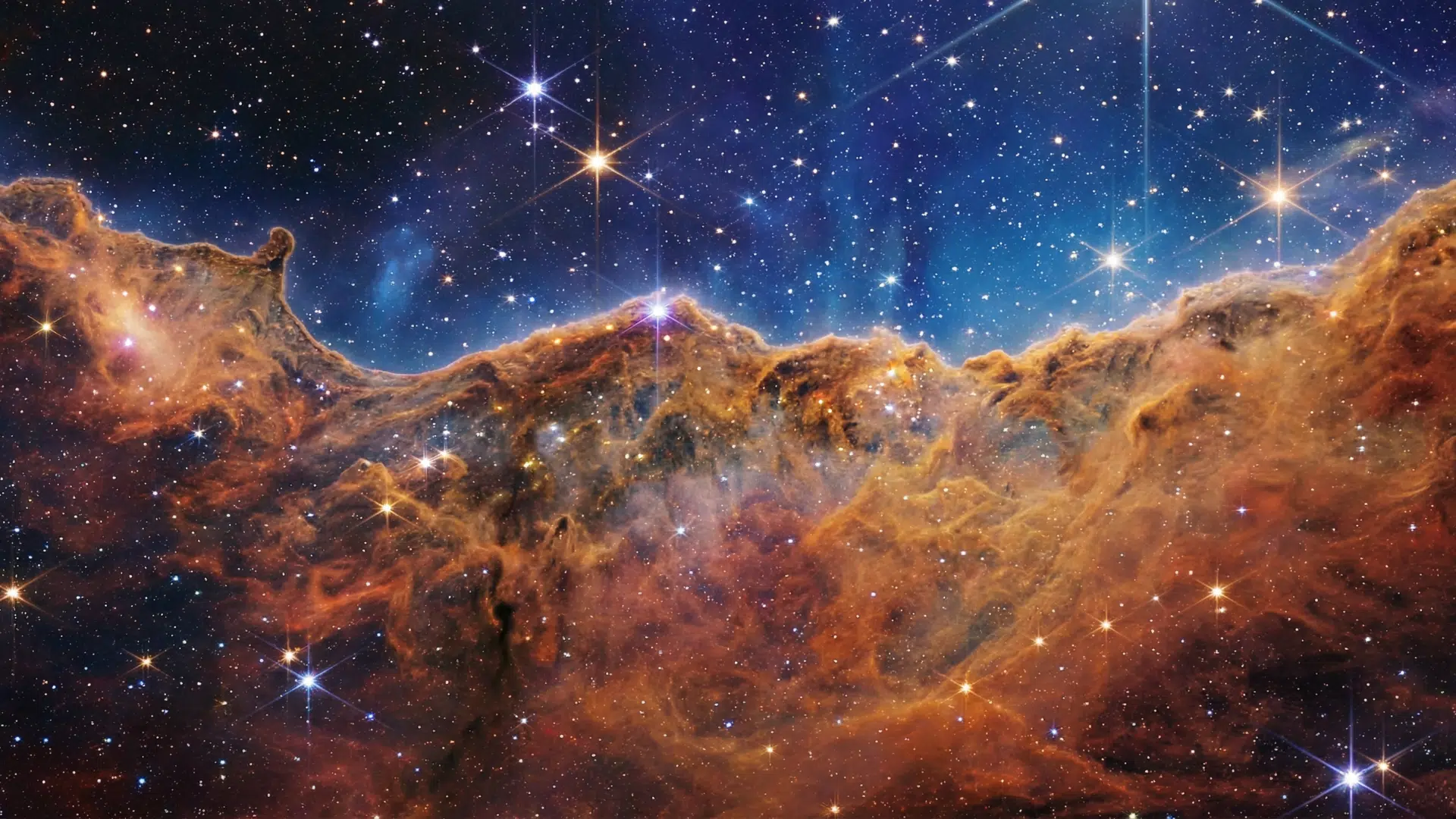



Nebulae are vast clouds of gas and dust drifting through space. They may look soft and colorful in telescope images, but they play a powerful role in the universe.
For astronomers, nebulae are not just beautiful sights. They are active regions where important changes occur over long periods.
Inside these clouds, physical forces slowly shape matter in ways that can lead to the birth of stars.
Understanding how nebulae form stars helps explain how galaxies grow and how cosmic systems begin. This topic gives a clearer view of how the universe continues to change and renew itself.
What is a Nebula?
A nebula is a vast cloud of gas and dust drifting through space. The term comes from a Latin word meaning “cloud,” which clearly describes its appearance.
These clouds can span dozens or even hundreds of light-years, making them some of the largest structures in a galaxy.
Although telescope images show bright colors and glowing shapes, most nebulae are extremely thin, with gas spread over huge distances.
Hydrogen is the primary element, along with helium and trace amounts of heavier elements.
Tiny dust particles are also present and help regulate temperature. Nebulae are common in galaxies, and many stars in the Milky Way formed within them.
The Different Types of Nebulae

Not all nebulae are the same. Astronomers group them into several main types based on how they form and how they appear.
Emission Nebulae
Emission nebulae glow because the gas inside them is energized by nearby hot stars. Ultraviolet radiation from these stars excites the hydrogen atoms, causing them to emit light. The Orion Nebula is a well-known example. These are often the regions where new stars are actively forming.
Reflection Nebulae
Reflection nebulae do not produce their own light. Instead, they reflect the light of nearby stars. Dust particles scatter the starlight, often giving the nebula a blue appearance. These regions can also be associated with star formation, though they are usually less intense than emission nebulae.
Dark Nebulae
Dark nebulae are dense clouds of gas and dust that block light from objects behind them. They appear as dark patches against brighter backgrounds. These clouds are often cold and dense, making them ideal places for star formation.
Planetary Nebulae
Planetary nebulae are not linked to new star formation. They are created when a dying star sheds its outer layers. Although beautiful and important for recycling elements into space, they are not the main focus when asking how nebulae form stars.
How a Star is Born Inside a Nebula

Star formation inside a nebula follows a clear physical sequence. It begins in cold, dense regions and ends when nuclear fusion stabilizes a new star. Below is the step-by-step process in a structured format.
1. Cold and Dense Regions Form
Star formation does not occur throughout the entire nebula. It happens in specific areas where:
- The gas is extremely cold, often just a few degrees above absolute zero
- Internal pressure is low
- Material begins to gather into denser pockets
Low temperature reduces particle motion. When particles move more slowly, outward pressure weakens. This allows gravity to become more effective.
The densest regions are called molecular clouds. In these areas, hydrogen exists as H₂ (two hydrogen atoms bonded together). Molecular clouds are the true stellar nurseries.
2. Gravity Triggers Collapse
Gravity is the driving force behind star formation.
- Every particle of gas and dust pulls on nearby particles
- When density increases, gravitational attraction strengthens
- Once gravity overcomes internal pressure, collapse begins
As material moves inward, the region becomes even denser. Increased density strengthens gravity further, accelerating the contraction process.
This stage can take hundreds of thousands to millions of years.
3. Formation of a Protostar
As collapse continues:
- A central core forms
- Gravitational energy converts into heat
- The temperature inside the core rises steadily
At this point, the object is called a protostar. It is not yet a true star because nuclear fusion has not started.
During this stage:
- A rotating disk of material forms around the core
- Jets of gas may shoot out from the poles
- Excess angular momentum is gradually removed
The surrounding disk can later develop into planets and other smaller bodies.
4. Ignition of Nuclear Fusion
The final step occurs when the core temperature reaches an extremely high level.
- Hydrogen nuclei begin fusing into helium
- Fusion releases vast amounts of energy
- Outward pressure increases dramatically
This outward pressure balances the inward pull of gravity. When this balance is achieved, the object becomes stable.
5. Birth of a Main-Sequence Star
Once equilibrium is reached:
- The protostar becomes a true star
- It enters the main sequence phase
- It begins a long period of stable energy production
For a star like the Sun, this stable phase can last billions of years.
Why Nebulae are Ideal Star-Forming Regions
Nebulae contain the basic ingredients required to build stars. Hydrogen gas, helium, and fine dust particles are present in enormous quantities throughout these clouds.
Because nebulae can stretch over hundreds of light-years, they hold enough material to produce entire clusters of stars rather than just one.
The most important parts of these clouds are molecular regions. These are colder and denser than the surrounding gas. Low temperature reduces pressure, allowing gravity to gather material more efficiently.
Inside these regions:
- Gas begins to clump together
- Density increases over time
- Gravity strengthens as mass concentrates
- Multiple stellar cores may form at once
This is why nebulae often produce star clusters. A single molecular cloud can give birth to hundreds or even thousands of stars.
What Can Trigger Star Formation?
Gravity drives collapse, but outside forces often act as catalysts.
Supernova Shock Waves
When a massive star explodes, it sends powerful shock waves into surrounding space. These waves compress nearby gas clouds. If compression becomes strong enough, parts of the cloud collapse rapidly.
Radiation from Massive Stars
Young, hot stars emit intense ultraviolet radiation. This radiation creates expanding bubbles in nearby gas. At the edges of these bubbles, material becomes compressed, which can initiate new star formation.
Galaxy Collisions
On a much larger scale, interactions between galaxies disturb enormous gas reservoirs. Compression increases dramatically, leading to starburst events where stars form at unusually high rates.
Star formation, therefore, is not always quiet or gradual. It can be triggered by violent cosmic events.
Why Star Formation Matters in Astronomy
Star formation influences how galaxies evolve. Galaxies with active star formation appear bright and blue because they contain many hot, young stars.
Galaxies where star formation has slowed appear redder and older. The balance between star birth and star death determines long-term structure.
There is also a chemical consequence.
When stars die, they release heavier elements into space. These elements mix into nebulae and become part of the next generation of stars. Over billions of years, this process increases the complexity of matter in the universe.
The carbon in living organisms and the oxygen in Earth’s atmosphere were once formed inside stars. Nebulae serve as collection points for this recycled material, making them central to cosmic evolution.
How Astronomers Study Stellar Nurseries
Star formation cannot be observed from start to finish because it unfolds over immense timescales. Instead, astronomers compare many regions at different stages.
Different tools reveal different details:
- Infrared telescopes detect young stars hidden behind dust.
- Radio telescopes measure molecular gas and internal motion.
- Space observatories provide high-resolution images of active regions.
The Orion Nebula is one of the closest examples of an active stellar nursery. Regions such as the Eagle and Carina Nebulae offer additional insight into how nebulae form stars under varying conditions.
By combining observations across wavelengths, scientists build a coherent model of star formation.
To Conclude
Nebulae show that the universe is not static. Even in regions that appear quiet and distant, powerful physical forces are constantly at work.
Over immense spans of time, gravity shapes diffuse gas into organized systems that can shine for billions of years.
This ongoing cycle influences the structure of galaxies and the distribution of matter across space. Star formation is not just an isolated event; it is part of a much larger cosmic pattern.
By studying nebulae, astronomers gain insight into how the universe continues to evolve. Keep learning about space science to better understand the forces shaping our cosmos.