


Building a data center is not a decision to be taken lightly. It takes serious planning, a lot of moving parts, and a budget that can shift in ways most people don’t expect.
For businesses looking to set up their own infrastructure, the cost question is often the first and hardest one to answer. And that’s because there’s no single number that fits every situation.
The size of the facility, the location, the cooling systems, the power setup, all of it plays a role. So does the type of data center being built.
This blog examines what goes into the total cost of building a data center in 2026 and the factors that can push that cost up or down.
What Determines Data Center Cost?
Several factors shape how much a data center costs to build. Some are obvious, and some are easy to overlook until the bills start adding up.
- Location: Land prices, energy rates, and local regulations vary widely by region and urban density.
- Infrastructure Scale: Larger, high-performance builds need more hardware and redundant systems, raising both upfront and ongoing costs.
- Power Availability: Areas with limited grid access or high electricity prices can significantly drive up total expenses.
- Redundancy Levels: Higher reliability means more backup systems, and that always comes at a premium.
- Tier Certification: Tier III and IV facilities need more robust builds, which adds to construction and operational spending.
- Labor Costs: Skilled workers are not cheap, and local wage rates affect both build time and budget.
- Weather and Site Conditions: Locations prone to extreme weather may need extra structural work to protect critical equipment.
Detailed Breakdown of Data Center Construction Costs
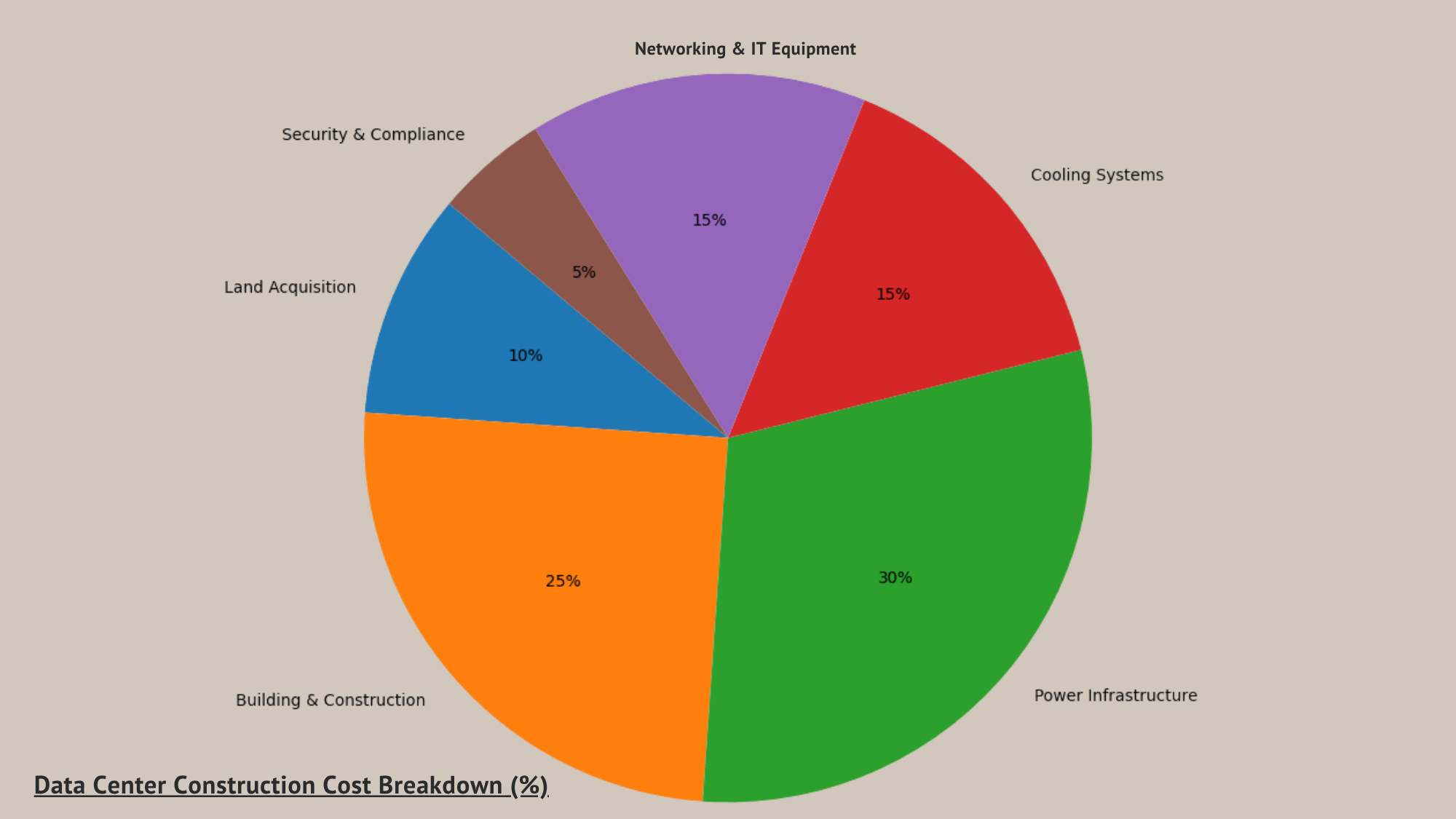
Building a data center involves multiple cost components, each contributing significantly to overall investment, efficiency, scalability, and long-term operational sustainability.
1. Land Acquisition Costs
Land costs vary widely depending on geography, infrastructure access, and regional policies. Urban areas offer proximity to networks and talent but come with higher land prices and stricter regulations.
Rural locations are more affordable yet may require additional investment in connectivity and utilities. Zoning laws, environmental clearances, and tax incentives also influence expenses.
Choosing the right location balances upfront savings with long-term operational efficiency and expansion potential.
2. Building & Construction Costs
Construction expenses include the physical structure, flooring systems, and built-in security features.
Data centers require reinforced buildings, raised flooring for cable management, and specialized layouts for airflow. Costs typically range from $600 to $1,200 per square foot, depending on design complexity and tier level.
High-tier facilities demand redundancy and durability, increasing costs. Efficient architectural planning helps reduce waste, improve energy flow, and support future scalability without excessive reinvestment.
3. Power Infrastructure Costs
Power infrastructure is one of the largest cost drivers in a data center. It includes backup generators, uninterruptible power supply (UPS) systems, transformers, and grid connections.
Reliable electricity ensures uptime, making redundancy essential. Facilities often invest heavily in dual power feeds and backup systems to prevent outages.
The cost also depends on local electricity rates and grid reliability, making location selection crucial for balancing both initial investment and long-term operating expenses.
4. Cooling System Costs
Cooling systems maintain optimal temperatures for equipment, directly affecting performance and lifespan. Traditional HVAC systems are widely used but consume significant energy.
Liquid cooling, though more expensive initially, offers higher efficiency for modern high-density workloads. The choice depends on workload requirements and sustainability goals.
Energy-efficient cooling reduces long-term operational costs, making it a strategic investment rather than just a construction expense in modern data center design.
5. Networking & IT Equipment Costs
This category includes servers, racks, switches, and cabling essential for data center operations. Initial costs can be substantial, especially for high-performance computing environments.
Equipment selection depends on workload demands, scalability plans, and redundancy requirements.
Over time, upgrades and replacements add to overall expenses. Investing in modular and scalable hardware solutions allows businesses to expand capacity efficiently without overcommitting resources during the initial setup phase.
6. Security & Compliance Costs
Security costs cover both physical measures and cybersecurity systems. Facilities require surveillance cameras, biometric access controls, and secure entry points to protect infrastructure.
On the digital side, firewalls, monitoring tools, and threat detection systems are essential. Compliance with certifications like ISO and SOC adds additional costs but ensures reliability and trust.
These investments are critical for protecting sensitive data and maintaining operational credibility in competitive markets.
Operational Costs of Running a Data Center
Building a data center is one thing. Keeping it running is a whole different expense.
Operational costs cover everything that keeps the lights on: literally and figuratively. Power and cooling take the biggest share, often eating up 40 to 60% of the annual budget.
After that come staffing, hardware maintenance, software licensing, and physical security. These costs don’t stay flat either. They grow as the facility scales and as equipment gets older.
- For large facilities, annual operating costs can run anywhere from $10 million to $25 million.
- Mid-sized setups typically land between $200,000 and $500,000 per year.
- Smaller operations may spend around $50,000 to $100,000 annually, though that number climbs fast with any expansion.
Cost Per MW: The Most Important Metric in Data Center Budgeting
When it comes to data center budgeting, cost per megawatt (MW) is the number that matters most.
It cuts through the noise and gives planners a clear, standardized way to compare projects across different sizes and markets. Traditional construction has cost around $7 million to $12 million per MW.
But that figure has been climbing. By 2025, costs reached as high as $38.9 million per MW, driven largely by rising IT equipment prices.
Tier level also plays a role here. A Tier I facility runs roughly $11,500 per kW, while a Tier IV build can push past $25,000 per kW.
Colocation vs Building a Data Center
Not every business needs to build from scratch. Colocation offers a cost-effective path worth considering before committing to a full build.
| Aspect | Building Own | Colocation |
|---|---|---|
| Upfront Cost | $7–12M/MW | Low or none |
| Annual Operations | $10–25M | Usage-based, lower total |
| Scalability | Rigid, slower to expand | Flexible and quick |
| Control | Full control | Shared, expert-managed |
| Best For | Large enterprises need full ownership | Businesses wanting lower CapEx |
Hidden Costs of Data Centers You Must Consider
The visible costs are just the start. Several less obvious expenses can quietly add up over time.
- Legacy Infrastructure Maintenance: Aging equipment demands more frequent repairs and drives up energy consumption with every passing year.
- Scalability Limitations: Expanding an outdated facility often requires costly redesigns that were not part of the original budget.
- Talent Shortages: Finding and retaining skilled data center staff is increasingly difficult, and competitive salaries add to operational spending.
- Compliance and Regulatory Costs: Meeting evolving data protection and environmental regulations often requires upgrades that come with a significant price tag.
- Security Risks: A single breach or unplanned downtime event can result in costs far beyond what any insurance policy covers.
- Software Licensing Fees: Ongoing licensing for management, monitoring, and security tools adds a steady and often underestimated layer of expense.
How to Reduce Data Center Costs Without Compromising Performance
Cutting costs does not have to mean cutting corners. Several practical strategies can bring expenses down without affecting reliability.
1. Implement Data Tiering and Virtualization: Organize data by usage frequency and virtualize resources to reduce waste and improve overall infrastructure efficiency.
2. Adopt Liquid or Free Cooling Solutions: Modern cooling methods like liquid cooling and variable-speed fans can deliver over 20% in power savings.
3. Automate Maintenance and Operations: AI-driven ventilation control and automated monitoring reduce manual workload and catch inefficiencies before they become costly problems.
4. Use Flexible Workloads: Shifting workloads based on demand can cut operational costs by 2 to 5% without impacting performance.
5. Switch to Renewable Energy Sources: Long-term renewable energy contracts help stabilize electricity costs and protect against unpredictable grid price increases.
6. Conduct Regular Energy Audits: Periodic reviews of energy use identify waste, and renegotiating vendor contracts can deliver meaningful savings over time.
7. Consolidate IT Equipment: Reducing the number of underutilized servers and storage units lowers both power consumption and hardware maintenance costs significantly.
Future Trends Impacting Data Center Costs
Data center costs are not going to get simpler anytime soon.
AI is the biggest driver right now. The power demand from AI workloads is expected to reach 945 terawatt-hours by 2030, and that is pushing construction costs well past $11.3 million per MW in many markets.
On top of that, tighter environmental regulations and growing grid support requirements are adding new layers of expense for operators.
The silver lining is that efficiency technology and renewable energy adoption are helping offset some of those increases. But for anyone planning a build today, factoring in these trends from the start is not optional; it is necessary.
Conclusion
Data center costs cover a wide range, from construction and power systems to hidden operational expenses that catch many planners off guard.
The key takeaway is this: understanding each cost component before breaking ground makes a real difference.
For businesses still on the fence, colocation is worth a serious look. And for those committed to building, focusing on energy efficiency and smart planning from day one keeps costs from spiraling later.
Got questions about data center costs? Drop them in the comments below.