


Generative AI is changing the way people create content, solve problems, and handle daily work.
It can write text, create images, answer questions, and support faster decision-making across many industries. As its use continues to grow, many people want a clear understanding of both its strengths and its limits.
While this technology offers major advantages in speed and creativity, it also raises concerns about accuracy, privacy, and reliability.
A balanced view helps readers understand where generative AI works well and where it still faces important challenges.
What is Generative AI?
Generative AI is a type of artificial intelligence that creates new content based on patterns learned from large amounts of data.
It can generate text, images, music, videos, and even computer code in a short time. Popular tools like ChatGPT and image generators are common examples of this technology.
Unlike traditional AI systems that mainly analyze information, generative AI produces original responses and creative outputs.
Businesses, students, and creators use it to improve productivity and save time. At the same time, it also raises concerns about accuracy, bias, privacy, and responsible use.
What Makes Generative AI Unique?
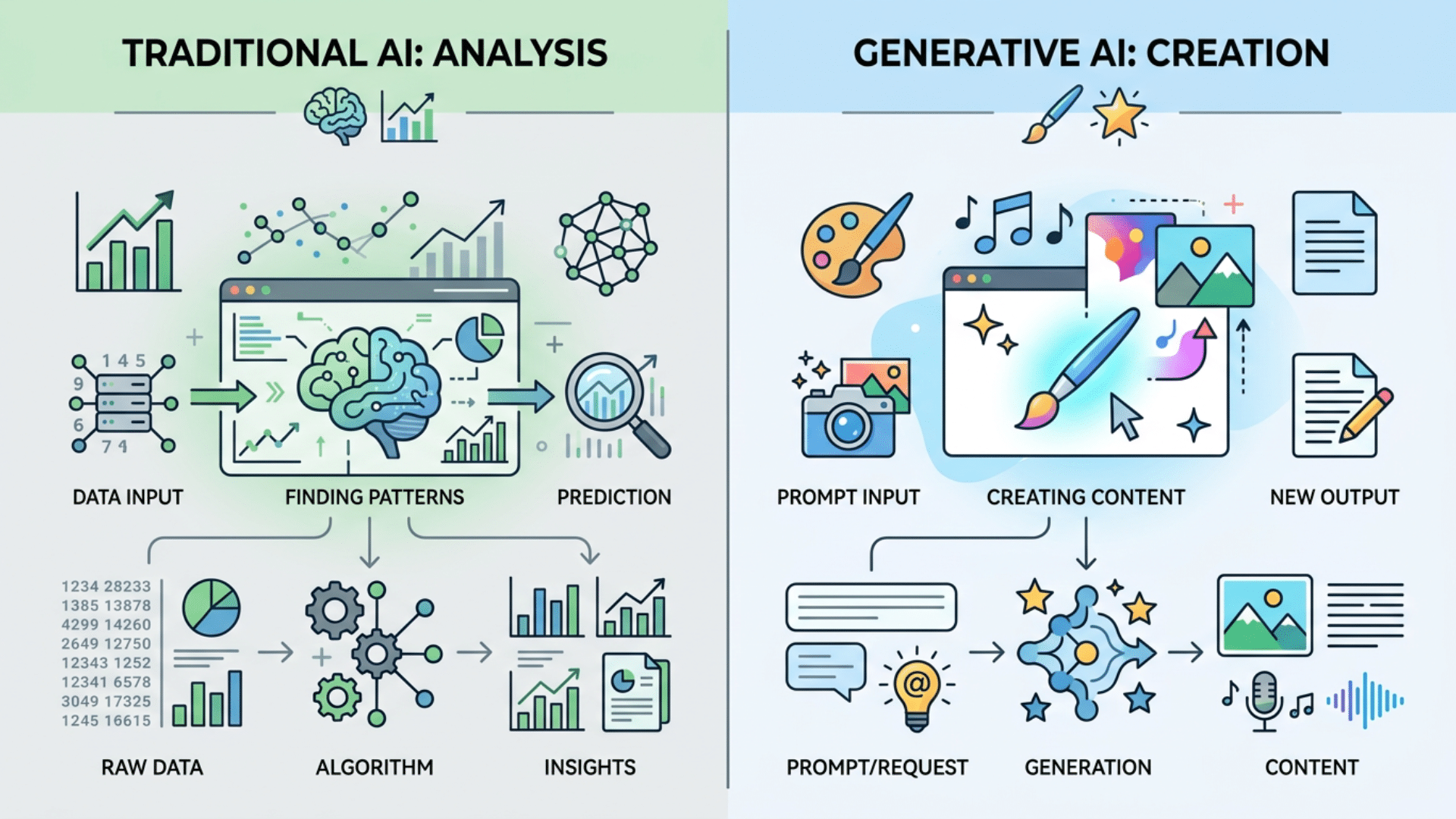
Generative AI differs from traditional AI because it creates new content rather than merely analyzing existing information. Its ability to produce human-like outputs across many formats makes it one of the most advanced forms of AI today.
- Content Generation: Creates original text, images, videos, music, and code instead of only processing existing data.
- Human-Like Communication: Produces natural responses that closely match human writing and conversation patterns in many situations.
- Multi-Format Capability: Works across different content types, including writing, design, audio, coding, and video creation tasks.
- Large-Scale Learning: Trains on massive datasets to recognize patterns, language structures, and relationships between different types of information.
- Context Awareness: Understands prompts and generates responses based on the meaning and context of user input.
- Natural Language Interaction: Allows users to communicate with AI through simple instructions without requiring technical programming knowledge.
- Adaptive Output Generation: Creates different responses for the same prompt depending on the wording, tone, or context provided by users.
Major Benefits of Generative AI

Generative AI is helping people and businesses complete tasks faster, improve efficiency, and create content with less manual effort. Its growing use across industries shows how valuable AI tools have become in daily work and communication.
Faster Content Creation
Generative AI can create blogs, emails, reports, product descriptions, and social media posts within seconds. This reduces the time needed for writing and editing tasks.
Businesses and creators use AI tools to produce large amounts of content quickly while maintaining consistent quality and faster turnaround times for projects.
Improved Productivity
AI tools help automate repetitive tasks such as summarizing documents, answering questions, organizing information, and generating drafts.
Employees can spend more time on strategic and creative work instead of routine activities. This improves overall efficiency and helps businesses complete projects faster with better workflow management and reduced manual effort.
Better Creativity and Brainstorming
Generative AI supports creativity by helping users develop fresh ideas for content, marketing campaigns, designs, and storytelling.
It can provide multiple suggestions in seconds, making brainstorming easier and faster. Writers, designers, and marketers often use AI tools to overcome creative blocks and improve the quality of their work.
Reduced Business Costs
Businesses can lower operational expenses by using generative AI to automate tasks that normally require larger teams or long working hours.
AI tools reduce the need for manual content creation, customer support, and data processing. This helps companies save time, improve efficiency, and use resources more effectively across departments.
Personalized User Experiences
Generative AI helps companies create personalized recommendations, advertisements, emails, and customer interactions based on user preferences and behavior. Streaming platforms, online stores, and marketing teams use AI to improve customer engagement.
Personalized experiences often increase customer satisfaction and help businesses build stronger relationships with their audiences over time.
Faster Research and Analysis
Generative AI can process and summarize large amounts of information much faster than manual methods. Researchers, students, and businesses use AI tools to gather insights, identify trends, and understand complex topics more efficiently.
This saves time during research and helps users make informed decisions with quicker access to important information.
Improved Customer Support
AI-powered chatbots and virtual assistants provide instant responses to customer questions at any time of the day. They help businesses improve response times and handle large numbers of customer requests efficiently.
This reduces pressure on support teams while improving customer satisfaction through faster and more consistent communication services.
Easier Access to Technology
Generative AI allows people without technical skills to create content, generate images, write code, and complete tasks using simple text prompts. Users do not need advanced programming knowledge to use many AI tools effectively.
This makes technology more accessible for students, small businesses, freelancers, and everyday users worldwide.
Support Across Multiple Industries
Generative AI is used in healthcare, education, finance, marketing, entertainment, and software development. Hospitals use AI for documentation, teachers use it for learning materials, and businesses use it for marketing and automation.
Its flexibility allows organizations in different industries to improve efficiency and solve problems more effectively.
Continuous Improvement Over Time
Generative AI systems improve as developers train them with larger and more updated datasets. New versions often provide better accuracy, stronger reasoning, and more reliable outputs.
This ongoing improvement helps AI tools become more useful for businesses and individuals while expanding their capabilities across different tasks and industries.
Disclaimer: Generative AI should be used with human review because AI-generated content may contain inaccuracies, bias, outdated information, or misleading responses.
Challenges and Limitations of Generative AI
Generative AI offers many advantages, but it also creates technical, ethical, and practical challenges that users and businesses must consider.
| Challenge or Limitation | Explanation |
|---|---|
| Accuracy Problems | Generative AI can produce incorrect or misleading information, often called hallucinations, even when responses sound confident and believable. |
| Bias in AI Outputs | AI systems may reflect bias from training data, leading to unfair, inaccurate, or unbalanced results in generated content. |
| Privacy Concerns | Some AI tools collect and process user data, creating concerns about personal privacy and sensitive business information security. |
| Copyright Issues | AI-generated content may raise legal questions about ownership, originality, and the use of copyrighted training materials online. |
| Lack of Human Judgment | Generative AI cannot fully understand emotions, ethics, or real-world situations the way humans naturally can during decision-making. |
| Dependence on Training Data | AI quality depends heavily on the data used during training, which may contain outdated or incomplete information. |
| Risk of Misinformation | AI can create fake news, deepfakes, and misleading content that spreads quickly across social media and online platforms. |
| High Development Costs | Building and training advanced AI systems requires expensive computing power, technical expertise, and large amounts of energy. |
| Job Displacement Concerns | Automation through AI may replace certain repetitive jobs, creating uncertainty for workers in some industries and roles. |
| Limited Critical Thinking | Generative AI can analyze patterns but still struggles with deep reasoning, logic, and complex real-world problem-solving tasks. |
| Security Risks | Cybercriminals may misuse generative AI to create scams, phishing emails, malware, or other harmful digital content more easily. |
| Need for Human Oversight | AI-generated outputs often require human review to check accuracy, tone, context, and ethical concerns before final use. |
Real-World Uses of Generative AI
Generative AI is now part of many industries because it helps people work faster, improve efficiency, and reduce manual effort. From healthcare to marketing, AI tools are changing how organizations create content, solve problems, and communicate with users.
Business and Customer Service
- Automates customer support through AI chatbots and virtual assistants
- Creates reports, emails, and business documents quickly
- Improves response times and customer satisfaction
- Helps businesses handle repetitive administrative tasks efficiently
Education and Online Learning
- Generates study notes, quizzes, and lesson summaries
- Explains difficult topics in simpler language for students
- Supports personalized learning experiences and tutoring
- Helps teachers prepare educational materials faster
Healthcare and Medical Research
- Assists with medical documentation and patient records
- Helps doctors summarize patient information quickly
- Supports faster medical research and data analysis
- Reduces administrative workload in hospitals and clinics
Marketing and Content Creation
- Creates blogs, advertisements, and social media captions
- Generates product descriptions and email campaigns quickly
- Helps businesses maintain consistent brand messaging
- Supports personalized marketing for different audiences
Software Development and Coding
- Generates code snippets and programming suggestions
- Detects bugs and improves software debugging processes
- Creates technical documentation automatically
- Helps developers complete coding tasks more efficiently
Entertainment and Media Production
- Creates scripts, music, animations, and visual content
- Assists with video editing and special effects production
- Helps creators speed up content production workflows
- Supports new forms of digital storytelling and design
Finance and Banking
- Helps detect fraud and unusual financial activities
- Generates financial summaries and business reports
- Improves customer communication through AI assistants
- Supports faster analysis of financial data and trends
E-Commerce and Online Shopping
- Recommends products based on customer preferences
- Generates product descriptions for online stores
- Improves customer experiences with personalized suggestions
- Automates customer support for shopping platforms.
Ethical Concerns Around Generative AI
As generative AI becomes more common, concerns about ethics, safety, and responsible use continue to grow across industries worldwide.
- Bias and Discrimination: AI systems can produce unfair or biased results based on the data used during training.
- Misinformation Risks: Generative AI can create false information, fake news, and misleading content that appears realistic online.
- Deepfake Content: AI-generated videos, images, and audio can be misused to spread deception, fraud, or harmful misinformation.
- Privacy Concerns: Some AI tools may collect personal or sensitive data without users fully understanding how information is stored.
- Copyright and Ownership Issues: AI-generated content raises legal questions about originality, ownership rights, and the use of copyrighted training materials.
- Lack of Transparency: Many AI systems do not clearly explain how they generate responses or make decisions for users.
- Job Replacement Concerns: Increased automation via AI may reduce demand for certain jobs that involve repetitive or routine tasks.
- Misuse for Cybercrime: Criminals may use generative AI to create phishing emails, scams, malware, or harmful digital content.
- Dependence on AI Systems: Overreliance on AI tools may undermine human critical thinking, creativity, and independent decision-making.
- Need for Human Oversight: AI-generated outputs still require human review to ensure accuracy, fairness, and ethical responsibility before use.
UNESCO has emphasized the importance of ethical AI use to improve transparency, fairness, and accountability in AI development worldwide.
Future of Generative AI
Generative AI is expected to become more advanced and widely used across industries in the coming years.
Businesses, schools, healthcare providers, and technology companies are already increasing investments in AI tools to improve efficiency and automation.
Future AI systems may offer better accuracy, stronger reasoning, faster processing, and more personalized user experiences. Smaller and more efficient AI models are also likely to become common across devices and platforms.
At the same time, governments may introduce stricter regulations on privacy, copyright, and the ethical use of AI as concerns about security and misinformation continue to grow worldwide.
Is Generative AI More Helpful or Harmful?
Generative AI offers many benefits, but it also creates serious challenges that cannot be ignored.
It helps businesses improve productivity, supports creativity, speeds up research, and automates repetitive tasks. Many industries already rely on AI tools to save time and improve efficiency in daily operations.
At the same time, concerns about misinformation, privacy, bias, job displacement, and ethical misuse continue to grow.
AI-generated content can sometimes be inaccurate or misleading, especially when used without human review. These risks make responsible AI use extremely important for individuals and organizations.
Overall, generative AI is more helpful when used carefully and ethically. Its impact depends largely on how people develop, manage, and apply the technology in real-world situations.
Conclusion
Generative AI is no longer a future concept. It is already influencing how people create, communicate, learn, and work every day.
Its rapid growth brings both valuable opportunities and important concerns that cannot be ignored.
While AI can improve efficiency and support innovation, human judgment still plays a critical role in how these tools are used.
The long-term impact of generative AI will depend on responsible development, clear regulations, and thoughtful use across different industries and daily life.
Frequently Asked Questions
Which 3 Jobs Will Survive AI?
Healthcare workers, skilled tradespeople, and creative professionals will likely survive AI because their jobs require human judgment and adaptability.
How Does Generative AI Learn to Create Content?
Generative AI learns by analyzing large datasets and identifying patterns in language, images, audio, and other forms of information.
Does Generative AI Always Provide Reliable Information?
No. AI systems can sometimes generate outdated, incomplete, or incorrect information that still sounds convincing to users.
How Do Companies Train Generative AI Models?
Developers train AI models using large datasets, advanced machine learning techniques, and high-performance computing systems over long periods.