



Every accountant has had that moment scrolling through LinkedIn late at night, stumbling on another post claiming their job will vanish completely within five short years.
Maybe you’ve felt that same knot in your stomach watching an AI tool draft a full report in just seconds, something that used to take you most of an entire afternoon to finish.
The question of whether AI will replace accountants is a fair one to ask, no matter if you’re a student picking a major, a junior associate watching daily tasks change, or a small business owner deciding if you still need to hire someone.
This breaks down what AI can do in accounting today, where it still falls short, and what that means for your career or business.
Will AI Really Replace Accountants?
This is the question every accounting student, junior associate, and small-firm owner keeps asking. The honest answer is no, not entirely, but yes for a large slice of routine work.
Software already handles reconciliation, basic categorization, and repetitive reporting faster and cheaper than a human ever could.
What it still can’t do is apply judgment to a messy, ambiguous financial situation, argue a position with a regulator, or read a nervous client’s tone during a difficult conversation.
AI replacing accountants outright is not the trend; AI replacing specific repetitive tasks within accounting is, a shift that’s easier to see once you look at what current AI-powered accounting tools actually do day to day.
That distinction matters more than the headlines suggest, and it’s the lens this article uses throughout.
Why Some People Believe AI Could Replace Accountants
The fear isn’t irrational. A few real trends are driving the assumption that AI will replace accountants:
- Machine learning tools can now read an invoice, extract line items, categorize expenses, and flag mismatches without a person touching a spreadsheet
- Firms have quietly cut hours spent on data entry by using these systems
- Some smaller practices have reduced junior hiring as a direct result
- Accounting software companies keep pushing product announcements claiming their tool “does the work of an entire team”
- The pattern looks familiar, echoing earlier waves of automation in manufacturing, retail, and customer service jobs over the past two decades.
Taken together, it’s easy to see why people assume the profession is on its way out.
What Accounting Work AI Is Already Automating
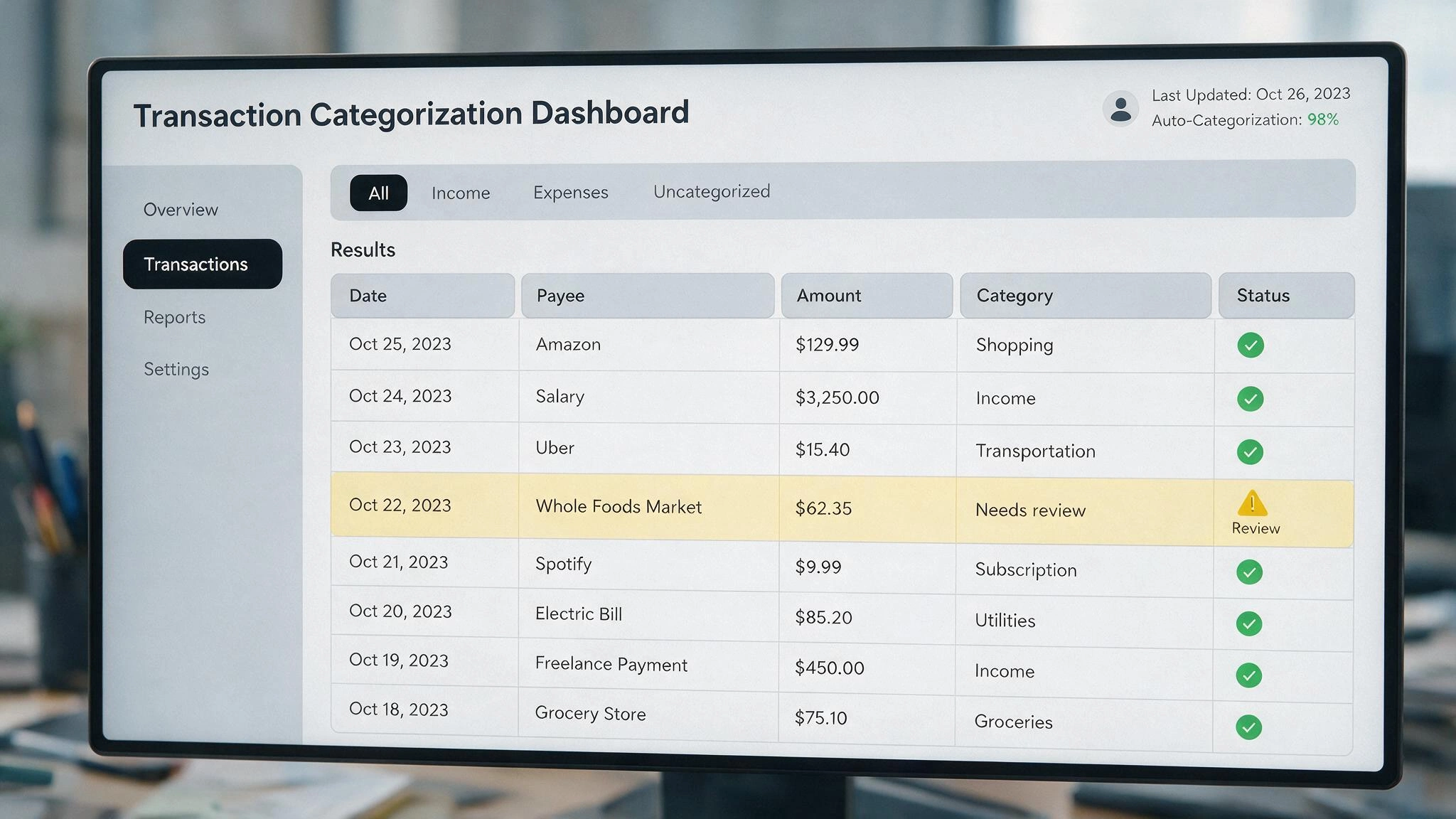
Automation hasn’t touched every corner of accounting equally. It’s made the deepest inroads into the parts of the job that are repetitive, high-volume, and rule-based the kind of work that follows the same steps every time, regardless of which client or account it belongs to.
1. Data Entry, Categorization, and Reconciliation
Categorizing transactions used to eat hours of a bookkeeper’s week. Modern tools now handle most of that load automatically:
- Bank feeds get read and matched against patterns from prior periods
- Categories get assigned to transactions with minimal oversight
- Reconciliation, once a tedious line-by-line exercise, runs largely on its own in most cloud accounting platform.
- A person still reviews exceptions and unusual entries, but routine matching no longer needs constant attention, the same pattern showing up as businesses explore which AI agents actually save time on repetitive work across departments.
This has genuinely cut the entry-level hours firms bill clients for basic bookkeeping.
2. Invoice Processing and Routine Reporting
Invoice processing was one of the first accounting tasks to fall to automation, and the gains have added up quickly:
- Optical character recognition paired with machine learning pulls vendor names, amounts, and due dates from scanned documents or PDFs
- Routine internal reports, like weekly cash summaries, get generated on a schedule without manual building
- A junior staffer’s afternoon of formatting now takes minutes instead
That freed-up time now goes toward reviewing flagged discrepancies and handling client questions, a shift that mirrors how broader business software platforms are reshaping day-to-day operations beyond just accounting.
3. Tax and Audit Support Tasks
Tax software has used automation for years, but newer tools push further into audit territory too:
- Prior-year data gets pulled automatically, with missing documents flagged and deductions suggested from similar returns
- Audit teams use comparable systems to sample transactions, detect outliers, and build initial testing populations
- These tools speed up prep work and lower the risk of simple math errors
They don’t replace the professional who signs the return or forms the audit opinion, but they do compress the prep work significantly.
Where AI Still Falls Short in Real Accounting Work

Software can process information, but it cannot take responsibility for a decision the way a licensed professional does. That gap is exactly where accountants remain essential, and it is unlikely to close anytime soon.
1. Professional Judgment and Complex Decisions
No system can fully weigh incomplete or conflicting information the way an experienced accountant can, since judgment calls often depend on years of pattern recognition from similar cases and clients.
A model can suggest an answer, but someone still has to decide if it fits the situation at hand.
Complex restructuring, valuation disputes, or fraud investigations require reasoning beyond pattern matching, and mistakes in judgment carry consequences that current tools aren’t built to absorb.
2. Regulatory Interpretation and Accountability
Regulations change constantly, and interpreting a brand-new rule requires reading intent, not just text.
Licensed professionals carry legal liability that no software vendor will accept on their behalf, and regulators expect a named, accountable individual behind every filing and formal opinion.
AI tools can summarize a regulation, but they cannot be held responsible if that summary is wrong, and compliance decisions often hinge on judgment calls that vary by jurisdiction and client circumstances.
3. Client Communication and Business Context
Clients often need reassurance, not just numbers, especially during audits or financial trouble, and software doesn’t read tone or unspoken concerns during a meeting.
Business context, like a client’s history, relationships, and long-term goals, shapes advice in ways data alone cannot.
Trust is built over years of conversations, not a single automated report, and a good accountant turns numbers into decisions a business owner can act on.
What Accountants Are Saying About AI and Job Security
Ask working accountants directly, and the reaction is rarely panic. A few themes come up again and again:
- Many describe automation as a relief from repetitive tasks they never enjoyed in the first place
- Career planning is shifting too, with more accountants choosing specializations like forensic work or advisory over general practice earlier on.
- Firm leaders often frame automation as a way to serve more clients with the same headcount, not a reason to cut staff.
- Compensation conversations are changing, with some firms starting to price advisory work separately from routine compliance work
- Professional development budgets increasingly include automation and AI tool training alongside traditional certification.s
Overall, the mood is more adaptive than fearful.
What Reddit Thinks: Real Accountants Weigh In
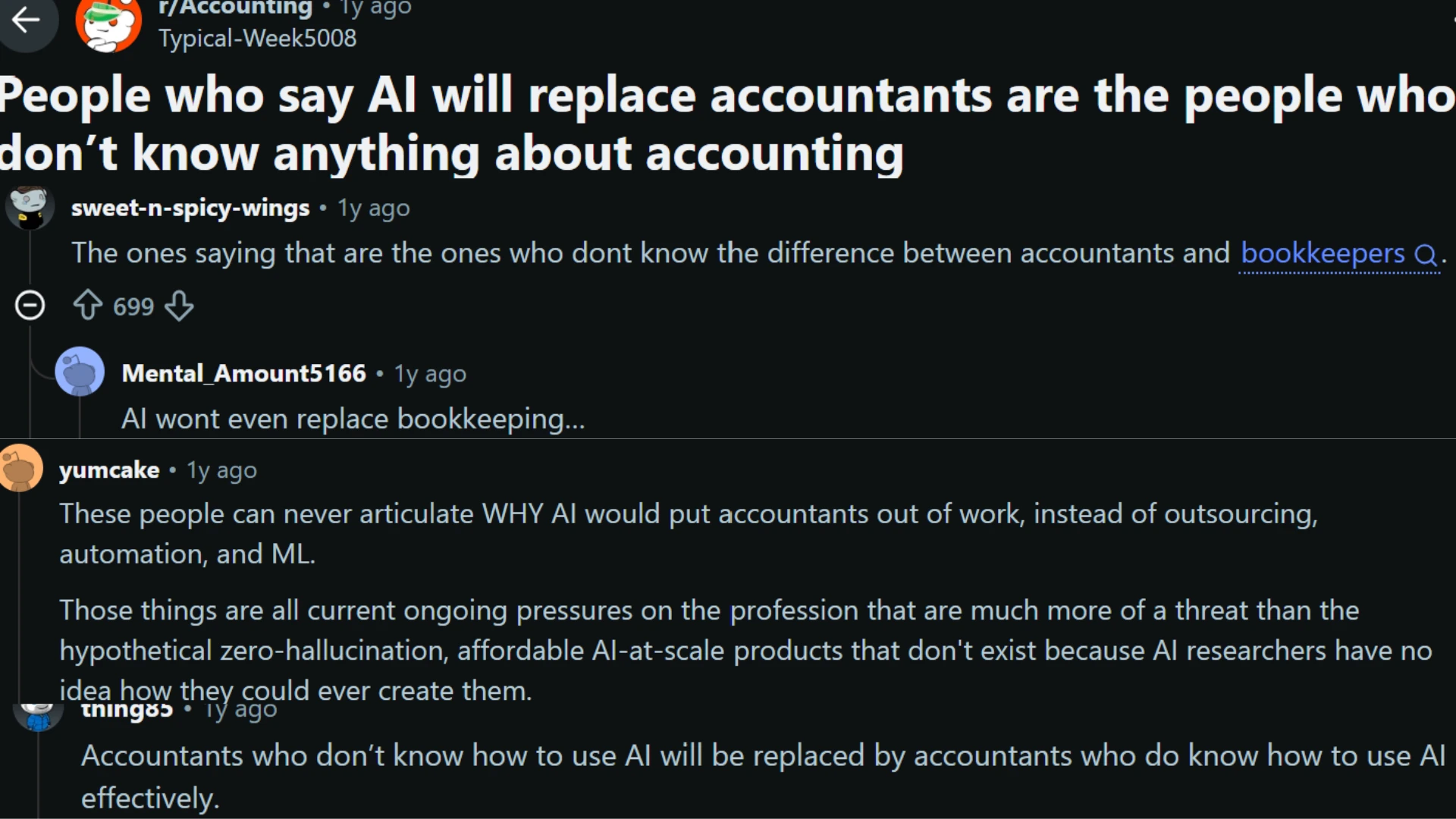
The thread pushes back hard on the AI-replacement narrative. The top comment argues that people making the claim are conflating accountants with bookkeepers, a distinction that changes the whole argument.
A reply goes further, doubting AI will even fully replace bookkeeping. Another comment takes a more analytical angle, pointing out that critics rarely explain why AI specifically threatens jobs rather than outsourcing, automation, or machine learning more broadly, since those are real ongoing pressures, unlike hypothetical error-free AI systems.
The thread closes with a now-familiar line: accountants who use AI will replace those who don’t.
What Skills Will Help Accountants Stay Competitive?
Staying competitive isn’t about outworking the software; it’s about picking up a specific set of skills alongside it:
| Skill Area | Why It Matters |
|---|---|
| Automation and software fluency | Lets you direct and check the tools instead of competing against them |
| Advisory and communication skills | Makes you the person clients call before a decision, not just after |
| Reviewing and validating AI output | Someone still has to confirm the software got it right |
| Specialized knowledge (forensic, valuation, tax strategy) | Harder to automate, higher value to clients |
| Staying current on regulatory changes | Positions you for the roles software can’t touch yet |
| Explaining finances in plain language | Clients need decisions, not just data |
None of this means abandoning traditional training; it means layering it on top.
Final Verdict
So where does this leave you? The honest answer to whether AI replaces accountants is more boring than the headlines suggest: it’s reshaping the job, not erasing it.
The parts of accounting built on responsibility, judgment, and trust aren’t going anywhere, and no amount of software progress changes who’s accountable when something goes wrong.
What actually separates accountants who thrive from those who struggle isn’t their job title or years of experience; it’s whether they treat these tools as something to work with, rather than against.
The ones who do will be setting the pace for everyone else within a few years. If you’re curious how this same AI-versus-human question is playing out in other professions, that’s worth exploring next.
Frequently Asked Questions
Do Small Businesses Still Need an Accountant If They Already Use AI Software?
Yes. Software handles data entry and basic reports, but a professional is still needed for tax strategy, compliance decisions, and signing off on filings.
Could Relying on AI-Generated Financial Reports Create Legal Liability for a Business Owner?
Potentially. Business owners remain responsible for filings and decisions based on that data, even if an AI tool generated the underlying numbers.
Should Students Still Study Accounting?
Yes. The core skills, financial literacy, judgment, and regulatory knowledge remain valuable. Students should pair traditional coursework with training in automation tools to stay competitive as the entry-level job shifts.