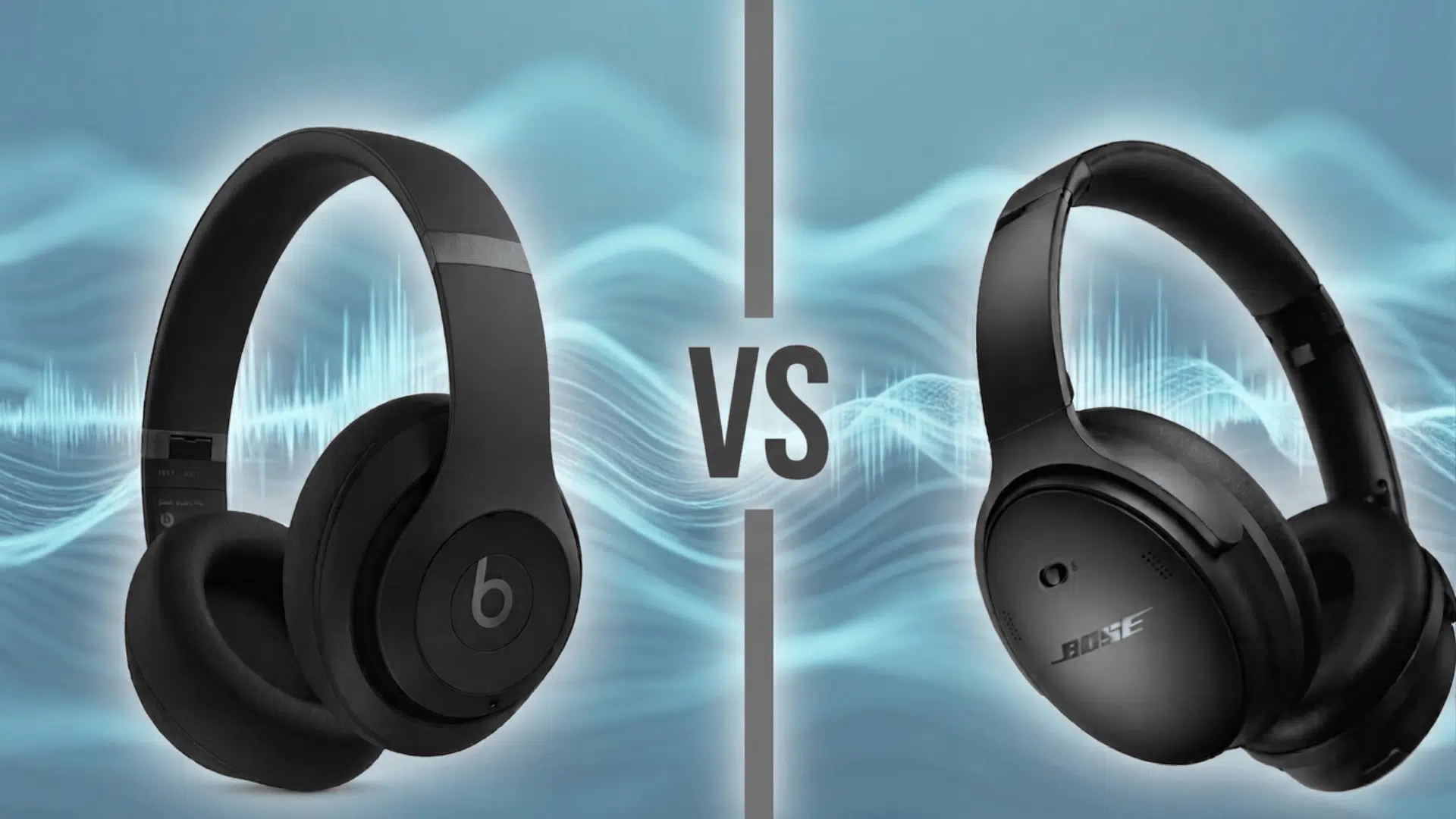



Beats vs Bose has been one of the most debated matchups in headphones for years, and for good reason.
Both brands offer premium sound in different ways: one for Apple fans, the other for silence seekers.
The real answer depends less on specs and more on how you actually live. Read on, because the winner might not be who you expect.
Who Makes Beats and Bose?
Beats launched in 2008 and was bought by Apple in 2014 for $3 billion. Bose is an independent audio company built on decades of engineering research.
Today, Bose offers the QuietComfort and the premium QuietComfort Ultra, while Beats has the Solo 4 ($200) and the flagship Studio Pro.
Beats targets style-focused Apple users; Bose appeals to listeners who prioritize sound quality above all else.
Beats vs Bose: Design and Build Quality

Both headphones look sharp, but they take very different approaches; one leans understated and plush, the other bold and eye-catching.
Bose Design
Bose showcases a sleek and straightforward design that exudes a natural, high-quality elegance.
- Soft synthetic leather and memory foam earcups
- Lighter weight than the Beats Studio Pro
- Breathable and comfortable for long wear sessions
Beats Design
Beats expresses its personality more through brighter color choices and a sportier design, making it even more appealing and fun.
- Bold, modern colors with a dense plastic build
- Cushioned earcups, though less plush than the Bose
- Folds into a compact footprint, but uses only a softshell case
Build Durability
Bose feels noticeably more solid and well-constructed; the Beats Studio Pro feels flimsier and creakier by comparison, though it does use metal at the headband and hinges.
- Bose wins on overall build confidence
- Beats plastic feels less premium at this price point
- Both should hold up fine with everyday use
Note:If you’re deciding between specific models, most people end up comparing the Beats Studio Pro vs Bose QuietComfort, but this guide focuses on how the brands differ overall.
Bose vs. Beats Comfort: Which Is More Comfortable?
Are Beats or Bose more comfortable? Bose wins, and it’s not close.
The Bose QuietComfort is 32.5 grams lighter than the Beats Studio Pro, a difference you feel immediately, and its cushioned headband and earpads make it the most comfortable full-size ANC headphone in its class.
The Beats Studio Pro’s biggest problem is clamping force, the strongest in this category, paired with a headband that needs more padding.
One longtime tester put it simply: “I wore the Bose on a 10-hour flight and forgot they were on.” For all-day wear, Bose is the clear choice.
Sound Quality: Beats vs Bose Audio Performance

Both brands have matured well beyond their reputations, but they tune their headphones very differently, and that gap matters depending on how you listen.
1. Bass and Sound Profile
Beats has moved past its muddy bass days as the Solo 4 and Studio Pro both deliver well-balanced, even sound.
Ironically, it’s now the Bose QuietComfort models that carry the warmer, louder bass. If you love deep, rich, low-end straight out of the box, Bose is the surprising winner here.
2. Sound After EQ
The Beats can perform well out of the box, but Bose surpasses them when customized. The Bose QuietComfort’s default tuning is bass-heavy, but EQ adjustments create a balanced, detailed sound.
Casual listeners might not always dive into the details, but audio enthusiasts will truly appreciate what Bose has to offer.
3. Spatial Audio and Lossless
Beats has a clear edge here for Apple users. The Studio Pro supports head-tracked Spatial Audio with full
Dolby Atmos and lossless playback over USB-C are features that Bose simply does not match on this front. For iPhone users who want a cinematic listening experience, Beats is the stronger pick.
Beats vs Bose ANC Comparison Table
When it comes to noise cancellation, both brands block out the world effectively, but Bose has held the crown for years, and its latest technology makes that gap even harder to ignore.
| FEATURE | BEATS STUDIO PRO | BOSE QUIETCOMFORT / ULTRA |
|---|---|---|
| Overall ANC strength | Good | Best-in-class |
| Low-frequency noise (planes, traffic) | Decent | Excellent |
| Voice & sudden noise blocking | Moderate | Strong |
| ANC levels | 3 modes | 11 adjustable levels |
| Transparency mode | Basic | Advanced + Wind Block |
| Travel performance | Good | Exceptional |
Beats vs Bose: Battery Life
Beats pulls ahead on paper, but in real-world use, the gap closes fast, making this category much tighter than the specs suggest.
1. Raw Numbers
Beats has a clear spec advantage here, but quick charging on both means you are rarely left scrambling for an outlet.
- Beats Studio Pro delivers up to 40 hours of playback with ANC off
- Bose QuietComfort Ultra tops out at around 30 hours
- Both include quick-charge options for several hours of playback in minutes
- Beats wins for marathon listeners who occasionally toggle ANC off
2. Real-World Use with ANC On
Turn noise cancellation on, and the story changes completely, bringing both headphones to nearly identical stamina levels.
- With ANC enabled, both headphones last around 24 hours, making them essentially equal for most everyday listeners
- If you run ANC all day, the Beats battery advantage largely disappears
Beats vs Bose: Connectivity and Smart Features
Beats is built deep into the Apple ecosystem, while Bose plays well across all platforms. Here’s how they compare in real-world use:
- Beats offers faster pairing and tighter integration with Apple devices, making it seamless for iPhone users
- Bose supports multipoint pairing, allowing you to switch between devices more easily
- Call quality is slightly better on Bose, especially in noisy environments
- App controls and EQ customization are more flexible on the Bose
- Find device support is stronger on Beats through Apple and Google networks
Beats vs Bose: Price and Value
Price is one of the most decisive factors in this comparison. Beats generally comes in at a lower entry point, but the gap narrows considerably once discounts and buying options are factored in.
- The Bose QuietComfort typically runs $50–$100 more than the Beats Studio Pro, though prices can converge depending on sales and availability.
- Both can be found at reduced prices when buying renewed or used, making either a stronger value proposition.
- Beats is the better pick for budget-conscious buyers, while Bose suits those willing to pay more for premium performance.
- Overall, your budget and priorities, not just specs, should drive the final decision.
Which One Should You Buy: Beats vs Bose?
Choose Bose if you travel frequently, work from home, or need to focus for long stretches. Its class-leading noise cancellation and lightweight comfort make it ideal for blocking out the world.
Choose Beats if you’re deep in the Apple ecosystem, love bass-heavy sound, or want longer battery life and a stylish design at a lower price.
Both are excellent headphones; your lifestyle and priorities are what tip the scale.
Wrapping It Up
The Beats vs. Bose debate has no single winner; it has two, depending on who is asking. If silence and comfort are non-negotiable, Bose delivers.
If Apple integration and bold sound matter more, Beats is your match.
Either way, you are investing in a headphone that punches above its price. Pick the one that fits your world, and you will not look back.
Frequently Asked Questions(FAQs)
Are Bose Headphones Worth The Extra Money Over Beats?
Yes, Bose consistently outperforms Beats in ANC and comfort, making the $50–$100 price difference justifiable for frequent travelers and commuters.
Which Brand Has Better Noise Cancellation?
Bose wins decisively. Its QuietComfort line is the industry gold standard, sitting one to two tiers above Beats Studio Pro in real-world performance.
Do Beats Or Bose Sound Better Out Of The Box?
Beats edges ahead in stock with a more balanced profile. Bose sounds bass-heavy by default but surpasses Beats significantly once EQ is applied.
Which Is More Comfortable For Long Listening Sessions?
Bose is the clear winner. Its lighter build, plush memory foam earpads, and lower clamping force make it far more wearable than the tighter-fitting Beats Studio Pro.